The Manchurian Recession

Coming back from my own trip out to the provinces, I find that Simon Denyer of the Washington Post has an excellent report on the economic problems of China’s northeast. As is becoming increasingly clear, if you want to find China’s recession, the northeast is the place to look. And you don’t have to look very hard: in the first half of 2015, nominal GDP growth in both Liaoning and Heilongjiang provinces was negative (Jilin managed a meagre 4.4% gain).

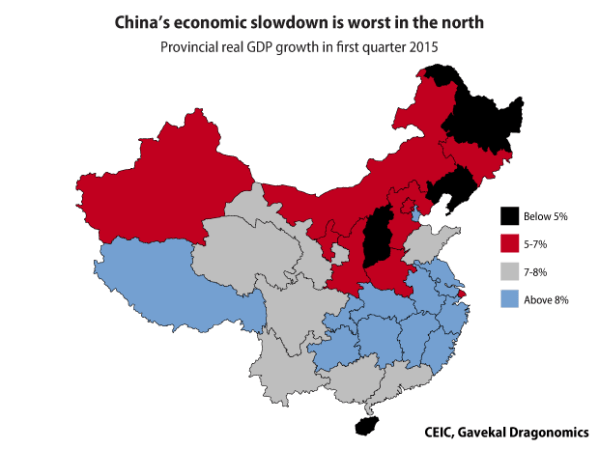
The three provinces that comprise most of historic Manchuria are more dependent on heavy industry and more dominated by state-owned enterprises than the rest of the country. So they are extremely vulnerable to the current downturn, whose main feature is stagnant or declining demand for many of the products, like steel, that are made by state-owned heavy industrial companies. The northeast is not the only part of China effectively in recession: coal-mining provinces like Inner Mongolia and Shanxi are suffering, as is Hebei, the nation’s largest steel producer. But these northern and northeastern provinces are at the center of China’s current problems, as is quite clear from the data:

2015Q1-provincial-GDP-tradmap

Simon’s piece has a couple of choice observations that encapsulate some of the problems the northeast is facing. Here is one:

“Everyone knows what the problem is. It is structural,” said an official dealing with economic policy in the Liaoning government who spoke on the condition of anonymity because he was not authorized to talk to the press.

“Everybody knows what to do. You need to change the economic structure. But what concrete steps to take? Nobody knows,” he said. “What can we do? Financial sector? You can’t compete with cities like Shanghai. High-tech industries? Those won’t flourish overnight.”

and another:

Zhou Dewen, who runs a business association in Wenzhou, scouts out investment possibilities throughout China. He has led 20 small-business delegations to the northeast, but he has not been able to work up much enthusiasm for the region.

“The northeast still thinks of itself as the big brother, because they were the first to get rich after the new China was founded,” he said. “They are sitting on their glories and not advancing with time. Their mind-set is still the old planned-economy stuff. They don’t see that small businesses can do big things.”

Still wanted: some frank talk about China’s growth prospects

One of the more depressing pieces of economic news to come into my inbox recently was this piece in the Chinese-language Economic Information Daily. I translate the first paragraph below:

The Fifth Plenum will be held in October this year to research and draft the proposal for the 13th Five-Year Plan, but the Economic Information Daily has learned that as of now it is still undecided whether the economic growth target will be 6.5% or 7%. Economists have different views on China’s potential economic growth rate over the next five years, but most of them think it should be over 7%.

This is depressing because it appears to indicate (with the usual caveats about the reliability of Chinese press reports) that there is hardly any meaningful debate about China’s economic prospects at the highest level of policymaking. If the question is whether the growth target for 2016-2020 should be the same as the previous five years, or half a percentage point slower, then that’s not even asking the right question. It is also disappointing because there had previously been some discussion about whether the next five-year plan should jettison GDP growth targets entirely, and instead target other indicators more directly related to the welfare of its population (maybe China could do something crazy like, I don’t know, target inflation and unemployment instead?). A move away from the fetishization of GDP numbers and toward more realistic policymaking in China is desperately needed, and right now I’m not feeling so optimistic that it is coming.

To get a sense of the problem, sample the rest of the commentary in the article, which features quotes from lots of big names–the type of economists who speak at conferences, write op-eds and get asked to advise the government. Hu Angang, a prominent Chinese economist who has been on the academic advisory commission for a few five-year plans now, is quoted as recommending a growth target of “about” 7% for the next five-year plan period (2016-2020). He says this would imply that anything from 6.6% to 7.4% would be an acceptable growth rate, but that 6.6% would be a “floor” for growth. Peking University economist Liu Wei says potential growth will be 7% or higher until 2023. Fan Gang, another well-known economist from one of the main non-government think tanks, also thinks future growth should be 7% or higher. Wang Yiming of the Development Research Center, a major in-house government think tank, also plumps for 7%. A more cautious view comes from China Banking Association economist Ba Shusong, who warns that because of the exhaustion of the demographic dividend and slower exports, GDP growth is likely to slow to 6.5% over the next five years.

Is it just me, or is it feeling like an echo chamber in here? Of course, it is easy to find Chinese economists who are not wedded to the view that GDP growth will never fall below 7% (I even work with some). But the point is that the public discussion of future growth prospects has been extremely impoverished of late. For all the recent propaganda about a “new normal” that requires some tough adjustments to slower growth, there is little public discussion of scenarios other than continued steady 7% growth. While in the international media you can read about a full range of possibilities, from crash to boom, in the official Chinese press you rarely see numbers other than 6% or 7% growth (or even 8%–I have on this blog previously criticized Justin Lin’s insistence that growth will be 8%). It feels like the topic of future growth rates has become so politicized that, whatever people’s private views, they have little incentive to publicly argue that China should prepare for lower growth. And if that means no one is preparing for lower growth, then we have a problem.

Out in the real world, it is pretty obvious that growth will head below 7% during the next five-year plan period, thanks to extremely high debt levels, the end of a decade-long housing boom and a severe slowdown in private-sector investment. The IMF, hardly a bastion of radical views, is forecasting 6.8% GDP growth for this year, and said in its Article IV review last week that China should look for growth of 6.0-6.5% in 2016. The IMF is urging China to accept this slowdown to what it calls “safer and more sustainable” growth rates, and adapt policy to this trend. I sure hope they succeed.

China goes after occupational licensing

It is rare that the preoccupations of economics bloggers and the priorities of Chinese bureaucrats overlap. But yet it has come to pass, in the form of a July notice from China’s State Council declaring what sounds like an all-out bureaucratic assault on occupational licensing. “All localities and departments should further strengthen their efforts and continue to focus on cancelling occupational licensing and certification requirements,” the document reads. “Professional qualifications that lack a legal basis, whether established by government departments, national industrial associations or academic societies, must all be abolished.” The notice also terminates 62 types of occupational licenses recognized by the central government, for professions like “web advertising broker” (nope, that doesn’t sound like something you really need a license for to me either).

While this admittedly obscure announcement has drawn little public commentary that I’m aware of, it’s interesting that it comes at a time when excessive occupational licensing has become a moderately prominent policy issue in the US. Indeed, in July the White House published a report on occupational licensing that notes that “there is evidence that licensing requirements raise the price of goods and services, restrict employment opportunities, and make it more difficult for workers to take their skills across state lines.” The proliferation of licensing requirements in the US has drawn criticism from commentators and bloggers on both the left and the right, making it an unusually non-partisan issue.

The State Council’s move seems to be less a response to the grassroots and more of a top-down initiative, specifically Premier Li Keqiang’s recent campaign to slash various types of administrative red tape. According to a background paper by the labor ministry, central government agencies had 618 different types of occupational licenses by end-2013, and local governments another 1,875. The recent announcement is actually the third of its kind; in 2012 the State Council canceled 265 types of licenses, and then eliminated another 149 in 2013. With the latest 62 cuts, the central government has reduced by a third the number of occupational licenses under its control. There was no word on what local governments have done.

The trimming back of occupational licensing also seems related to recent government measures to reduce the employment costs created by mandatory social insurance programs (which I wrote about previously). Both are measures that could help increase employment by lowering the barriers and costs that employers face when hiring. It is probably too much to say that these moves portend a radical deregulation of the Chinese labor market, but I for one did expect to be writing two posts about supply-side labor market reforms in China in the space of two months.

Although I doubt that many people in the US are paying attention to the nitty-gritty of Chinese labor market regulation, it is fun to speculate about the potential demonstration effect here. I generally don’t have much truck with most attempts to use the example of China to argue for changes in US public policy–for instance in arguments that US is losing global leadership in renewable energy because China has much bigger subsidies. I don’t think that particular institution of China is something the US should be emulating; it probably led to a lot of renewable energy equipment (particularly wind turbines) being purchased before it could be effectively used by the grid, and it won’t be long before it is rendered obsolete by even newer technologies. But my personal experience of both countries leads me to believe that the problems of excessive occupational licensing are likely to be bigger in the US than in China–mainly because the US actually enforces these kind of rules, whereas in China there is usually a way around them. A nationwide effort by the US to identify and eliminate pointless occupational licensing requirements, which is just what China has been doing for a couple of years now, does not sound at all like a bad idea.

How state ownership came to China

Transitional periods in history are always interesting to me, but they are usually under-researched. It’s easier to find books about how one era or system worked in its heyday then works that discuss the shift from one to another. I’ve always wanted to know more about China’s transition from the chaotic civil war period to the orthodox planned economy of the 1950s, and I’m finding Andrew Walder’s new book China Under Mao: A Revolution Derailed to be a very clearly written analytical history of this period. In line with my interest in all things SOE, the following excerpt is from chapter 4:

From the late 1920s, the Communist Party’s strategy for revolution focused on rural China. Mao’s early doctrine about class struggle was applied in regions that the party controlled, and as the PLA rolled south and west in its military conquest of China after 1947, CCP cadres orchestrated revolution in villages according to a well-practiced script. The cities, however, were another matter entirely. Not until April 1946 did the party take control of a major city, when they took over Harbin from departing Soviet forces. … Initially, their strategy was to implement military control and leave existing ownership of industry and commerce intact, with the exception of state enterprises controlled by the Nationalists. In the cities, the main emphasis was to stabilize the economy and promote industrial development, not to obliterate the economic foundations of the old society.  …

The urban private sector declined immediately after 1949, even before the party leadership announced its decision to move toward socialism in 1953. Government agencies began to take over banks and wholesale suppliers, making it more difficult for businesses to obtain credit and financing, supplies, and customers. These changes deprived the private sector of the means to compete and grow. … Increasingly, private firms depended on state contracts for their business: the output sold by private firms on state contracts rose from 12 to 56 percent during the same period. … Without any explicit attacks on the private sector, it was gradually being squeezed by state policy and made dependent on state agencies.

The gradual squeezing of the private sector turned into a frontal attack in 1952. The party launched the Three-Anti movement to combat “corruption, waste, and bureaucratism,” and the abuse of power by cadres in urban administrations. The campaign struck civil servants who had stayed in their posts and pledged loyalty to the new regime. … The campaign then pivoted to an attack on private businesses. The Three Anti campaign was merged into a Three Anti, Five Anti campaign. The new claim was that corruption among cadres was caused by the business practices of private entrepreneurs. The new Five Anti targeted “tax evasion, bribery, cheating on government contracts, theft of economic intelligence, and stealing state assets.” Work teams moved into private businesses, demanded to see their accounts, and conducted all-night interrogations that pressured business owners to confess to corruption and tax evasion, reveal the source of their “illegal profits,” and divulge hidden assets. Large fines were levied that bankrupted many businesses, which subsequently closed. Many business owners “voluntarily” turned their firms over to the government as payment for their alleged back taxes and criminal fines.

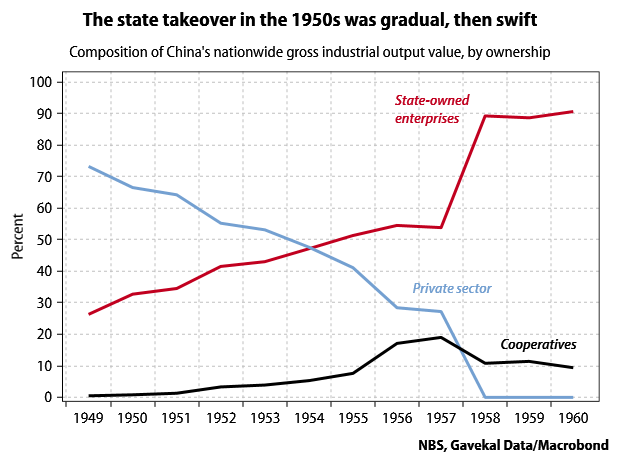
And there’s lots more of interest on other aspects of the creation of the planned economy. Inspired by this reading, I dug up some historical statistics and pulled together the following chart to illustrate the progress of nationalization (the figures in this chart are slightly different from the ones Walder cites in his text, as I’m using a later statistical compilation with revised data). It’s interesting to note that pre-revolutionary China already had a significant amount of state-owned enterprises, as the Nationalists had no aversion to state ownership and made some attempts at planning industrial development (Rana Mitter’s excellent history of the civil war period Forgotten Ally discusses this theme).

abolition of private ownership in 1950s

Further reading: a more detailed account of the early transition to state ownership that Walder cites is Bennis Wai-yip So, “The Policy-Making and Political Economy of the Abolition of Private Ownership in the Early 1950s: Findings from New Material,” a 2002 article in The China Quarterly (JSTOR link).

The real source of China’s local government money problems

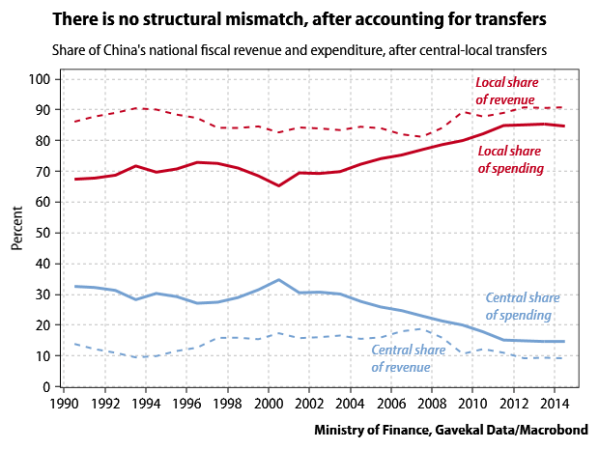
China’s struggles to deal with its mounting burden of local government debt continue to make headlines, giving the dry topic of intergovernmental fiscal relations an unusual amount of relevance these days. The proximate cause of all this local government debt is obvious enough: when the world was falling apart in late 2008, the central government wanted to do a big stimulus, but didn’t want to pay for it. So instead it told local governments to spend whatever they needed on infrastructure to get growth going, and told banks to lend the local governments whatever they needed, and turned a blind eye to any irregularities in all this borrowing. But many scholars and analysts argue that the roots of the problem lie even deeper, that they are the result of a system where there is a fundamental mismatch between the huge burden of public services that local governments have to provide, and the scanty revenues the central government permits them to raise. It’s not just in infrastructure that Beijing pushes the burden down on local governments, the argument goes, but in schools and hospitals and so on. Exhibit 1 in this argument is usually some variant of this chart: Central-local mismatch From these figures, it is easy to get the impression that China’s central government is just rolling in money and not spending any of it–so no wonder local governments have to borrow so much just to make ends meet! Yet this impression is totally false. What is the central government doing with all this revenue? Simple: giving it back to local governments. Of the 6.45 trillion RMB in revenue that the central government collected in 2014, it sent 5.16 trillion back to local governments as transfers (it also spent 2.25 trillion itself, so it was running a deficit). These enormous transfers account for about 60% of total local government revenue, and are the main method by which money is redistributed from richer provinces to poorer ones. If these transfers are treated as what they really are–the main source of local government revenue–then the apparent mismatch disappears: Central-local-mismatch-disappears So while it is fashionable these days to blame excessive centralization of revenues for the mess in Chinese local government finances, this clearly is not a sufficient explanation. Yet it is equally clearly the case that there are real problems in local government finances, and that many localities have to resort to extra-budgetary or extra-legal means to raise money, for infrastructure projects as well as other spending. So how to understand this? As Linda Chelan Li and Zhenjie Yang put the question in a recent article (available for free for a limited time):

The dominant view is that excessive centralization of revenues and decentralization of expenditure responsibilities have precipitated a fiscal crisis in many Chinese counties and townships, with dire consequences to local governance. The ‘gap’ argument emphasizes the relative ratio of central vis-a-vis local revenues and the impact of decentralization of expenditure, and slights the impacts of other parallel fiscal developments, in particular the large flows of central subsidies to local coffers since the 1994 tax sharing reform. As pointed out by the few sceptics, the presence of a large and growing central fiscal subsidy, of a comparable size to the centralized tax revenues, means that logically the latter cannot in itself constitute a sufficient condition for local fiscal difficulties. What then accounts for the difficulties, as localities are not blatantly short of monies?

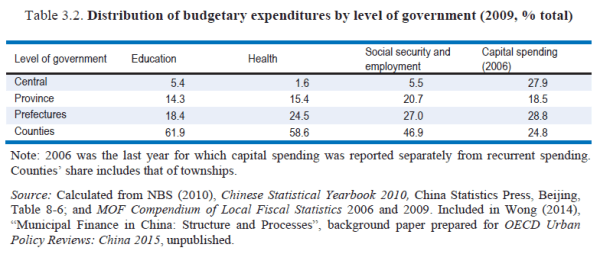
The answer is that there is not one thing called local government in China: there are multiple levels of local government (at least three). Money does not just have to flow from the central government to local government, but between different levels of local governments. And it is easy to see that this flow might not always be smooth, or that “leakage” may happen along the way as different officials get their hands on the funds. This in fact is the key problem: the central government sends plenty of money to local governments in aggregate, but it does not end up in the right places. The lowest-level governments (counties) are where spending responsibilities are concentrated (see table below), but they are the furthest away from the flow of money from the top. And since responsibility for spending is often assigned without regard to where the revenues come from, mismatches abound. OECD-spending-by-govt-level So the lowest-level governments do in fact have many fiscal obligations and often not enough resources to meet them. The better recent research on China recognizes this more complex reality. Li and Yang’s article demonstrates it through a case-study approach that documents how higher-level local governments undercut those below them, while the OECD’s urban policy review of China has a more data-driven presentation (see pages 189-212). The issue is not that the central government does not give enough money to local governments; it is that the money does not go to the right local governments. As the OECD notes, transfers are often made based on assessments of need that do not match up well with reality:

One of the limitations of the Chinese system is that the need for transfers is assessed mostly based on registered rather than actual population in a province. The problem is that the actual population is generally lower than registered population in low-income provinces, given that migrants remain registered in their home province, regardless of where they live. The government is set to henceforth include 15% of the difference between actual and registered population in the formula for determining transfers. This will partly take into account the cost of migrants to a province.

It’s understandable why the simpler account of a central-local fiscal imbalance dominates the discussion: “the central government has too much money” is a much better slogan than “the fiscal transfer system is suboptimal.” But the first the step in fixing the problem is coming to an accurate diagnosis.

Is food security the untouchable “third rail” of Chinese politics?

One of the most interesting developments in the first year of Xi Jinping’s tenure was his iconoclastic approach to farm policy. He gave a major speech on agriculture in December 2013, in which he outlined a relaxation of China’s policy of maintaining 95% self-sufficiency in grains. As usual for speeches announcing a change in policy, there was much fiery rhetoric about why the old policy was correct: “We cannot look at grain security only from an economic perspective, we must also look at the political perspective,” he said. But in substance what Xi proposed was allowing a higher level of food imports, and focusing efforts at self-sufficiency on only a few crops with sustainable levels of domestic production. (The full text of the speech is not online, but is available in a book of Xi’s speeches, which I’m sure you own.) The new grain security slogans, with included a prominent mention of “appropriate imports,” then made their way into numerous government policy documents.

And then things stopped. As the new line started to get more publicity and public discussion, media coverage and criticism started to mount. The furor got so intense that in February 2014, the Ministry of Agriculture ended up publicly denying that the new slogans meant that China was softening its commitment to grain security. Since relaxing the grain security standard was the whole point of adopting the new slogans, this of course was not really true. But it was significant that the government did not reinforce Xi’s decision to break with past policy, but rather reaffirmed the existing policy. Possibly as a result, there have been no specific measures that actually put into practice the new grain security policy: more than a year and half after the new framework was finalized, there is still no clarity on exactly what level of imports of what products are officially considered acceptable. There have also been possibly retrograde developments, like the new national security law that names grain security as one the key parts of national security. Agricultural economist Cheng Guoqiang summarized the situation in a recent presentation: policymakers remain divided, with some emphasizing the traditional approach to self-sufficiency while others urge change, and there is no consensus on how to move forward.

Why is it important for China to change its approach to grain security? The most obvious reason is that the old one isn’t working: China imports much of its soybean supply, and recently became a net importer of corn (the concept of grain used in China is really a broad category of staples, including beans and potatoes as well as cereals). But as the excellent and indefatigable Dim Sums blog has repeatedly documented, Chinese bureaucrats’ obsession with maintaining high levels of domestic grain output has led to many other problems, like the stockpiling of grain on a vast and wasteful scale, as well as huge overuse of fertilizers and increasing degradation of land. It has also required increasing levels of government subsidy and market intervention to maintain. As the OECD has documented, China has been steadily ramping up subsidies and other farm supports at a time when many other governments have been scaling them back (in absolute terms, China is both the world’s largest agricultural producer and the largest disburser of agriculture subsidies). So in environmental and financial terms, maintaining a high level of self-sufficiency looks increasingly unsustainable–and is only likely to become more so. The chart below shows some model results from Kym Anderson (from an online presentation; here is an ungated version of the supporting paper), arguing that maintaining self-sufficiency in key products will require implausible, and WTO-illegal, levels of tariffs and trade restrictions by 2030.

self-sufficiency-tariffs

Grain security is probably not the most urgent short-term issue Xi Jinping has to deal with right now, so it’s understandable that he may not want to spend much political capital to push through this particular change. But many reformist figures in China view the overhaul of grain security as a key market of progress on Xi’s pledge to give market forces a “decisive role” in the economy. Since Chinese prices for grain are higher than world prices, if market forces play a greater role, then more market forces means more grain imports. Finance minister Lou Jiwei himself, in a now-famous rant about how China can avoid the middle-income trap, named agricultural reform as one of the top economic priorities. “From seed to table, the whole chain has subsidies and interference in resource allocation,” he said at an April forum at Tsinghua University (the Chinese transcript is online; here’s an English write-up). “What should we do? Liberalize prices, preserve crop rotation, give subsidies for fallow land, and import.” Such matter-of-fact acceptance of large food imports breaks is clearly still rare in China. The desire for self-reliance, and the related tendency to see their country as alone in an uncaring world, have deep roots.

Technical note:

How exactly did Xi Jinping propose relaxing the grain security policy? This is a bit hard to explain without resorting to some Chinese terms. The original self-sufficiency policy (laid out in a 1996 white paper) was that net imports of grain were not to exceed 5% of domestic demand. But grain is not just grain; the Chinese term liangshi also includes soybeans and potatoes, among other things. Since China is now a huge importer of soybeans, mostly to make animal feed, this is clearly a big problem for the old policy. Corn (maize) imports are also now growing, and also go mainly into animal feed.

One of the new slogans (谷物基本自给、口粮绝对安全) therefore does away with liangshi, and in its place introduces two new terms: guwu, or cereals, and kouliang, or food grains. There must be “basic self-sufficiency” in cereals (rice, wheat, corn), and “absolute security” in food grains (rice, wheat). Because liangshi is no longer the operative term, the requirement to maintain self-sufficiency in soybeans (and potatoes, for that matter) has been quietly jettisoned. And since corn is subject to the looser “basic” standard, the new policy also means greater tolerance for corn imports. The problem is that there is not yet a definition of what “basic” or “absolute” self-sufficiency might mean in numerical terms, and without that clarity it is hard for officials to know how to actually implement the new policy. The text of the new national security law also refers to the old formulation of grain security in terms of liangshi, further muddying the issue.

Term liangshi (粮食) guwu (谷物) kouliang (口粮)
Usual translation grain cereals food grains (i.e., not feed)
Technical meaning rice, wheat, corn, beans, tubers rice, wheat, corn rice, wheat
Old policy 95% self-sufficiency
New policy “basic self-sufficiency” “absolute security”

Some less desirable consequences of China’s climate-change commitments

The excellent Lucy Hornby at the FT has a good piece pointing out one reason why not everyone is happy with the fact that China is strengthening its commitments to reduce greenhouse gas emissions:

Beijing last week formally submitted its 2030 goals for generating energy from non-fossil fuels, garnering international praise as nations prepare for the Paris climate summit in December. The White House welcomed the announcement, which it said would pave the way for a “successful climate agreement” in France. But the goals cement China’s commitment to another round of dams in southwest, central and far-western China, which would seal the fate of the few remaining free-flowing rivers — some of them sources for vitally important river systems within China and in neighbouring countries. … China’s plan to generate 20 per cent of its power from non-fossil sources by 2030 implies a huge build-out in hydropower dams, nuclear power plants and subsidised wind and solar farms. Installed hydropower capacity is set to rise to 350 gigawatts by 2020, the end of the next five-year plan, compared with 290GW now.

The fact that hydropower development in China now seems to have very strong renewed momentum is interesting. There was actually a period of several years when it looked like a public backlash had slowed development of new large dams. I’ve had an interest in the subject since 2007, when as a WSJ reporter I wrote the following piece after a trip to a disputed dam site in Sichuan:

Seeking to control floods and produce clean energy, China’s central planners have presided over a relentless dam-building drive: The country’s 22,000 large dams represent nearly half the world’s total. But growing numbers of Chinese citizens are criticizing the environmental and social upheaval caused by the structures… Dams have emerged as one of the few legitimate subjects of vigorous public debate, one that’s testing the limits of the public’s role in shaping policy in this authoritarian country. Beyond Dujiangyan, other proposed dams in places like Tibet have been put on hold, or scaled back, after public outcry.

So much for that. A related development is the renewed enthusiasm for building nuclear power plants, another energy source that does not emit carbon dioxide. While nuclear plants haven’t been the same kind of magnet for popular protest that dams have been, there are a few lonely critics who worry that safety and regulation are not keeping up. Which seems like a not unreasonable concern, in a country where “independent regulator” is an oxymoron. Here’s Emma Graham-Harrison in The Guardian back in May:

China’s plans for a rapid expansion of nuclear power plants are “insane” because the country is not investing enough in safety controls, a leading Chinese scientist has warned. Proposals to build plants inland, as China ends a moratorium on new generators imposed after the Fukushima disaster in March 2011, are particularly risky, the physicist He Zuoxiu said, because if there was an accident it could contaminate rivers that hundreds of millions of people rely on for water and taint groundwater supplies to vast swathes of important farmlands.

Bringing the wonders of the hex grid tile map to China

As you may have noticed I have a bit of a thing for maps. I often go out of my way to find a way to present statistics in map form, because it’s fun, and also because I think it’s important to understand regional variation in China (here’s one recent attempt). But that kind of map where different areas are colored in to convey information, known as choropleths to infographics aficionados, has some drawbacks when applied to Chinese provinces. Namely, the size of Chinese provinces varies hugely. A standard map is visually dominated by Xinjiang and Tibet, which happen to have few people and small economies, while the economic powerhouses of Beijing and Shanghai are barely visible.

This is in fact an extreme version of the problem faced when mapping the US, which also has some big empty states and small populous ones. A recent solution adopted by many infographics mavens is to make all the states the same size; the resulting “grid” maps, usually made up of squares, have been the talk of the infrographics community. Recently the folks over at NPR came up with an even cooler solution, which is to use hexagons rather than squares. This allows the resulting layout of tiles to more closely approximate geographic reality and the well-known shape of the US. I quite like it:

npr-hex-tiles


Naturally, this presented a challenge: can this same technique be applied to China? You betcha. After some playing around I came up with the following solution, which preserves both the chicken-shaped outline of China, and is reasonably accurate about the positions of individual provinces relative to each other. The biggest compromise with reality I made was to pull off the coastal municipalities (Beijing, Tianjin, Shanghai) from the main part of the map. This makes it easier to get the relative positions of the remaining provinces correct.

hex-map-simple

I’m pretty pleased with this (though suggestions for improvement are naturally welcome). Now for the test: does the hexagon tile map work better at presenting information visually? Here’s a map I produced earlier this year, which highlights the regional variation in economic growth across China.

2015Q1-provincial-GDP-tradmap

And here’s the same statistical information presented in a hex tile grid map.

2015Q1-provincial-GDP-hexmap

The differences are interesting. The traditional map presentation works quite nice visually, because the big swath of the slow-growing black and red provinces across the north half of the country conveys a daunting impression. The hex map, as intended, lessens the visual impact of the large but less-important western provinces, and makes it clearer what is happening in the municipalities. It also makes it easier to see how many provinces are growing slowly versus how many are growing more quickly (and has the added benefit of being able to fit in province names, which is hard to do legibly on a regular map). It’s a bit less scary as a result, since you can see that there are still more fast-growing ones than slow-growing ones. So it seems like the hex map is best for illustrating data where the important point is the number of provinces meeting various criteria. I’m not sure for this particular example I would prefer the hex map, but it was certainly fun to explore.

Feedback between the stock market and real economy

I have a short post up at the Paulson Institute blog, in response to a question about the impact of the sharp fall in Chinese stock prices. The even shorter version:

If the rising stock market has been supporting the real economy, then that support could well be in the process of unraveling. It’s difficult to find much strong evidence of such support.

Issues considered include the wealth effect, corporate investment, and the surprisingly large contribution of the financial sector to GDP.

Finally, China starts to tackle the high cost of hiring

There was a lot of news out of China last week–stock markets tanking, interest rates being cut, etc–so it’s understandable that some other interesting developments slipped through with little notice. This one is worth highlighting as I think it may well mark the beginning of an important longer-term shift in China’s labor market and policies: the State Council lowered employers’ required contributions to two social insurance programs, injury and maternity insurance, a move it said would save firms 27 billion renminbi a year (see the China Labour Bulletin for an English-language summary). Yes, I know this sounds boring and technical, so why is it important? Because it starts to address one of the biggest but least-known issues in China’s job market: the very high costs employers face to hire workers.

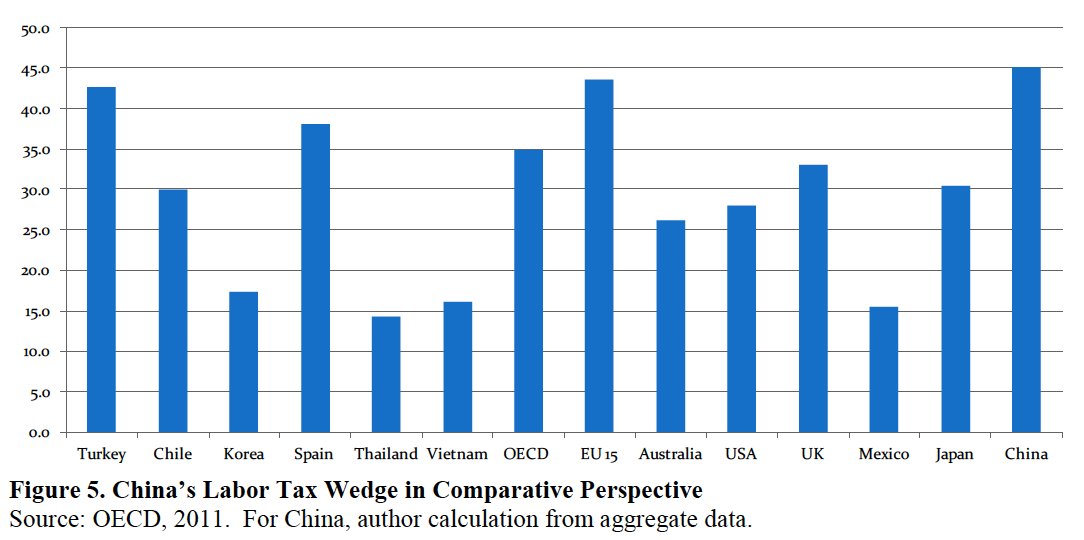
It is not a very well-known fact that China has some of the toughest labor regulations in the world, and some of the highest required contribution rates to social insurance programs. As a result, the “labor wedge”–the percentage of the total cost of an employee that comes from things other than wages–in China is around 45%, as high as in a number of European countries (this is according to an estimate by John Giles in a World Bank paper; see chart below).

laborwedge2

This fact does not square with the widespread perception of China as a nation of sweatshops employing hordes of migrant workers, and indeed is a relatively recent development stemming from the 2008 Labor Contract Law. But China’s problem with these generous worker protections is ultimately the same one that many other developing countries have encountered: strong legal protections and generous insurance programs are so expensive that in practice they only become available to part of the workforce. Effectively China has two labor markets: one for urban white-collar jobs with all the legal protections, and one for blue-collar jobs held by rural migrant workers that generally lack the full set of benefits. As John and his co-authors summarize the issue in their 2013 paper:

China’s urban social insurance system carries heavy burdens for both employers and workers, and may carry significant implications for China’s long–run competitiveness. Moreover, this high implied labor tax wedge likely encourages informalization of the labor market: employers under-report wages and game the system in numerous ways, while workers have incentives to opt out of participation in social insurance schemes. As in other developing countries, high mandated contribution rates provide strong incentive for employers to evade compliance through the use of labor dispatch services and under-reporting of employment and wages.

The IMF in its last Article IV report on China also, very correctly in my view, highlighted this issue and urged the government to change:

Social contribution rates, which are high and very regressive, should also be reduced as they distort the labor market, make growth less inclusive, and favor informal over formal employment.

So economists have for years been flagging this issue as an area where “structural reform” is needed. Having a relatively high cost of employment should, other things being equal, discourage employers from hiring. But there’s been little evidence that this was in fact a real problem over the last few years–instead, it was much more common to hear complaints and anecdotes about labor shortages. So the very high rates of social contributions did not seem like they were imposing much of a cost on the economy: the job market stayed tight and wages continued to grow rapidly. While high hiring costs may have lowered employers’ demand for workers relative to what it otherwise would have been, this effect was not big enough to seriously affect the balance of the labor market.

That has all changed in recent months, as the economy has continued to weaken. With employers finding growth in demand for their products continuing to soften, it’s hardly surprising that their demand for additional workers is also softening. Public data on China’s labor market is limited, but there is much labor data that is collected but not published, and this seems to have been enough to get policymakers worried. The State Council has warned of “growing pressure on employment,” and rolled out a whole series of measures designed to assist the unemployed, such as tax breaks for hiring new workers, cheap loans for small businesses, and support for laid-off workers to start their own companies. The most recent of these moves, the small cut in some social insurance costs, may indeed be a needed reform, but, as is so often the case, the timing of reform is being driven by the economic cycle.

We therefore seem to be at a tipping point in the labor market that is causing the government to look again at the cost-benefit analysis of its labor policies. And as China’s economic growth continues to slow in coming years, I expect the costs of its current set of labor policies will become increasingly apparent. So the balance of its policies should shift more toward encouraging employment, and preferring higher rates of enrollment in social insurance programs to higher benefit levels. European countries have often been criticized for preferring labor policies that reward people who already have jobs at the expense of people who want jobs. China’s latest move is a clear if marginal shift in the other direction: it would prefer that 27 billion renminbi not go to improve the welfare of people who already have jobs, but instead be spent on hiring new workers.

The fact that China is moving relatively early to make this adjustment–before there has been a big increase in unemployment–to me is a hopeful sign that it could be more flexible in navigating this transition than some other countries. That may not be the most obvious conclusion, since China is after all a Communist country that one might expect to have a strong ideological commitment to social-welfare institutions. But the “socialist market economy with Chinese characteristics” of the past three decades has in fact never been particularly keen on socialist labor market institutions, as a whole host of workers’ rights groups will tell you.