
Is bigger really better for China’s GDP?

Over the last few months there’s been a fair amount of news about China’s GDP statistics, all of it pointing in one direction: China’s level of output and income was larger than we previously thought. This has been pretty much universally taken as good news for China, and generally as reinforcing the China-is-big and China-is-taking-over-the-world narratives in the press. But there are some other more sobering implications that are also worth pointing out.

In October, the IMF released updates to its World Economic Outlook database that incorporated the latest estimates of purchasing-power parity exchange rates. This pushed China’s per-capita GDP at PPP in 2013 from $9,828 to $11,868. It’s not everyday that economies grow 20% overnight! The change unfortunately also resulted in a lot of guff about how China had suddenly become the world’s largest economy, which is mostly nonsense: PPP exchange rates are really intended to help compare living standards across countries. For most purposes, the total size of an economy is something that’s much more meaningful at market prices.

China objected to the new PPP estimates, apparently mostly because it didn’t want people to think it was the world’s largest economy. Mostly this seems to be a political rather than technical objection: China often finds it advantageous to present itself as a developing country with lots of poor people rather than a major global economic power (of course, it is both). And given how the press keeps harping on the China-as-largest-economy theme, those jitters seem justified. However it’s not clear what the technical quibbles actually are, and it it seems much more likely that the new PPP numbers are in fact more accurate. Economists including Robert Feenstra and Angus Deaton have pointed out problems in the 2005 estimates that would have over-estimated the PPP exchange rate, and under-estimated GDP, which seem to have been corrected in the latest work.

PPP revision effect on per capita GDP

But Chinese statisticians rather reinforced the trend when in December they published the results of their own economic census, a quinquennial effort where they go around the country and try to make sure they have an accurate count of businesses and their output. This resulted in GDP estimates for 2013 being revised upward by 3.4%, or about $308 billion. In the Chinese context, this was in fact not a huge change, even though it is equivalent to finding another Malaysia lying around. So apparently it’s okay for Chinese GDP to be a bit bigger, just not a lot bigger.

All this is perhaps more than just a storm in a statistical tea cup, as much fun as it is to debate the technicalities. China’s income level does have implications for how its economy might perform in the future. This is because fast-growing emerging economies like China benefit from what is called “catch-up growth”: they can grow more quickly than the US and Europe by adopting technologies and practices from them. Because China doesn’t have to invent everything itself, but can rapidly absorb past inventions from other countries, it can grow faster than countries where those inventions are already widespread. But catch-up growth has this property: the more of it you’ve already done, the less of it you have left to do. The fact that estimates of China’s income level keep getting higher means that China has in fact done more catching up than we realized–about two years worth, to be precise (i.e., per-capita GDP in 2014 is now at a level that China was previously not forecast to reach until 2016). So the more successful China has been at catch-up growth, the closer the future gets when China is just an ordinary economy that does not grow at supercharged rates.

One illustration of this general tendency is the research Barry Eichengreen and his Korean co-authors have done on growth slowdowns. They find that there has been a pattern for economies to shift to a permanently slower rate of growth around $10-11,000 of per-capita GDP, and sometimes again around $15-16,000. So the fact that China is currently around $12,000 per-capita GDP means that its growth slowdown over the past few years is likely to have been a permanent downshift, and not a temporary episode that will be followed by more fast growth at the previous rate. While this is certainly my own view, it has been a contentious one within China, where some prominent local economists insist potential growth has not slowed down. The winds shifted last year, when the Chinese government’s official rhetoric about getting used to a “new normal” for the economy marked an acknowledgement that 10%-plus GDP is indeed a thing of the past. But the patterns from Eichengreen’s research also suggest China could well have another downshift in growth in a few years time, and this is certainly not the official line. So probably the most important implication of the fact that China’s economy is bigger than we thought is that the slower-growth future is closer than we thought, too. This of course is a mark of success, not failure.

Asian growth slowdowns by income level

Here’s some clear thinking about the causes of the Industrial Revolution

For some reason, there has been a spate of commentary recently about the Industrial Revolution on the economics blogs I follow. From my perspective this has been great: I am an enthusiastic if amateur reader of economic history, and putting together a comprehensive account of this event is one of the great, incomplete projects of social science.

Dietz Vollrath’s excellent Growth Economics Blog sets up the discussion very nicely by contrasting two canonical and competing views of the drivers of the Industrial Revolution: Joel Mokyr’s idea-centric argument that an English culture of innovation laid the groundwork for an explosion of new technologies, and Robert Allen’s hard-nosed factor prices argument that high wages in England simply created stronger incentives to adopt new technologies. For me his great contribution is pointing out that these two arguments are not in fact in contradiction:

There are two different questions about the IR in Britain that we want to answer. First, why did several particularly important innovations take place in Britain, and not in other places? Second, of all the innovations available, why were they adopted first (or with greater speed) in Britain than in other areas of Europe?

Ultimately, Mokyr’s thesis is an answer to the first question, and Allen’s thesis is an answer to the second question. This is more or less the same point made independently by Anton Howes on his very good blog:

Allen’s theory is therefore one that best explains bias in the adoption of Britain’s numerous inventions (both in Britain, and abroad). … For a fuller explanation of the IR, though, we need to go right to the inventive source – why was there so much more invention in Britain to be adopted in the first place?

Well, that’s a shocker all right: one of the most complex and important historical events of all time turns out not to have a single cause or a simple explanation. And to complete the roundup of recent blog posts, inequality guru Branko Milanovicpoints out that the England-had-high-wages explanation is itself incomplete, because we still need to know why England had higher wages than other places. He links to a recent paper that argues the root cause is “the difference in the response to the Black Death-driven increase in real wages.” In other words, that it goes back to social and political institutions. The details are interesting but I won’t repeat them here. At any rate I now feel much better equipped to tackle some more Industrial Revolution scholarship.

Does any of this have contemporary relevance? Sure. The problem of explaining how modern economic growth came to pass in the first place two hundred-plus years ago is of course a very different problem than that of explaining how  economic growth can be sustained and replicated in today’s world. But there are some obvious parallels that arise: is it more important for China, say, to develop a Mokyr-style “culture of innovation,” or should we focus instead on Allen’s relative prices?

One could for instance make an Allen-style argument that the sharp rise of labor costs in China in recent years has created a much stronger incentive for companies to adopt labor-saving technologies. In that case, higher labor costs would not be the death knell for China’s international competitiveness that some say they, but rather the trigger needed to push productivity and income to the next level. I haven’t decided whether I believe this or not–there are some complexities given that China has had cheap capital as well as cheap labor–but it’s not obviously absurd and bears thinking about.


How to compete with state-owned enterprises

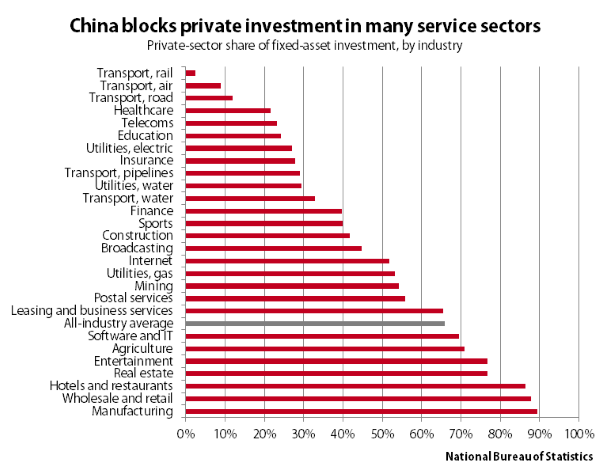
The WSJ has another good article about SOEs in China, this one focusing on Hainan Air’s efforts to compete with the three big state-owned airlines. Air transportation is one of China’s most state-dominated industries, with private-sector firms accounting for less than 10% of investment in the sector (but a somewhat larger share of passenger volume, according to the WSJ’s graphic). In manufacturing by contrast private firms account for 90% of capital spending.

private_sector_fai

So if we are going to see movement to a more liberalized economy in China, then what we should look for is signs of private firms getting more access in these state-dominated sectors. Hainan Air seems to be a pretty well-managed firm (I’ve always liked their service), and as the article shows has tried many different ways to break out of the ghetto of second-tier airports and routes that regulators have placed it in.

But the short version is that Chinese regulators are not bending over backwards to help a private-sector competitor. What this example shows is how the oligopoly of the three big carriers does not have to be mainly maintained by an explicit regulation or law, but can be enforced pretty effectively just through a series of discretionary government decisions. I suspect this is the case in a lot of China’s state-dominated sectors: SOE market power domination is not so much written into law as the result of an inherited industry structure and repeated government action to prevent change to that structure. Of course, there are also examples like the salt industry, where there are written regulations that will have to be changed if recent pledges to open it up to more competition are to be realized.

What this means is that liberalization is going to be hard work for China — it’s not simply a matter of repealing legislation that discriminates against private firms, but requires lots of detailed work to change entrenched practices and priorities in many different industries and parts of the bureaucracy. Personally, I think liberalizing these state-dominated service sectors is the most important economic reform that China could carry out. In contrast to signs of excess capacity in heavy industry, there are still obvious bottlenecks in delivery of many services, like healthcare. And given China’s now reasonably high incomes, a lot of the future growth in consumer spending is going to go to services. So shifting more investment into what should still be relatively high return sectors would help keep China’s overall growth rate from falling too sharply. But it’s not going to happen quickly or easily.

The third wave of culinary globalization

I’m going to develop a theory of the stages of culinary globalization, based on not much more than walking around and eating, so bear with me.

Let’s call the first wave the exchange of ingredients after 1492 — when New World plants were first incorporated into Old World cuisine (like introducing tomatoes to Italy, chili peppers to China). And the second wave the exchange of people — the great 19th and 20th century waves of immigration that shifted populations around, and meant that you could eat more than one country’s food in any given country (Thai restaurants in America, Italian restaurants in Japan). I would like to venture that we are now starting the third wave. Unfortunately I have not yet come up with the perfect catchphrase for this yet, but it’s something like the great recombination, or the remixing of cuisines.

The vanguard of this third wave are not your straightforward ethnic restaurants of the last wave. Rather, they are the products of the last wave: cuisines that have been transformed so much by their relocation to a second country, that they are now distinctive enough to be re-exported as a new cuisine all their own. I first noticed this trend when I walked by a Japanese hot-dog restaurant in Hong Kong a few years ago. Hot dogs are American. But no American would recognize what’s being served in this place: the hot dog has been transformed and reimagined. And now a Japanese hot dog is a distinct enough thing that it can go abroad on its own. There are three cultural layers in that restaurant: America / Japan / Hong Kong. Another example came last year wandering through a mall in Xiamen, where I spotted an ad for a “California-style” sushi restaurant. And indeed, we all know that California-style sushi is not quite the same thing as the Japanese original. Again three layers: Japan / America / China.

Today this was driven home to me again when my wife and I had lunch at a steak-and-salad-bar place in the neighborhood we just moved into. It was a lot like Sizzler: big steaks and lavish all-you-can-eat “salad” bar with a lot more than just salad. But it was not American at all: it was a branch of a Korean restaurant. So three layers: America / Korea / China. While there was plenty of Caesar salad and the usual suspects, there were also things that let you know you were not in Kansas anymore, like the blueberry pizza or the mix-your-own rice bowls. Again an American cuisine that has been subtly remixed (and probably improved) by passing through another culture. I can’t help but feel we are going to see a lot more of this culinary remixing. And I haven’t even tried the crazy Korean pizza place yet…


How strategic are China’s state firms?

Dinny McMahon of the WSJ has an excellent profile of a giant but obscure Chinese state-owned enterprise, Sinomach. I have been fascinated by SOEs since I first moved to China, and over the past couple of years I have also spent a lot of time digging into the finances and other technicalities of how the SOE sector works. Dinny’s piece nicely captures a lot of the key facts about the SOE sector today: 1) far from being world-straddling corporate giants, most Chinese SOEs are poorly performing companies suffering from a combination of arbitrary political goals and poor management; 2) a lot of “SOE reform” happened from 1998-2003, but not a lot has happened since, and there is a lot of room to further overhaul these companies — which indeed the government is now trying to do; 3) the government’s support for SOEs is based on the premise that they will develop “strategic” technologies to boost national security and competitiveness, but in fact the actual achievements in this area are decidedly subpar. (Those interested in more data and detail on these issues can look at the paper on SOE reform I wrote for the Paulson Institute.)

To close, here’s one lovely tidbit from the Sinomach story:

Despite China having passed through more than three decades of reform, Sinomach’s Erzhong unit—set up by China’s Red Army in 1958—still adheres to many of the traditional customs of the country’s major state-owned firms. It still pays retirees a living stipend, and runs a sports center with two swimming pools and a television station. Staples of the station’s programming, which is only available on the factory grounds and to people living in residential zones once owned by the company, include a U.S. English teaching program from the early 1990s and training programs for operating and repairing machinery and electrical equipment.

Where to find China’s recession

One of things I’ve often heard said about China over the years is that 3-5% growth would be equivalent to a recession, since they are used to growing at 8-10%. That may be true at a national level, but at the local level you can now find places that are in outright recession by anyone’s standards. Mark Magnier at the WSJ did some nice reporting from Jixi, an isolated coal town in the far east of Heilongjiang province, about an hour’s drive from the Russian border. It’s a treat for me to see this otherwise obscure town get a dateline in a major newspaper, since I have been to Jixi a few times.

Jixi was the the slowest-growing city in China in 2013, and things have gotten even worse this year: the local economy has shrunk 3.7% (and yes, that’s negative 3.7%, not growth of 3.7%) and capital spending has fallen by more than 20%. These are obviously horrible numbers, and the cause is also pretty obvious: coal prices have been in the toilet for a couple of years already, and the city is basically built around a big coal mine and doesn’t have much else going on. So it’s not representative of the Chinese national economy, which has a lot more going on than coal. But as I’ve pointed out before, China’s mining belt is in fact pretty large and a bigger part of the economy than many people realize. Jixi may be an extreme example, but China has a lot of coal towns, and most of them are in trouble too.

Is there more to Jixi’s problems than just a coal bust? Sure, any city built on top of a coal mine is going to decline when the coal runs out. But it’s certainly my own impression that Jixi and other places in Heilongjiang have not done a good job on using the windfall gains from the past decade’s resource boom to develop more broadly. There’s a nice quote in Mark’s piece which I think captures some of the distinctive old-school central-planning flavor you find in Heilongjiang (even agriculture is still more state-dominated up there, with large state farms and collectives):

Heilongjiang was the first to start the planned economy and is the last to give it up, said Jiao Fangyi, economics and business dean at Heilongjiang University. We have great ample natural resources, but the good times are over. Its like were begging for food from a golden bowl.

Find a city, find myself a city to live in

I talked to Kevin Hamlin of Bloomberg recently about urbanization; Kevin’s big story is out and he was kind enough to quote me. The piece is about the debate among China scholars over the best strategy for urbanization. While we may think of urbanization as a natural process, government policy plays a big role in China given the institutional restrictions on urbanization through the hukou system, and heavy state involvement in urban planning and investment. China’s policy over the last decade or so has been to favor a “distributed” model of urbanization that tries to encourage population flows to smaller cities, and reduce the concentration in megacities. I think the most charitable explanation for this choice is that they want to distribute the economic gains from urbanization more widely across the country. The justification you hear more often is that big cities are too big and crowded and just can’t get any bigger; it is hard to be charitable about this view, since it seems to put a higher priority on the people who already live in Beijing and Shanghai and earn high incomes than on the people who don’t live in Beijing and Shanghai and don’t earn such high incomes.

My view, which I think is shared by a number of foreign observers, is that the current policies of favoring small cities just don’t make that much sense, and aren’t particularly effective anyway. The economic gains from urbanization come from the economies of scale and scope (and network effects, etc) offered by big cities, so there are more of those gains in big cities than in small ones. This is reflected in labor markets, and so migrants in search of higher wages go to bigger cities rather than smaller ones. Obviously China is a big place and not everyone is going to be able to live in Beijing, Shanghai or Guangzhou/Shenzhen. But with better planning and infrastructure those cities could cope with larger populations. Instead using that money to build infrastructure and housing in smaller cities that have difficulty attracting new migrants seems a much chancier proposition that is much more likely to result in spending being wasted. I am pretty disappointed that all the fuss about urbanization since Li Keqiang took over as Premier has not resulted in a deeper rethinking of this issue. The new urbanization policies announced earlier this year look a lot like the old urbanization policies, in that they call for restraining growth in big cities and encouraging growth in small cities.

The hierarchy of Chinese restaurant workers

This recruitment poster appeared the other day outside a (fairly large) noodle shop near my office. The thing I like about these ads is how they give you a clear view into the amazingly hierarchical world of low-end service jobs. Here we have no fewer than 11 distinct jobs advertised, along with pay grades (which make a pretty useful labor market datapoint as well). And this is for a noodle shop serving dishes that cost about $2.

restaurant_wages

In the halcyon days of my youth, I recall American restaurants posting a simple “Help Wanted” sign, possibly with the addendum “Inquire Within.” And when I worked in a pizza parlor, we had basically two job types: people who worked the front, and people who worked the back.

Chinese restaurants, for reasons I have yet to divine, have a much more elaborate division of labor. For instance, most restaurants have not only fuwuyuan (“servers”), who are usually female and take your order and bring you the bill, but also duancaiyuan (“dish carriers”), who are usually male and who carry the dishes from the kitchen to your table. In my experience this fine distinction does not actually improve service quality: since the duancaiyuan are not allowed to actually talk to you, you can’t ask them for more tea, or to bring the rice now, or whatever. Which means you still have to flag down a fuwuyuan even though someone has already come to your table. The noodle shop in question is not structured as a sit-down restaurant, so it doesn’t have this particular division. But it is seeking a lot of different skill sets for the kitchen. And there is an ironclad distinction between someone who works the cash register, and someone who brings the food (the latter is paid RMB400 a month less).

The woes of China’s mining belt

Tiff Roberts over at Bloomberg Businessweek gave a nice write-up of a recent piece I did looking at how the impact of lower energy prices on China differs depending on where you are in China.This provides an excuse for me to reproduce one of my favorite maps for a wider audience:

energy-dependence-map-2011

While we stereotypically think of China as a huge consumer of energy and commodities, it is in fact also a big producer of same (one way in which China resembles the US).  Within China, this is essentially a regional phenomenon: the center, south and east are mainly resource consumers (and are inhabited mainly by ethnic Han Chinese). The northern and western provinces are where all the resources are produced (and where ethnic minority populations are larger).

One of the interesting things I learned from this map is that in economic structure terms Heilongjiang and Xinjiang are not that different, even though conventional geography and economic analysis never puts them together. Xinjiang is usually considered an exception to everything in “core China”, because it is so clearly a frontier territory, with different ethnic and economic dynamics (same goes for Tibet). Heilongjiang by contrast is uncomplicatedly part of “core China”. But in fact both have local economies with a high degree of resource dependence. And in historical terms it was not all that long ago that Heilongjiang was not part of “core China”: it is one of the three modern provinces covering the territory of Manchuria, which in the 19th century was an ethnic enclave for China’s Manchu rulers, then a booming frontier region when migration was opened up to Han, then a de-facto colony of Japan. Heilongjiang is obviously much more integrated now but I wonder if its earlier history offers any parallels to some of the dynamics we’re seeing in Xinjiang today

Small Business Won’t Save China

http://www.wsj.com/articles/small-business-wont-save-china-1410281985

Small Business Won’t Save China
To succeed, private Chinese companies of all sizes must be able to compete with state-owned enterprises.

By ANDREW BATSON
Sept. 9, 2014 12:59 p.m. ET

These are good times for China’s small businesses. Despite a steady slowdown in economic growth, new companies are being founded at the fastest pace in a decade. Small businesses have long complained of difficulty getting loans from the state, but roughly 30% of corporate loans now go to small firms, up from 20% a few years ago. A government notorious for favoring state-owned enterprises now regularly praises small firms and offers them help.

“The government has the responsibility, and the obligation, to create better conditions for your businesses,” Premier Li Keqiang told small business owners in July. Beijing has told state banks to expand their loans to small businesses faster than the rest of their loan books. Mr. Li has also eased regulatory burdens to starting new companies, for example eliminating onerous requirements that anyone registering a company deposit large sums in a bank account to show they can pay the bills. Judging by the 21% increase in registered private companies this year, entrepreneurs are taking advantage of the change.

But this friendliness to small business isn’t enough to solve China’s economic problems. China does need stronger private firms as it tries to move away from its excessive reliance on public investment to support growth, yet the government’s trumpeting of good news for small businesses betrays a misunderstanding of their real role in the economy.

The core issue for private Chinese companies of all sizes is their ability to compete with state-owned enterprises. For the government to hand out favors to small businesses—rather than ensuring a level playing field for all companies—risks confining entrepreneurs to a ghetto of small shops and service companies where they can’t challenge state firms’ hold on strategic sectors. The Communist Party’s “glass ceiling,” which keeps private firms from becoming dominant players in industries other than the Internet, hasn’t been shattered.

Nor did small businesses have it so bad before the reforms of the past two years. The population of private companies has been growing by double-digit rates since the 1990s. In 2012, 40% of all firms were three years old or younger. China’s registered-capital requirements were indeed high by global standards before the latest change, which took effect in March, but most other startup costs were relatively modest.

Small businesses everywhere find it hard to borrow from banks, and there is little evidence that this phenomenon is more severe in China. According to the Organization for Economic Cooperation and Development, loans to small- and medium-sized enterprises accounted for 24% of U.S. corporate lending in 2012—a rate below China’s.

So why all the official and public attention on China’s small businesses? The conventional justification, repeated in Beijing as often as elsewhere, is that small businesses create most jobs. Premier Li has credited his deregulatory measures with helping keep job creation humming this year even as growth slowed. Yet this is only a partial view: Small businesses create a lot of jobs but also destroy a lot of jobs, as most new companies fail. Permanent job gains come from those few small firms that become successful large firms.

The founding of many new small businesses doesn’t guarantee increased national productivity. Small companies are often less efficient than large ones because they don’t have the same economies of scale. Small businesses deliver their biggest boost to the economy when they successfully compete with existing businesses—forcing incumbents to raise their game or displacing competitors with a superior product or service. That process requires not just lowering barriers to entry for new competitors, but also lowering barriers to exit for old ones. Creating more private businesses will therefore do China little good if those firms can never successfully compete against entrenched state-owned enterprises.

If Beijing really wants to help the private sector and small business, it should slash the ranks of inefficient SOEs. There have been steps in this direction: 19 provinces have put together plans for overhauling local SOEs, and Beijing is now pushing even the biggest firms to shape up.

But the government seems more interested in using antitrust legislation to make examples of foreign multinationals than in breaking up state-backed oligopolies. Tolerance for real corporate failure remains low: This year friendly officials have organized informal bailouts for many companies near bankruptcy or default.

Thus while Beijing has embraced the “creation” part of the creative destruction that drives market capitalism, it still needs to get more comfortable with destruction.

Andrew Batson is the China research director for Gavekal Dragonomics.