If Chinese investment declines, will savings decline too?

I have been happy to see Brad Setser return to the blogosphere, filling the giant hole his foray into public service had opened. In a recent post, he pushed back against the conventional concern about excessively high levels of investment in China to argue that there should be more focus on the issue of high savings:

A high level of national savings—national savings has been close to 50 percent of GDP for the last ten years, and was 48 percent of GDP in 2015, according to the IMF—creates an on-going risk that China will either over-supply savings to its own economy, leading to domestic excesses, or to the world, adding to the risks from global payments imbalances.

From this point of view, the high level of investment, and the risks that come from high levels of investment, flow in part from the set of policies that have given rise to extraordinarily high levels of domestic savings. …

So I worry a bit when policy advice for China focuses primarily on reducing investment, without an equal emphasis on the policies to reduce Chinese savings.

If I understand him right, Brad is worried that if China takes everyone’s advice and slows credit and investment growth, savings will not also slow down–and therefore the balance of payments will blow out, which the rest of the world would not be happy with. I think this is obviously true in the short term: investment can move quite quickly, while savings behavior seems to change more slowly. So a sudden slowdown in Chinese investment is unlikely to be smoothly accompanied by a similar adjustment in Chinese savings. But it seems like this would be the case in any sharp cyclical adjustment in investment, so fine-tuning policy advice to China might not make much of a difference.

Over the longer term though I’m not sure I am as worried as Brad is about continued high savings in China. Brad’s concerns I think arise from the view that high savings in China are driven by structural factors, and so a cyclical slowdown in investment will not affect savings that much. He is correct to note that national and household savings rates have not changed very much recently, so counting on them changing rapidly in the future does not seem like a good bet.

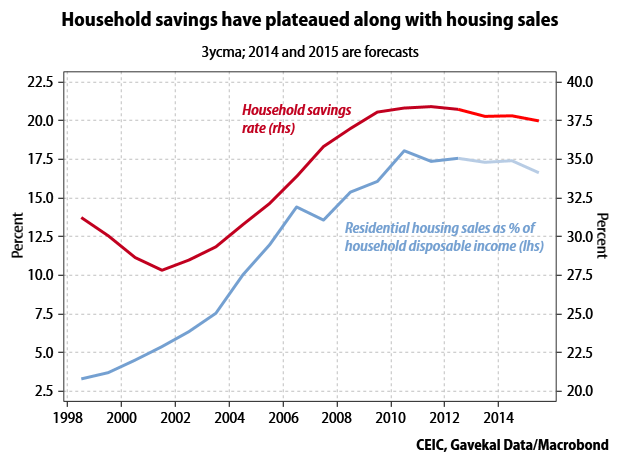
I agree that savings rates tend not to change very quickly, but I also think high savings in China are to some extent a cyclical phenomenon driven by high growth and large investment in housing. This view is in part based on recent research that emphasizes the role of demographics and rapid income growth in driving household savings (see this post); the hypothesis that stingy social welfare policies are the main culprit, because they induce lots of precautionary savings behavior, was conventional wisdom around 2003-04 but has not held up well. And in part it’s because I think the housing boom drove up savings and investment at the same time, rather than just providing an investment channel for already-high savings.
housing-vs-saving

An excellent paper by Guonan Ma, which I have previously cited, is one of the best and most comprehensive statements of this housing-centric view; he estimates that household investment (ie, housing), accounts for most of the rise in household savings, which in turn accounts for most of the rise in national savings:

The household sector has been the largest driver of China’s gross domestic saving, accounting for around half in 2013 and generating nearly two-thirds of the rise in the national saving rate during the two decades for which we have flow-of-funds data. … the increase we observe in household capital formation can itself account for more than three quarters of the rise in household saving and thus could explain more than half of the reported fall in the household consumption during the 1992-2013 period.

A recent paper from the Kansas City Fed on Chinese consumption also endorses the view that savings rates were pushed higher by the housing boom of the first decade of this century:

The large jump in the household saving rate from 2000 to 2010 is largely related to development in China’s housing market during this period. Before 1998, most Chinese families lived in government-provided houses; after economic reforms in 1998 removed this benefit, however, most Chinese families needed to buy their own homes. This change triggered rapid growth in the Chinese real estate sector, causing home prices to rise tremendously. Furthermore, as house prices started to increase quickly, housing became a popular investment for wealthy Chinese households, raising demand even further and exacerbating house price increases.

As I think the housing boom in China is more or less over (it seems to have peaked, in volume terms, around 2011-12), I expect housing investment to slow and decline in the future. Savings motivated by housing investment should therefore also slow and decline. So the previous decade’s rise in investment and savings rates should naturally be followed by a decline in both investment and savings rates–rather than, as Brad fears would be the case, just the investment rate.
If you think China has an SOE problem, take a look at Russia

The following summary of a recent report on the size of the state sector in Russia is truly mind-blowing:

The state has rapidly increased its presence in the economy. Together with state-owned companies, its share in GDP rose from 35 percent in 2005 to 70 percent in 2015. The number of state and municipal unitary enterprises has tripled in the last three years alone, and they continue to appear in markets with highly-developed competition where their use of administrative resources and government financing poses a serious threat to other players. Such businesses have mushroomed at the regional and municipal levels, squelching competition in local markets.

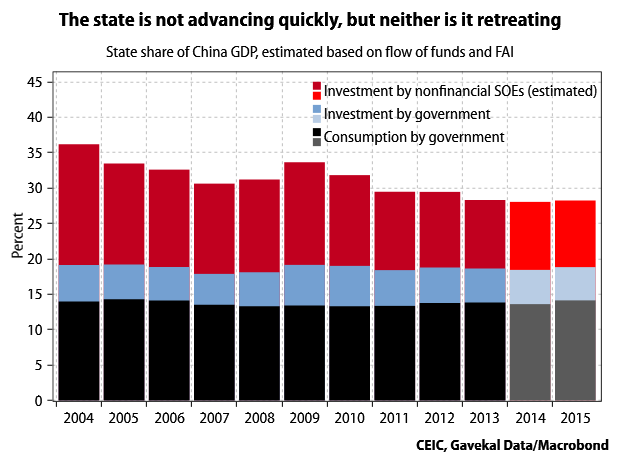
A 35% of GDP increase in the state (government + SOE) share of GDP over a decade is absolutely enormous. For all of the hand-wringing about the dire state of SOE reform and growing government intervention in China, it has seen nothing at all like this. Rather, China has gone from a positive trend of a declining state share of the economy in the 2000s to a less promising flat trend in the post-crisis yeas. My best estimate of the state share of China’s GDP is below (I use the flow of funds for government consumption and investment, and calculate gross capital formation by SOEs from the SOE share of fixed-asset investment; the flow of funds data only goes to 2013 so 2014 and 2015 are extrapolations). China and Russia seem to have had about the same state share of GDP in 2005, but since then China’s share has declined modestly:

state-share

Yes, that means that all of the huge amounts of infrastructure spending channeled through SOEs in recent years did not substantially increase SOEs’ share of the economy. Infrastructure is just not that a big a sector of the economy, and private investment in manufacturing is much more important (it’s true that the SOE share of the economy is not the same thing as broad government influence over the economy, but I’m sticking to things that can be measured at least approximately).

What has happened over the past several years is that private-sector investment, which previously was always much faster than state-sector investment, has slowed down substantially, while state-sector investment has picked up. As a result private investment is not growing much faster than state investment, and so the private-sector share of the economy is no longer rapidly rising. Nick Lardy explained it well at a recent presentation at a Peterson Institute conference:

The underlying problem or the underlying reality is that private investment growth relative to state investment growth has moderated quite a bit since 2011 and now has slowed down even more. … In part it’s because of the huge emphasis on infrastructure investment [carried out by state firms] and in part that state firms have gotten better access to what you might think of as external funding either on the form of bonds, bank credit, or the state budget. …

The rise of private firms, particularly the growing share of investment undertaken by these firms, has been a major driver of China’s economic growth in the reform period. While private industrial firms continue to dramatically outperform their sate counterparts, if the slowdown in private investment that we’ve seen so far in 2016 continues, I think it will be quite adverse for China’s medium-term economic growth.

This is definitely not a positive trend. But if the Russian numbers are at all accurate, something much more dramatic has happened there. The enormous rise in debt and distortion of the financial system that has occurred in China was sufficient only to stabilize the SOE share of GDP. So my guess is that it would be basically impossible for the state share of China’s much larger and more diverse economy to increase as much as Russia’s has, at least in the absence of radical expropriation. I guess that’s a good thing.

Some surprising continuities in Chinese economic history

Three economic historians–Loren Brandt, Debin Ma, and Thomas Rawski–have produced a very nice overview of China’s development over the past century, titled simply “Industrialization in China.” While the story of China’s post-1978 boom has been told so often it risks becoming over-familiar, the pre-1978 and pre-1949 economy is usually skipped over quite rapidly. The great virtue of this paper is how it creates a complete narrative that links the more recent period with developments as far back as the late 19th century. Standard accounts tend to focus mainly on the dramatic 1980s reforms and risk turning into hagiography of Deng Xiaoping; a different perspective helps show how China’s emergence as a global economic force was a truly long-term process:

The unusual speed of China’s post-1978 industrial growth is well known. Much less appreciated is that rapid industrial growth extends back at least to 1912. Over a period spanning nearly a century, Chinese manufacturing has grown at annual rate of more than 9 per cent.

The paper is at its best when making illuminating comparisons between different eras of Chinese economic history. In the 1920s, China became a net exporter of textiles, as local firms rapidly adopted new techniques and caught up with the productivity of British and Japanese firms–clearly a preview of post-1978 developments. But textiles were not the only success story:

Matches present a similar picture, with imports giving way to domestic production first by foreign and then by Chinese-owned firms. Liu Hongsheng, China’s “match king,” built his business in small cities ignored by foreign rivals, where customers put a premium on price over quality, and only later challenged the Japanese and Swedes in the Shanghai market, China’s largest. Liu’s strategy foreshadows the recent success of PRC start-ups in telecom equipment (Huawei) and construction machinery (Sany, Zoomlion, Liugong) that used capabilities accumulated through selling lower quality goods to less demanding markets to break into high-end global markets initially dominated by prominent multinationals like Caterpillar and Ericsson.

Another interesting continuity is between the wartime economic strategy of the Nationalist government and the industrialization drive launched after the Communist victory in 1949; indeed some of the same people were involved in both efforts:

The Nationalists and Communists shared a common vision of an industrial sector oriented toward military strength, directed by government technocrats, and dominated by state-run firms. When Communist forces routed their Guomindang rivals, the large majority of Nationalist industrial planning personnel, including the entire senior leadership of the National Resources Council, the KMT’s lead agency for economic planning, remained on the mainland, imparting a strong element of continuity to the establishment of Soviet-aided socialist planning by the incoming PRC government.

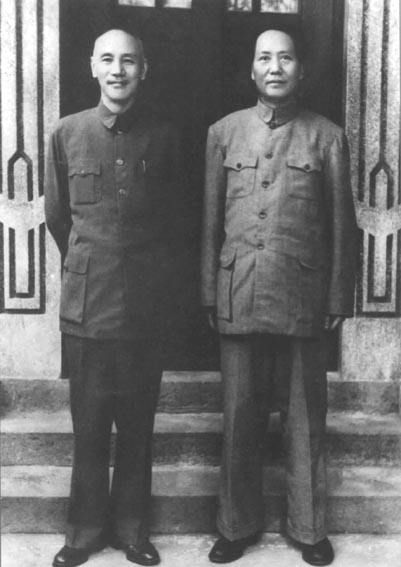
Chiang Kai-shek and Mao Zedong in 1945

Chiang Kai-shek and Mao Zedong in 1945

This probably should not be too surprising given the large role that SOEs had in Nationalist-run Taiwan until the 1980s, but the increasing divergence of the Taiwan and China models in more recent years makes it easy to overlook their historical links.

More on this theme can be found in the interesting work of Morris Bian, who has documented how the Communist state-owned enterprise system in many ways built on institutions that were created by the Nationalist government. Even the very distinctive and Soviet-influenced industrial strategy of the early 1950s–developing heavy industry in inland provinces a safe distance away from any invading force–had parallels in similar wartime efforts by the Nationalists. Here is an excerpt from chapter 2 of his The Making of the State Enterprise System in Modern China:

The Japanese invasion of Manchuria in 1931 and their attack on Shanghai in 1932 shocked the nation. Japanese aggression aroused strong Chinese nationalism and forced the Nationalist government to take a firm stand against Japan. In a speech delivered in October 1932, Chiang Kai-shek stated that ‘the Chinese nation has reached a critical moment and the fate of the nation is about to be decided’; his only purpose was to ‘revive the nation and save China.’ He proposed economic reconstruction and education as two means of saving China. What Chiang failed to mention in his public speech, however, was the fact that he was about to create a secret national defense planning commission as a first step toward resistance against Japan. …

In April 1935, the National Defense Planning Commission was renamed the National Resources Commission…what occurred was more than a name change. It marked an important change in purpose and direction. …In effect, the organization was transformed from Chiang Kai-shek’s brain trust to an organization in charge of industrial development. The development of a ‘Three-Year Plan for Heavy Industrial Reconstruction’ in 1936 best embodies these changes. … Heavy industry would receive the lion’s share of investment capital. Geographically, most planned factories were to be built in interior provinces such as Hunan and Jiangxi for fear of future Japanese aggression.

Why didn’t I read René Girard in Anthropology 101?

René Girard’s I See Satan Fall Like Lightning is perhaps the strangest, most unusual book I have read all year–as well as the one with the best title. Then again, I don’t read many works of Biblical exegesis-cum-philosophical anthropology, if that is even a genre. It was strongly recommended by a French colleague after Girard passed away last year, and not having been familiar with Girard before, I decided to fill that hole in my education.

And indeed I feel like I should have encountered him much earlier. I See Satan Fall Like Lightning may not have been the best place to start for a Girard newbie, but it does contain some of the most concise, most powerful and beautifully written statements of the key insight of social science: that human beings are not autonomous monads but fundamentally social beings, whose thoughts and actions are shaped by the people around them. (Peter Thiel, who has been vocal about Girard’s greatness, seems to have put these insights to more practical use than me or most of my classmates in anthropology did.)

Girard takes an unusual route to get to this insight, using scraps from the Bible and the Greek myths more in the manner of a literary critic, but he expresses it as well or better as any of the greats of twentieth-century social science. He might not want to be put in the company of Claude Levi-Strauss, about whom he was quite scathing, but it’s hard not to see the similarities in their grand ambition to construct a philosophical anthropology. Here’s a spectacular passage, in which Girard builds an account of human nature and culture out of just one of the Ten Commandments:

The tenth and last commandment is distinguished from those preceding it both by its length and its object: in place of prohibiting an act it forbids a desire: “You shall not covet the house of your neighbor. You shall not covet the wife of your neighbor, nor his male or female slave, nor his ox or ass, nor anything that belongs to him.” (Exod. 20:17)

Without being actually wrong the modern translations lead readers down a false trail. The verb “covet” suggests that an uncommon desire is prohibited, a perverse desire reserved for hardened sinners. But the Hebrew term translated as “covet” means just simply “desire.” This is the word that designates the desire of Eve for the prohibited fruit, the desire leading to the original sin. The notion that the Decalogue devotes its supreme commandment, the longest of all, to the prohibition of a marginal desire reserved for a minority is hardly likely. The desire prohibited by the tenth commandment must be the desire of all human beings in other words, simply desire as such. …

If individuals are naturally inclined to desire what their neighbors possess, or to desire what their neighbors even simply desire, this means that rivalry exists at the very heart of human social relations. This rivalry, if not thwarted, would permanently endanger the harmony and even the survival of all human communities. Rivalistic desires are all the more overwhelming since they reinforce one another. The principle of reciprocal escalation and one-upmanship governs this type of conflict. …

Even if the mimetic nature of human desire is responsible for most of the violent acts that distress us, we should not conclude that mimetic desire is bad in itself. If our desires were not mimetic, they would be forever fixed on predetermined objects; they would be a particular form of instinct. Human beings could no more change their desire than cows their appetite for grass. Without mimetic desire there would be neither freedom nor humanity. Mimetic desire is intrinsically good.

Humankind is that creature who lost a part of its animal instinct in order to gain access to “desire,” as it is called. Once their natural needs are satisfied, humans desire intensely, but they don’t know exactly what they desire, for no instinct guides them. We do not each have our own desire, one really our own. The essence of desire is to have no essential goal. Truly to desire, we must have recourse to people about us; we have to borrow their desires.

This borrowing occurs quite often without either the loaner or the borrower being aware of it. It is not only desire that one borrows from those whom one takes for models; it is a mass of behaviors, attitudes, things learned, prejudices, preferences, etc. And at the heart of these things the loan that places us most deeply into debt–the other’s desire–occurs often unawares.

The only culture really ours is not that into which we are born; it is the culture whose models we imitate at the age when our power of mimetic assimilation is the greatest. If the desire of children were not mimetic, if they did not of necessity choose for models the human beings who surround them, humanity would have neither language nor culture. If desire were not mimetic, we would not be open to what is human or what is divine.

Mimetic desire enables us to escape from the animal realm. It is responsible for the best and the worst in us, for what lowers us below the animal level as well as what elevates us above it. Our unending discords are the ransom of our freedom.


What I’ve been listening to lately

  • Charlie Parker – A Studio Chronicle 1940-1948. My first loves in jazz were 1930s swing and 1960s avant-garde, so it took me a while to get around to really listening to 1940s bebop and 1950s mainstream. Guess what, Parker is a genius; I know that’s not an original opinion, but I didn’t really appreciate how true it was before.
  • Bud Powell – The Complete Bud Powell On Verve. More bebop immersion. Five CDs worth of piano trios is not normally the kind of listening experience I would seek out, as there’s a big risk of stuff just sounding the same. But Powell’s vigorous, forceful playing stands out.
  • Bobby Hutcherson – Patterns. In honor of his passing I have been listening to a lot of his stuff again; I love the vibes and Hutcherson is one of the great masters. That said, his recordings under his own name tend to be a little soft-edged for my taste; he is responsible for one undisputed jazz classic, Dialogue, but it really sounds more like an Andrew Hill record. But Patterns is a good and often overlooked session, with lovely flute from James Spaulding.
  • Prince Buster – Fabulous Greatest Hits. The King of Ska is dead, long live the king; too many obituaries of late. This greatest hits record is in fact the only readily available recording by Prince Buster; to hear much, much more, don’t miss Steve Barker‘s great four-part radio tribute.

Regional convergence has stalled, says The Economist

John Parker of The Economist talked to me for a story on regional inequality in China, which is now out in the latest edition. It’s a nice overview of some of the questions I’ve written about on this blog, here’s a sample:

There are three reasons why convergence has stalled. The main one is that the commodity boom is over. Both coal and steel prices fell by two-thirds between 2011 and the end of 2015, before recovering somewhat this year. Commodity-producing provinces have been hammered. Gansu produces 90% of the country’s nickel. Inner Mongolia and Shanxi account for half of coal production. In all but four of the 21 inland provinces, mining and metals account for a higher share of GDP than the national average.

Commodity-influenced slowdowns are often made worse by policy mistakes. This is the second reason for the halt in convergence. Inland provinces built a housing boom on the back of the commodity one, creating what seemed at the time like a perpetual-motion machine: high raw-material prices financed construction which increased demand for raw materials. When commodity prices fell, the boom began to look unsustainable. …

Investment by the government is keeping some places afloat. Tibet, for example, logged 10.6% growth in the first half of this year, thanks to net fiscal transfers from the central government amounting to a stunning 112% of GDP last year. Given the region’s political significance and strategic location, such handouts will continue—Tibet’s planners admit there is no chance of the region getting by without them for the foreseeable future.

Tibet is an extreme example of the third reason why convergence is ending. Despite oodles of aid, both it and other poor provinces cannot compete with rich coastal ones. In theory, poorer places should eventually converge with rich areas because they will attract businesses with their cheaper labour and land. But it turns out that in China (as elsewhere) these advantages are outweighed by the assets of richer places: better skills and education, more reliable legal institutions, and so-called “network effects”—that is, the clustering of similar businesses in one place, which then benefit from the swapping of ideas and people.


Daring to sympathize with China’s unhappy police

China’s Unhappy Police” is a perfectly-named and very interesting paper by Suzanne Scoggins and Kevin J. O’Brien, reporting the results of numerous interviews with low-level cops in China (link courtesy of Omnivore). It’s an unusually sympathetic account of a group that does not get a lot of sympathy. Some excerpts:

Facing piles of tedious, repetitive work, young police report that life on the force is not what they anticipated. Fresh recruits in their early 20s typically start out full of hope, imagining that they are taking up positions as brave law enforcers who will command prestige, get to wear a sharp uniform, and maybe, if they are lucky, fire a gun. They tend to be aware of the long hours and dangers of the job, but few are prepared for the monotony of street-level policing. When on patrol, they often spend hours parked on street corners with little to do.

Instead of fighting crime, many also find themselves occupied with matters unrelated to law enforcement. Members of the public often do not know what falls within their job description, and officers say they must respond to every phone request, no matter how insignificant. This means that street-level cops may be summoned to find lost cows in the middle of the night, search for missing dogs, or retrieve forgotten QQ numbers (login information for a popular social network). Despite being fix-it men for a host of community problems, young police complain that they have far less authority than they expected. “I can tell someone on the street to stop,” explained one officer, “but they don’t care. They just start arguing with me.” …

The trials of street-level officers have only worsened in recent years as they face new demands and reforms that tie their hands. Older cops complain bitterly about procedural changes that make it harder to conduct investigations and interrogate suspects. Officers of all ages lament a 1994 rule that forbids them from carrying guns (except under extraordinary circumstances) and often attribute some of their limited authority to being under-armed. Police are also unhappy about stepped-up reporting requirements. Chinese street cops, like those in many countries, are frustrated by the number, length, and complexity of the reports they must file with their superiors and the Ministry. Beset with busywork and pinned to their desks, officers argue they have insufficient time to attend to more important tasks such as conducting investigations. Finally, attacks on police have increased both in violence and frequency, undercutting the belief many hold that they are respected and, when needed, feared by the public. …

Like unhappy employees everywhere, discontented officers look for ways to avoid work. Some shirking is easy to observe. Parked patrol cars filled with dozing officers are a common sight on Chinese street corners. But most shirking occurs in the station house. Although none of our respondents admitted to evading their responsibilities, some commented on goldbricking by their co-workers. “The old guys do what they like,” explained one officer. “They don’t care about new rules [forbidding government workers from drinking alcohol during lunchtime]. They just close their office door after lunch and go to sleep.” While officers may prefer lunchtime boozing over afternoon work for any number of reasons, a group of older cops cited the stress that comes with the job when asked about their midday imbibing. “Drinking is the only pleasure we police have,” said one, as the others roared in agreement and continued enjoying just the sort of alcohol-infused banquet they had been told to eschew.

Shirking can also take on more creative forms. “Protocols are not specific,” explained one young officer. “One day I went to bust up a small hair salon, and when the boss fled, I ran a long way until I finally caught him. My colleagues laughed at me and said I was crazy [to chase the man]. We get paid so little and procedures don’t say what to do when criminals run.”

The general lesson, as in so many cases, is that China is messier than you might think:

China is often thought of as a well-funded and tightly organized security state, with a full palette of formal and informal agencies to maintain social order. Front-line police are only one part of that apparatus, but their unhappiness and weak job performance suggests a certain brittleness that may signal problems elsewhere. Since 1989, the Party has proven quite adept at managing or at least suppressing social unrest, but dissatisfaction and mismanagement of the lower levels of the security state speaks to abiding weaknesses that merit more attention. What ground-level agents of state power have to say matters. As our interviews reveal, the life of a front-line cop is filled with uncertainty, hardship, and feelings of powerlessness. Their accounts, self-serving as they may be, show them in a new light: as overburdened, under-armed and unhappy men and women trying to make the most of a difficult job.

Those waiting for the demise of the nation-state may be waiting for a while

Robert Shiller makes a valiant attempt to push back against the current climate of pessimism and nationalism in a recent Project Syndicate piece, arguing that increasing empathy will eventually reduce the political and emotional salience of the nation-state:

For the past several centuries, the world has experienced a sequence of intellectual revolutions against oppression of one sort or another. These revolutions operate in the minds of humans and are spread – eventually to most of the world – not by war (which tends to involve multiple causes), but by language and communications technology. Ultimately, the ideas they advance – unlike the causes of war – become noncontroversial.

I think the next such revolution, likely sometime in the twenty-first century, will challenge the economic implications of the nation-state. It will focus on the injustice that follows from the fact that, entirely by chance, some are born in poor countries and others in rich countries. As more people work for multinational firms and meet and get to know more people from other countries, our sense of justice is being affected. …

Ultimately, the next revolution will likely stem from daily interactions on computer monitors with foreigners whom we can see are intelligent, decent people – people who happen, through no choice of their own, to be living in poverty. This should lead to better trade agreements, which presuppose the eventual development of orders of magnitude more social insurance to protect people within a country during the transition to a more just global economy.

To put this in the terms of Dani Rodrik’s globalization trilemma, the argument is that the natural direction of human history is to choose economic integration and democratic politics over the nation-state. It seems that this was Rodrik’s own hope when he originally formulated the trilemma, though recent events like the UK’s vote for Brexit have made that direction seem much less inevitable. Shiller seems to think of political change as a kind of widening circle of intellectual empathy: over time, the boundary of empathy widens from your immediate neighbors, to include people of different races, different religions and eventually different nations.

I think this is an insufficiently anthropological approach that neglects how actual social institutions create more powerful ties than an abstract sympathy. Re-reading this year Benedict Anderson’s wonderful book on nationalism, Imagined Communities (it still ranks as one of the best reads of any academic book ever) has reinforced my feeling that this kind of purely intellectual approach neglects the very things that have made the nation-state a powerful and persistent institution. The nation-state is not an arbitrary oppressive illusion that people will see through once they become sufficiently advanced. Rather, it is a specific social institution like any other; to quote Anderson:

All communities larger than primordial villages of face-to-face contact (and perhaps even these) are imagined. Communities are to be distinguished, not by their falsity/genuineness, but by the style in which they are imagined.

The nation is imagined but it is not imaginary; it is founded in actual shared experiences, real relationships and established institutions, and these generate an emotional attachment. Anderson again:

Regardless of the actual inequality and exploitation that may prevail in each, the nation is always conceived as a deep, horizontal comradeship. Ultimately it is this fraternity that makes it possible, over the past two centuries, for so many millions of people, not so much to kill, as willingly to die for such limited imaginings.

For the nation-state to become politically irrelevant in the way Shiller suggests, it is not enough for people to be polite to the foreigners they see on their computer screens. Rather, the nation-state would have to be superseded by another “imagined community.” And this is a little difficult to (ahem) imagine.

What new social institutions are now creating shared experiences that could eventually supersede the nation-state? Many early nationalisms were based on shared experiences of imperialism and colonialism. So it makes some sense to argue that the nation-state’s successor is being bred by the experiences produced by the contemporary strain of global capitalism.

The multinational corporation is the example favored by Shiller; another obvious one is the European Union. The much-remarked age difference in the UK’s Brexit vote–youth overwhelmingly voting to remain–could perhaps be an early sign of changing attachments. A new generation, raised in the reality of a united Europe and taking pan-European travel and job opportunities as their rightful birthright, perhaps is indeed starting to imagine a community that supersedes the nation-state.

But is a multinational Europe (or Nafta, or whatever) in fact a community, or just a much wider field on which individuals pursue economic self-interest and career advancement? Do the participants in these multinational zones really see themselves as a community–are they forming emotional relationships rather than just engaging in arms-length market exchanges? I am not saying the answer is obviously no, but neither is it obviously yes.

I suspect it will not be until something more than economic self-interest binds together the emerging multinational class that the nation-state will be finally replaced by some other institution. I think this comment of Anderson’s is still an effective riposte to Shiller’s argument, despite having been made back in 1983:

In themselves, market-zones, ‘natural’-geographic or politico-administrative, do not create attachments. Who will willingly die for Comecon or the EEC?

Which Chinese people are more likely to marry foreigners?

Here is a fun piece of Chinese data journalism that got sent my way–somebody added up the total number of marriages between Chinese and foreigners over the past ten years, and then broke it down by province. I don’t have access to the underlying data but I can reproduce the main chart below, which shows marriages with foreigners as a percent of total marriages in each province:

foreign-marriages

The top 10 provinces are, in order: Fujian, Shanghai, Hainan, Guangdong, Zhejiang, Liaoning, Heilongjiang, Beijing, Yunnan, Jilin. Give how many mixed couples are in my social universe, the opportunity for doing a little armchair sociology here is downright irresistible. Theories for what each of these provinces are doing in the top ten:

Fujian, Hainan, Guangdong, Zhejiang. Pretty obvious — these provinces are the historical origin of most of the overseas Chinese diaspora, and have substantial populations of overseas Chinese returnees as well. It’s very likely that a lot of these marriages between PRC citizens and non-PRC citizens are marriages between two ethnic Chinese.

Beijing, Shanghai. Also not that hard — Beijing and Shanghai are where most of the foreigners in China live, so not too surprising that more marriages between foreigners and Chinese would happen as a result. Yunnan as a border province with a lot of cultural ties to Southeast Asia also has a fairly large foreign population, so the same explanation applies. Here is a quick plot of some data from the 2010 census to illustrate:

foreign-population

Liaoning, Heilongjiang, Jilin. Hey, what are the three northeastern provinces doing on this list? The original article also notes that while it is not surprising for the more economically developed and more internationally oriented provinces to have more marriages with foreigners, it is “quite surprising” for the former Manchuria to show up with such a high ranking. This is a little unfair to Liaoning: as the chart above shows, the foreign share of the population in Liaoning is higher than the national average. My guess is that this is due to the substantial investments by Japanese and Korean firms in Dalian.

But yeah, it’s definitely a bit surprising for these somewhat isolated and economically troubled provinces to be matching or beating China’s most cosmopolitan places. My circle of friends in fact includes a not inconsiderable number of men (both Chinese and foreign) married to northeastern women; I had always enjoyed this as a happy coincidence and did not suspect it might actually reflect some broader social trend.

My informants suggest that the economic troubles of the northeast could in fact be the explanation. As a result of the relative stagnation in the northeast, there has been a lot of out-migration over the past decade as people seek better opportunities elsewhere. (One point of detail is that China’s hukou system means that a Chinese-foreign couple who register their marriage in Jilin don’t necessarily actually live in Jilin; they could live elsewhere but have to return to the Chinese spouse’s home province to register the marriage.) So for the other provinces mixed marriages seem more likely to be a result of “pull” factors–more people mixing socially with foreigners–but for the northeast it could be “push” factors where a bad economy drives people out of their native social milieu. That makes some sense, though I’m open to other theories.

What not to expect from Chinese SOE reform

Just what can we realistically expect in terms of state-owned enterprise reform in China?

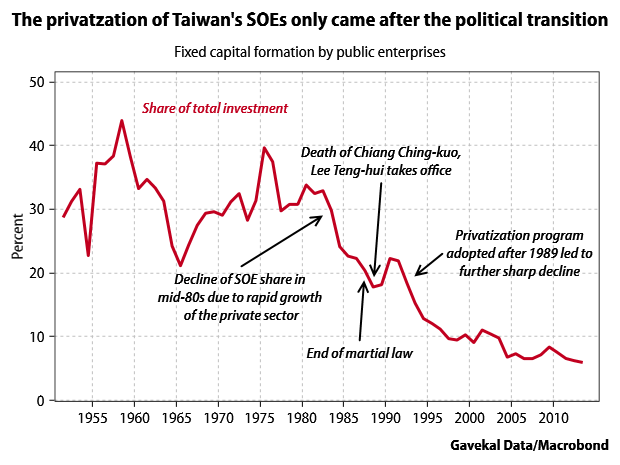
For those who take the once-standard view that China is following the “Asian developmental state” model of Japan, South Korea, and Taiwan, then substantive SOE reform and privatization should in fact be coming along any day now. Those other Asian economies also had large state sectors originally; Robert Wade’s 1990 book on Taiwan, Governing The Market, notes that “from the early 1950s onward Taiwan has had one of the biggest public enterprise sectors outside the communist bloc and Sub-Saharan Africa.” Wade defended the performance of Taiwan’s SOEs, but his book was published just as a major privatization program was pushed through. Taiwan, rather unusually, has good and transparent data about the size of SOEs in its economy, which makes for an interesting chart:

Taiwan-SOEs-politics

South Korea had an SOE sector whose relative size was not that dissimilar from Taiwan’s, and actually began privatization even earlier. I have cobbled these data together from a few different sources, so I wouldn’t pretend to a huge amount of precision, but the trend is still pretty informative:

Korea-SOEs

Major privatizations of SOEs in South Korea took place in the early to mid-1980s, when its per-capita GDP was $7,000-$9,000 at purchasing power parity. Taiwan’s privatization came later and at substantially higher incomes, around $17,000-$18,000 at PPP. China’s per capita GDP is around $13,000-$15,000 now. So if we’re just thinking in terms of income levels, China is more or less at the point when substantial SOE privatization happened elsewhere. But income levels are pretty obviously not the driving factor; SOE privatization in both South Korea and Taiwan was very much part and parcel of their political transitions toward democracy. And such a transition does not seem to be at all imminent in China.

A couple of conclusions seem to follow from this observation. One, the “Asian developmental state” framework, which was indeed helpful for analyzing China in its high-growth phase, seems to be outliving its usefulness. A different perspective that takes China’s socialist heritage more seriously, perhaps looking more at transition economies, could be useful. Two, expectations for SOE reform should be realistic about the existing political framework. Privatizing PetroChina and similar high-profile SOEs just does not seem conceivable in the current system (the privatizations of the late 1990s, under the “grasp the large, release the small” slogan, focused on locally-owned and nonstrategic firms).

In the paper I did a couple of years back on SOE reform, I was very careful not to aim for Washington Consensus-style idealized outcome, but to focus on what seemed plausible and possible in the Chinese context (and what I proposed had in fact been done before). So I consider myself to have pretty realistic expectations about what kind of SOE reform is plausible.

Yet even relative to modest expectations, reform has disappointed. It’s hard to overstate how depressed most China-watchers have become about the state of state-owned enterprise reform. After some promising signals in 2013 that seemed to indicate an openness to a new approach, it has just been one disappointment after another. Instead of more privatization and more professional management, there is instead a renewed love affair with forced mergers of large SOEs, a heightened emphasis on SOEs as instruments of government industrial policy, an increase in the Communist Party’s role in company management, and a proliferation of new “anticorruption” procedures to limit decision-making by SOE executives.

In a characteristically clear and concise post, Nick Lardy argues that the latest fashion for consolidation is a bad move:

These mega mergers may satisfy the ambition of the Chinese Communist Party to have more prominent national champions, but they aren’t likely to improve the efficiency of SOEs.

Barry Naughton, in one of his always-useful overviews of the policymaking process, similarly notes that:

There is a remarkable degree of consensus that [SOE reform] has, at a minimum, progressed too slowly and, at a maximum, failed altogether.

And the more I read from domestic commentators about the current SOE “reform” process, the more discouraged I get. Here are some excerpts from an interview with Yu Jing of CASS that give a flavor of the current conservative tone:

The basic idea of the previous round of [SOE] reform was to give full play to the role of the market, and accelerate integration with the more developed and more advanced global market system. Today, however, the international and domestic economic environment is not that optimistic, so a violent market reform could not only fail to achieve the goal of economic stability, but could even increase risk. …

The previous system for supervising state-owned enterprises had many regulations based on general principles; the current regulations have more attention to detail and focus on implementation. In the future, we still need to continually improve the system for supervising state-owned enterprises, and deal with the numerous problems that have been exposed. We need to have targeted constraints, and change the old method of after-the-fact supervision, so that the state-owned enterprise system can steadily improve. …

Future SOE reform will put greater emphasis on standards and norms, there will be more and more constraints on enterprises. For the top management of SOEs, they will face more difficult challenges in leading China’s large companies in a marketized and international direction, they will have to assume a more important historical responsibility. …

We should understand that the ultimate goal of SOE reform is–under the prerequisite of regularizing the operations and behavior of SOEs–to stimulate the vitality of SOEs, and to build a system that is more transparent, more standardized, and more in keeping with development of modern corporate culture.

The emphasis on avoiding risk is almost overwhelming. The “prerequisite” in the last sentence seems more important than the nod to “vitality”: SOE reform is not about making SOEs more like private-sector companies, but making them more like the government bureaucracy, where managers implement policy priorities while following detailed codes of conduct. This makes some sense if the priority is to avoid corruption at SOEs. And more checks and balances could reduce wasteful investment. But it does not seem like a recipe for raising the state sector’s extremely low return on capital.

The folks at the IMF, who have to come up with constructive suggestions rather than just complain, been reduced to suggesting that the government “pilot” serious SOE reform at one or two companies (implicitly making the point that the current approach is not going to solve the actual problems, so starting afresh is necessary). Here is Markus Rodlauer in a conference call after the IMF’s last Article IV report on China:

We have a view that it would be very helpful for China, both domestically and internationally to demonstrate a strong start to a new approach to state-owned enterprises. And the new approach, as we described it in the report, is comprehensive that addresses both the financing side of it, the debt side of it, the enterprise restructuring side of it, the social side of it, the employment consequences, altogether in a coherent way. And making a strong start with 1 or 2 or 3 large enterprises, to do it in the right way, then you also allow private investors, and even foreign investors to come in and play a role.

I think that’s a good suggestion, and I hope it gets traction, but it does seem like a sign of how far expectations for SOE reform have fallen.