How a Shandong grocery store’s accounts unlocked China’s 19th century economic history

History buffs should enjoy this account by Debin Ma and Weipeng Yuan of the rediscovery of the ledgers of a 19th century Chinese grocery store, which have turned out to be one of the key sources for the economic history of the period:

In a widely used statistical manual for Chinese economic history compiled in 1955 by Professor Yan Zhongping and ten other eminent economic historians, two tables and a figure are included that provide relatively continuous annual series of copper cash/silver exchange rates and two price indices for agricultural and handicraft goods (in copper cash) respectively for the period of 1798-1850.

These three pages of highly condensed statistical series stand out as a glaring anomaly in the dark alley of Chinese historical statistics. Despite the brevity of the explanation, they have not escaped the attention of researchers: the Ningjin series appeared frequently in some of the most influential works on China’s pre-modern monetary sector and often served as the key (or only) systematic data series for evaluating China’s balance of payment crisis caused by silver outflow, leading eventually to the fateful Opium War of 1842 – a watershed event in modern Chinese history.

Embedded in the footnotes to these two tables are brief explanations of the statistical methodology of constructing the exchange rate series and the number of items included in the construction of these price indices. They also indicated that the original data were extracted from a grocery store called Tong Taisheng, located in the town of Daliu of Ningjin county in the northern part of Zhili province.

Tong Taisheng was managed for several generations by the Rong family. But the store, despite its long history, is not mentioned at all the present-day official archives of Ningjin county (in what is now Shandong province). The ledgers–more than 400 handwritten volumes–survive only because they were donated to the national archives in 1935 by a descendant of the Rong family, who was himself a historian. But the donor, Rong Mengyuan, never made use of this amazing material for any of his own historical research! Perhaps because he did not want to publicize his “capitalist” family background, and perhaps because as a loyal Marxist he was genuinely ashamed of it:

Like countless others, Rong Mengyuan re-emerged from his intellectual exile and re-established himself as an authority on Chinese historical archives with a prolific publication record in the 1980s. The new era saw a revival of academic interest in traditional China’s indigenous commercial tradition and in the explorations of private merchant business archives, often filled with tales of valuable archives discovered or rescued by sheer accident while others were lost through continued neglect.

While generations of scholars are set to benefit from the rediscovery of Tong Taisheng and other archives, when Rong Mengyuan passed away in 1985, he himself may have harboured no pride or interest in his connection with that pile of family archives he donated five decades earlier. It is curious to note that throughout the 1980s Rong Mengyuan remained a loyalist to an ideology of a bygone age and his writings then continued to be infused with the stridently leftist rhetoric of identity politics.

The full piece “Discovering economic history in footnotes” is not overly long or technical, and well worth a read.

tts-ledger

About that China infrastructure paper that is making the rounds

A couple of people have asked what I think about this paper on Chinese infrastructure that is making the rounds, which claims that China “is headed for an infrastructure-led national financial and economic crisis.” It’s rather an obnoxious paper to read, in that it aggressively attacks a straw-man position that few people actually hold, and makes grand macro claims about China based on rather equivocal micro data. The general conclusion is certainly not wrong, though it is a fairly widely held view: China is very likely over-investing in infrastructure, and this is going to have negative consequences for its future growth and debt dynamics. But the actual content of the paper does not do as much to support this view as the authors claim. Here I will try to explain what I think is wrong with the paper, and outline the real reasons why China’s infrastructure investment is problematic.

The core of the paper is an examination of the performance of individual infrastructure projects in China, which the authors compare to projects undertaken in other countries. (The paper’s dataset is exclusively composed of infrastructure projects in China funded by the Asian Development Bank and the World Bank. One might therefore wonder whether the findings say more about the procedures of these multilateral institutions than about China’s unique circumstances. But let’s not quibble.) They find that infrastructure projects in China often cost more and take longer to complete than expected, and that planners often do not accurately forecast demand for the completed projects. Yet these seem to be general problems of large construction and engineering projects around the world:

Actual costs were on average 30.6 per cent higher than estimated costs, with a median of 18.5 per cent indicating that the distribution of costs had a heavy skew to the right (i.e. going over budget). … We found no significant differences in cost overruns between China and rich democracies—i.e. on our sample China’s cost performance is no better or worse than that of rich democracies. …

Similarly, in terms of schedule overrun China performed better than rich democracies. The average schedule overrun in rich democracies was +42.7 per cent (median = +23.0 per cent) compared to Chinese projects’ average of +5.9 per cent (median = 0.0 per cent). Only one in every two projects encountered a schedule delay in China compared to seven out of 10 in rich democracies. …

In the reports we studied for China, the typical BCR [benefit-cost ratio] for transport projects was 1.4 to 1.5, which is broadly in line with many other physical infrastructure assets such as large dams, road, rail, bridge, or tunnel capital investments. In other words, planners expected the net present benefits to exceed the net present costs by about 40–50 per cent.

The authors’ data on individual infrastructure projects tell us that China is basically no worse and no better than the rest of the world in terms of managing infrastructure projects–just like everywhere else, they often run behind schedule and over budget. This is certainly useful information but does not seem like a shocking finding. But if China is no better and no worse than the rest of the world at planning and executing infrastructure projects, it is hard to see how this would lead it into an infrastructure-driven financial crisis. The problem must therefore surely be that China is spending far too much on infrastructure, so that the ordinary problems of project mismanagement are magnified by the scale of its spending.

At this point in the paper I naturally expected the authors to show that China was in fact spending much, much more than other countries on infrastructure. But they don’t. In fact they present absolutely no statistical information about the level or growth rate of infrastructure spending in China. I know, I couldn’t really believe it either. What they do instead is present the usual numbers about the rapid growth of total investment and debt in China, such as the figures on gross fixed capital formation in the national accounts. It should hardly need pointing out that gross fixed capital formation is not the same thing as infrastructure spending; infrastructure is only one component of gross fixed capital formation, most of which is housing and business capital expenditure. (Putting a hard number on China’s infrastructure spending is indeed tricky, but not impossible. According to estimates by the former OECD economist Richard Herd, government and infrastructure sectors have usually accounted for 20-30% of gross fixed capital formation over the past couple of decades.) Since the authors do not establish that China is spending a lot on infrastructure in the aggregate, the conclusion that China’s macro problems from infrastructure spending are much greater than other countries simply does not follow from the micro evidence they present. It would certainly be useful to compare rates of infrastructure investment across countries, but this paper does not do that.

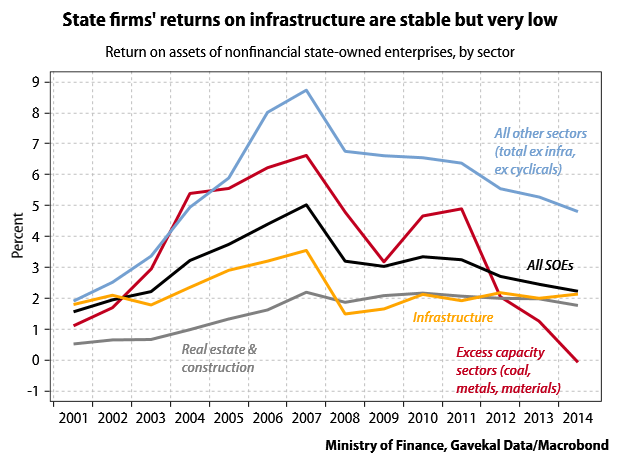
So does that mean infrastructure spending is not an issue for China? Not at all, the issue is very much a real one. I would express it much more simply however: Chinese infrastructure projects generate low financial returns, but have to repay debts at interest rates that are far too high. Here are two numbers to illustrate the point: the average return on assets of state-owned enterprises in infrastructure sectors is around 2%, but the average interest rate that state-owned enterprises pay on their debt is around 5%. It is pretty clear this is not a financially sustainable situation–and note that this is true regardless of what you may think about the broader economic benefits of infrastructure projects, since what matters is the financial returns realized by the project sponsors. And the magnitude is sizable: 6-7 trillion yuan a year, based on Herd’s figures.

soe-roa

It’s an important peculiarity of the Chinese system that so much of its infrastructure is provided by state-owned enterprises, rather than directly by the government. The reasons for this are not totally clear–maybe it helps expedite stimulus spending, or keeps measured government debt low. But the consequences are pretty clear: by channeling a lot of essentially public-sector borrowing through financing channels normally used by private companies, China has created a large financial problem. Since the returns on infrastructure projects are on average not high enough to repay the debt SOEs take out to fund them, if the government does not want the projects to default then it needs to restructure the debt into lower-cost government obligations. This is exactly what is happening now. And since infrastructure investment is still growing by around 20% annually, and returns on infrastructure investment could plausibly fall even further (capacity utilization at thermal power plants is already at a 20-year low due to excess capacity), China will be dealing with this infrastructure debt problem for a while.

Saying rude things about ‘supply-side structural reform’

…is not that common in China, where the drumbeat of propaganda for the government’s latest economic slogan has become nearly deafening. Tiff Roberts of Bloomberg however manages to quote a number of people, including me, who are generally un-enthused about what is happening, in a piece entitled “China’s ‘Supply Side’ Is a Far Cry From Reagan’s“:

No one expects the macroeconomic textbook definition of supply side in Xi’s China—the theory that inspired Ronald Reagan’s economic policies in the 1980s. Reagan’s version had as its goal freeing up the economy by cutting taxes and regulations in the hope that companies would invest and produce more, driving growth. Xi’s “supply-side structural reform” is a grab bag of policies, focused on cutting excess capacity, shuttering a limited number of “zombie” companies, and subsidizing favored and often inefficient industries, says Barry Naughton, an expert on the Chinese economy at the University of California at San Diego. The point isn’t to encourage supply but, for the most part, to curtail it. …

Provincial bosses, however, are eager to appear enthusiastic about the slogan. With a once-every-five-years party congress coming in the fall of 2017, they’re vying to show they’re on board with the policy; they hope that will help them win a promotion when China shuffles much of its senior leadership. Hebei, home to about one-quarter of China’s total steel production; Heilongjiang, part of China’s northeastern industrial rust belt; and coastal Shandong have all recently issued supply-side plans, including capacity reduction targets and tax breaks for new industries such as electric vehicles and eco-friendly agriculture. Guangdong, better known for making toys than steel, outdid others with a six-part, 42-page document, complete with a vision statement.

There is more discussion of what Chinese-style “supply-side reform” is and is not in the full piece.

Good China stories that I missed in the summer doldrums

Even with all the reading about China that I do, some stuff still slips through the cracks. It’s been a fairly slow summer news wise, so lately I’ve been challenging people to tell me about some interesting stories. Here are a few good pieces that I missed when they first came out–thanks to various journalist friends for passing these on.

Local officials judged by the people on a new reality TV show

Towns built on exhausted coal mines are sinking into the earth

Increased openness is finally making the scope of China’s child sexual abuse problem clear

How one Chinese welder navigated the economic slowdown

Robotics parks are springing up like mushrooms after the rain

Bonus link: amazing photos of China in 1956

The Hirschman explanation for China’s egalitarian turn

Of late there has been a strong egalitarian theme in Chinese policymaking, evident in things like Xi Jinping’s increased use of terms like “common prosperity;” the stepped-up program of aid for the northeast, the region worst-hit by the economic slowdown; and a pledge to eliminate absolute poverty by 2020. This trend to me is quite striking and already the subject of some domestic debate. Previously I have chalked this kind of thing up to Xi Jinping’s tendency to present himself as the leader who will complete the epochal tasks set by the great figures in China’s political history: such equalizing policies are part of the Maoist tradition, but were also endorsed by Deng Xiaoping.

Re-reading Albert Hirschman’s classic essay “The Changing Tolerance for Income Inequality in the Course of Economic Development” (in The Essential Hirschman), I see that it can offer an alternative theory. In this piece Hirschman made that the argument that:

In the early stages of rapid economic development, when inequalities in the distribution of income among different classes, sectors, and regions are apt to increase sharply, it can happen that society’s tolerance for such disparities will be substantial.

The tolerance for inequality comes about through what he called the “tunnel effect”:

Suppose that I drive through a two-lane tunnel, both lanes going in the same direction, and run into a serious traffic jam. No car moves in either lane as far as I can see (which is not very far). I am in the left lane and feel dejected. After a while the cars in the right lane begin to move. Naturally, my spirits lift considerably, for I know that the jam has been broken and that my lane’s turn to move will surely come any moment now. Even though I still sit still, I feel much better off than before because of the expectation that I shall soon be on the move.

In other words, people can see the economic success of others as a good thing rather than a bad one, as it may be a sign that they themselves will eventually be successful. But this is not always the case, of course:

For the tunnel effect to be strong (or even to exist), the group that does not advance must be able to empathize, at least for a while, with the group that does. In other words, the two groups must not be divided by barriers that are or are felt as impassable. … In passably homogeneous societies where resources are largely owned domestically, the tolerance for economic inequalities may be quite large as no language, ethnic, or other barrier keeps those who are left behind from empathizing with those who are “making it.”

China would seem to qualify on those criteria. But here we get to the key point. For the tunnel effect to produce social tolerance for inequality, people also have to believe that economic success is not just the result of connections and arbitrary government policies:

If decision making is perceived to be largely decentralized, individual advances are likely to be attributed to chance, or possibly to merit (or demerit). When decision making is known to be centralized, such advances will be attributed to unfair favoritism or, again, to merit. To the extent that merit is not a likely attribution, decentralized decision making, which permits success of others to be explained by chance, is therefore more conducive to giving full play to the tunnel effect. It is indeed characteristic of market economies. Centralized-decision-making economic systems have come typically into the world because of excessive inequalities existing in, or arising under, decentralized systems.

It is interesting to note that they will strain to be more egalitarian not just because they want to, but also because they have to: centralization of decision making largely deprives them of the tolerance for inequality that is available to more decentralized systems.

So Hirschman’s model would suggest that China’s government pursues egalitarian policies because officials know it is important to keep up the general population’s tolerance for inequality, and not have it turn to a corrosive cynicism that economic opportunity is just due to corruption. That realization would certainly be consistent with the general tenor of Xi Jinping’s apparently never-ending anti-corruption campaign.

Albert Hirschman

Albert Hirschman

What I’ve been listening to lately

  • Sun Ra – Monorails and Satellites, Vol. 1. After so many years of accumulating Sun Ra records, there aren’t too many that I haven’t heard before, but this one had escaped me until now. Thanks to the efforts of the Sun Ra Arkive, this brief solo piano recording has doubled in size with the addition of several unreleased tracks. I still like Sun Ra better with the band, but there are some good moments with his distinctive, blocky piano style. Serious fans will want it, for more casual listeners it’s optional.
  • Food – This Is Not A Miracle. I really enjoyed this group’s two previous albums, being a sucker for their combination of searching saxophone, guitar skronk and spacey electronics/drums. The latest recording is also very satisfying, atmospheric listening. It seems like there should be more people mining this particular intersection of jazz and electronic music, but maybe I just don’t know about them yet.
  • Prince Lasha – Inside Story. Prince Lasha is a multi-instrumentalist best known for his album Firebirds, a classic “freebop” recording from 1967 featuring Bobby Hutcherson. This lesser-known 1965 session is also very good, with Herbie Hancock on piano and a good rhythm section.
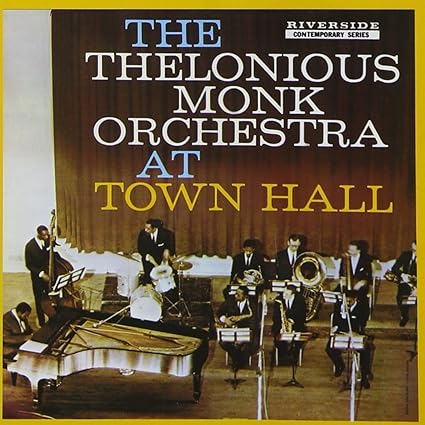
  • Thelonious Monk – Orchestra At Town Hall. The first of only two large-ensemble recordings Monk would make in his lifetime, this 1959 album is a stone-cold classic, every track is gold. It’s interesting to compare these very sympathetic arrangements of Monk’s tunes to some of the very earliest, from Cootie Williams’ big band in the early 1940s. Williams’ championing of Monk helped get him exposure, but the arrangements tend to hide Monk’s weirdness within a conventional framework rather than celebrating it.
  • Yusef Lateef. Best known for helping introduce “exotic” sounds into jazz with his Asian-influenced tunes and use of the oboe and flute, Lateef is also a gentle and surprisingly traditional tenor sax player. I have been listening to two compilations of his late 50s-early 60s recordings. If you don’t want to go through all of them, Eastern Sounds is probably the single best example of his approach, but I also liked The Centaur And The Phoenix, a more distinctive session with a larger ensemble.

Regional convergence versus regional aid

A few recent reports have noted that some of China’s poorer western provinces are still enjoying GDP growth of more than 10%, years after the country as a whole said goodbye to double-digit growth rates. In the first half of 2016, Tibet notched up 10.6% growth and Guizhou, in the southwest, 10.5%. Jan Zilinsky (briefly here, and at more length here) interprets this data optimistically, as a sign that the convergence process (aka catch-up growth) is still operating: incomes in poorer provinces are rising to close the gap with wealthier provinces.

The official narrative emphasizes how the poorer provinces are benefiting from investment flows taking advantage of their lower labor costs–Guizhou for instance is supposedly in the midst of a big-data boom, while Chongqing is emerging as a new manufacturing hub. It is definitely true that, since Foxconn opened a facility, Chongqing has risen in the export rankings. But overall there is not actually a massive shift of export-manufacturing activity to the Chinese inland.

A simpler explanation for the continued fast growth of poor western provinces is, in my view, that they just get lots of direct and indirect government subsidies, which are not subject to the cyclical vagaries of the rest of the economy. Tibet is in a class of its own: in 2014, it received 103 billion yuan in net fiscal transfers from the central government, a sum larger than its annual GDP of 92 billion yuan (for more detail, see this previous post on Tibet’s Potemkin economy). In other words, Tibet’s GDP growth is more or less whatever Beijing wants it to be. Guizhou, which is actually poorer than Tibet on a per-capita GDP basis, also gets most of its local budget from the center, though its dependence is not as extreme as Tibet’s. Most of the poorest provinces are in a similar situation:

transfers-vs-income

And here’s another chart, just because I can. Fiscal transfers are not the whole story in China, since a lot of government influence on the economy occurs not through the formal budget but through state-owned enterprises. In the chart below is the same data on central transfers as a share of provincial revenue, plotted against the share of state-owned enterprises in fixed-asset investment. Aside from the wealthiest coastal provinces, these two channels of government support seem to move together for most provinces. And the remote western provinces are notable for both receiving large fiscal transfers and for having very SOE-dominated economies.

Two-dimensions-state-support

There’s nothing wrong with regional aid of course: one of the benefits of having a national government is that it can spread resources around the country and help even out living standards. The political salience of regional redistribution seems to be particularly strong in China, part of its socialist heritage. Regional aid programs are certainly part of the process by which poor regions can converge with richer ones, but they are not generally thought to be all of it. So the large scale of state aid to China’s western provinces for me raises the question of how much of their income convergence is due to that support and how much to other drivers. It could even be the case that the state presence is so overwhelmingly large in some places that it crowds out the private-sector activity that would drive more market-based forms of convergence.

Some light summer reading

Since summer is winding down, a few notes on some recent fun reading:

  • John James – Votan. Extravagantly praised by Neil Gaiman, and in fact extremely good and really unlike anything else. Our narrator is a cynical Greek merchant out to swindle the German tribes living outside the Roman Empire’s sway. But his dry and humorous account is increasingly undercut by our sense that something more serious is going on, as he finds himself acting out ancient tales. A must read for anyone who has ever enjoyed the Norse myths.
  • N.K. Jemisin – The Fifth Season. Actually I read this at the beginning of the summer, but since it is has just won a Hugo Award, I figure I can join in the praise. I have been getting pretty burned out on recent genre fiction, very little of it seems worth the time, but this was excellent–truly surprising and exciting, and how often does SF&F, and particularly fantasy, actually surprise these days? The only off note for me was one section narrated in the second person, which felt forced and ultimately unnecessary.
  • China Mieville – The Last Days of New Paris. Mieville is definitely a phenomenon but an inconsistent one. This book (really a novella) starts off in a wonderfully disorienting way, plunging you into its madcap premise of surrealism come to life in WWII Paris. But about halfway through you figure out the plot is just a straight hero-kills-the-evil-monster. For me this was the same problem with his first book, Perdido Street Station–extravagantly complex worldbuilding as a backdrop to a highly pedestrian hero-kills-the-evil-monster plot.


Stalin and Mao are not making a comeback, but nationalism sure is

One interesting theme in recent press coverage of Russia is the revival of the popularity of Stalin, which seems to parallel the increasingly authoritarian governing strategy of Putin. Here is Alec Luhn in the New York Times:

In 2015, the Communist Party, which has 92 of 450 seats in Parliament and often toes the Kremlin line, raised a banner with pictures of Lenin and Stalin as the backdrop for the party plenary session. At Victory Day celebrations last May 9, his image adorned a fence next to a Moscow police station. Moscow’s best-known bookstore was recently promoting a book called “How Stalin Defeated Corruption.” School textbooks and state television programs, even if they briefly mention his human rights abuses, celebrate Stalin as a great leader. Mr. Putin …wants to play to the masses who are growing enamored of Stalin without alienating those Russians, such as the Moscow intelligentsia, who abhor him. The president has also carefully praised Stalin: “We can criticize the commanders and Stalin all we like, but can anyone say with certainty that a different approach would have enabled us to win?” he once said about World War II. …

This quiet rehabilitation began after Vladimir V. Putin came to power in 1999. Stalin’s legacy has become a tacit justification as the Putin government has strengthened its own grip on power. Under Stalin, “order” and national prestige trumped human rights or civil liberties. “By raising the figure of Stalin, the Putin regime is trying to raise the idea that collective interests are more important than individual lives, and that means the regime has less responsibility to society,” Lev Gudkov, who conducts the Levada Center’s Stalin polls, told me.

Yet in an interesting piece at the Lowy Institute’s site, Matthew Dal Santo says that while it is tempting to think the revival of Stalin is simply an official strategy to justify Putin’s authoritarian rule, that would be a mistake:

‘It is absolutely not the case’, says [Mikhail Remizov, director of the National Strategy Institute], ‘that there’s any official programme for rehabilitating the Stalin cult from above. It’s a popular movement, driven from below, propelled by a sense of anger towards what is perceived to be a vast trahison des élites.’ Motivated by a desire to cut the country’s oligarchs down to size, popular nostalgia for Stalin offers an implicit challenge to what has from the start been a central element of Putin’s legitimacy: his claim to have ‘tamed the oligarchs’. Despite his public image, says Remizov, Putin isn’t a Vozhd (‘Leader’, a popular name for Stalin) before whom Russia’s ruling elite trembles; he’s an (imperfect) moderator of their squabbles. Official treatment of Stalin reflects the result of this impasse, neither to suppress nor promote popular support for his legacy.

But if the Kremlin isn’t trying to revive Stalinism, what is going on?

Absent from Western reports of ‘re-Stalinization’ is the evidence for a much wider shift in Russians’ views on their country’s history. Particularly striking has been the rehabilitation of the pre-revolutionary regime. The same survey that showed an increase in favourable perceptions of Stalin also revealed that since 1999 the number of Russians believing the reign of Nicholas II (1894-1917), Russia’s last tsar, ‘brought more good than bad’ had risen from 18% to 30%. Also, the number believing the 1917 Revolution to have been a good thing fell from 27% in 1999 to 19% in 2016, while those believing it to have been for the worse rose from 38% to 48%. …With communism having withered, the contours of an older Russia have re-emerged.

What’s happening in Russia seems to be more like the creation of a new nationalism that encompasses both the Soviet era and the pre-revolutionary past (Dal Santo continues this theme with two more interesting posts on the revival of the Romanovs). In the logic of nationalism, the nation is good, and so everything that helped create the nation is also good: Russia would not be what it is today without the Romanovs, or without Stalin, so both should be embraced as part of the nation’s heritage. Including Stalin in such a nationalist vision is only appropriate, as Stalin himself made strong appeals to Russian nationalism during the Second World War. The following is from Charles Clover, whose book I previously recommended:

As the German forces swept closer to Moscow, Stalin began rapidly to restore the idols of Russian patriotism that the Bolsheviks over the last 20 years and more had assiduously purged from the national existence. The patriarch of the Orthodox Church was summoned and told, as he stood dumbfounded, that the Church would be expanded, with new positions and new churches. Stalin famously drank a toast to the ‘Russian people’ and had the national anthem changed from the ‘Internationale’ to the Soviet ‘Hymn’ because, it was thought, soldiers would respond to an anthem dedicated to their motherland more readily than to a worldwide movement. One (probably apocryphal) story has it that Stalin ordered the Madonna of Kazan icon flown around Moscow in an aeroplane, evoking the ancient Russian practice of parading icons around cities on the eve of war to bring good fortune and God’s blessing.

There seem to be some fairly strong parallels with China here. Xi Jinping’s alleged revival of the reputation and political methods of Mao Zedong has been a feature of much recent writing about Chinese politics. Suisheng Zhao’s recent article “Xi Jinping’s Maoist Revival” in the Journal of Democracy is a good representative of this line of argument:

Xi used Maoist imagery, rhetoric, and strategy to boost his own stature and revive public support for the Party. Mao Zedong, seemingly consigned to the bookshelf of history by Deng and his reforms, was dusted off and restored to a place of reverence as the unifier of the nation. In a collection of speeches that appeared following the CCP’s Eighteenth Party Congress in November 2012, Xi urged Party members to embrace “Mao Zedong Thought” lest China fall into chaos. On 26 December 2013, Xi honored the 120th anniversary of Mao’s birth by lauding him as “a great figure who changed the face of the nation and led the Chinese people to a new destiny.” Borrowing from Mao’s playbook, Xi launched a campaign to enforce CCP authority. Harkening directly back to the Maoist era, when officials were required to “get close to the masses” and to become intimately familiar with their needs and demands, Xi urged Party cadres to “focus on self-purification, self-improvement, self-innovation, self-awareness” or, as he put it in his folksy way, “take a good look in the mirror, comb your hair, take a bath, and try to fix yourself up.” The evocation of a Mao-style “rectification” movement—a tactic favored by the “Great Helmsman” when he wanted to purge rivals and enforce ideological discipline—was unmistakable. Xi, as observers noted, was “emboldening hard-liners who have hailed him as a worthy successor to Mao Zedong.”

I have previously been skeptical of the idea that Xi Jinping is trying to bring back Mao. Partly this is because it is pretty obvious that Xi is not in fact a Maoist: Mao was an ideologue who believed in permanent revolution and tried to destroy most forms of political and economic organization, while Xi is basically a nationalist organization man who wants to strengthen political order and discipline, not overturn them. And partly this is because Mao never really left: he continues to occupy his central place in the Communist Party’s history of itself. Xi is saying exactly the same things about Mao that Deng Xiaoping did–in fact often repeating Deng’s statements word-for-word. Far from consigning Mao to the “bookshelf of history,” Deng held that Mao had to be respected as the founding political figure of modern China.

Deng himself was a strong nationalist, and Xi Jinping is building on and expanding that nationalist approach. A Communist Party that sponsors “Confucius Institutes” around the world and glorifies the nation’s “feudal” past in expensive dramas on state television has gone a long way from what Mao would have supported. As in Russia, what’s going on seems to be more about building a nationalist narrative that includes both traditional culture and Communism. Liberals don’t really like the government saying nice things about Mao, and they use Maoist as a term of abuse. The official praise of Mao can indeed be hard to stomach, but I don’t think there is in any objective sense a revival of Maoism. It feels like China is not bringing back something old, but trying to create something new: a synthetic nationalism in which Mao and Confucius sit happily side by side as symbols of proud Chinese tradition.

Was actually existing socialism really an egalitarian system?

Branko Milanovic’s Global Inequality: A New Approach for the Age of Globalization has an aside (one of its many asides) on how socialism contributed to the narrowing of income inequality in the postwar decades:

A great leveling that was more radical than the one that occurred in the West took place in countries that, following Russia in 1917– 22, became socialist after World War II. …The socialist great leveling was produced in a simple manner. First, most enterprises were nationalized, which, as in state-owned enterprises in the West, resulted in a more compressed wage distribution…wages of low-skilled workers were relatively high and wages of high-skilled workers relatively low. Nationalization of the means of production had two other effects on income distribution. It abolished income from property, income that is always heavily skewed toward the rich, and it almost eliminated the entrepreneurial return, since private entrepreneurship was banned or pushed to the margins. …Finally, guaranteed jobs and thus the absence of unemployment (with a few exceptions), widespread pensions (often with the exception of agriculture), and subsidization of staple goods (thus ensuring that subsidies were progressive) completed this picture.

In other words, education and property ownership, the two most powerful determinants of income in market economies, were made irrelevant.

Without disputing any of these facts about income inequality, it still seems to me that this portrait omits some important aspects of socialist systems. Income inequality became less important under socialism because money income became less important. But political and/or bureaucratic position often replaced income as the driver of differential access to goods and services.

The roots of socialist inequality are well explained by Stephen Lovell in his The Soviet Union: A Very Short Introduction (recommended by Brad DeLong, and indeed a nice summary of key themes in Soviet history):

Already in the early days of the Bolshevik revolution we can see at least three different economic principles at work. The first was a powerful sense of egalitarianism born of historical injustice: the working people had been kept down by landowners and bourgeois who had enriched themselves at the expense of others’ toil, and it was now time to right the balance. …The second principle was coercive centralization along with hostility to market activity – and even to money itself. … The third principle was that of discriminatory distribution in favour of those groups in society most supportive of, or useful to, the Bolshevik regime. …These three principles sometimes contradicted each other, and in any case were hard to work practically.

This third principle turned out to be quite important. Socialism as practiced in the USSR, China, and elsewhere was a Leninist system, meaning that politics was organized around the idea of a disciplined “revolutionary vanguard” leading the country. This principle meant that some people were more important to the revolution than others, and were treated as such. Obviously this was somewhat in tension with the ideological egalitarianism of the Marxist part of Marxism-Leninism, but the Leninist component has proved to be much more enduring. In the Soviet system, political status replaced income as the determinant of inequality. One simple example was food; here is Lovell again:

From the start of 1931, a four-class provisioning system was instituted across the country. At the top of the hierarchy came workers in heavy industry in the capital cities and other major centres; at the bottom came white-collar workers. The top two classes made up only 40% of the people on rations, but received almost 80% of supplies. …

The material well-being of Soviet people would until the very collapse of the USSR depend on their workplace – namely, on the particular closed distribution system that they had at their disposal. In the hungry 1930s and 1940s, this would often be a matter of allotments or farms controlled by an enterprise that would provide its employees with a subsistence minimum. Later on, in the 1960s and 1970s, enterprise directors would establish more elaborate reciprocal relationships with shops, farms, and warehouses, thus slightly alleviating the conditions of the shortage economy for their workers.

Marty White’s excellent 2014 paper, “Soaring Income Gaps: China In Comparative Perspective,” finds a similar pattern in pre-reform China: inequality of income was indeed narrow under socialism, but income was probably not the most relevant indicator of actual well-being:

Centrally planned socialist systems do not systematically promote egalitarian distribution, but instead bureaucratic allocation, and in practice, socialist bureaucrats tend to produce societies that are quite unequal, although unequal in ways that are somewhat distinct from capitalism. …

Urban state employees were [before 1978] provided with subsidized housing and a package of benefits and subsidies that was worth more than their meager salaries, while rural commune members (then 80 percent of the population) received none of these benefits and were bound to the soil as virtual “socialist serfs,” unable to migrate and gain access to the official favoritism enjoyed by urbanites.

North Korea seems to have taken this Leninist style of bureaucratic inequality to its logical extreme with its songbun system of political classification; as in the 1930s famine in Russia, in the 1990s famine in North Korea there is evidence that the politically favored were allocated more food.

One important question about the increases in inequality in China and Russia after the transition from full-blown socialism is whether they should be understood not only as the re-emergence of income inequalities suppressed under socialism, but also as the translation of the inequalities of status under socialism into the currency of the new market economy. This in fact would be precisely what some of the leftist critics of market reforms in those countries feared would happen.