Manchuria rediscovers the resource curse

The unwinding of the boom in China’s resource-dependent provinces is leading to some introspection as to what went wrong. In a way, the explanation is not that complicated. The troubled provinces tend to be big producers of energy (mainly coal) and metals (mainly steel); prices for these goods are collapsing and demand is falling as China’s housing boom peters out. Therefore the slowdown is much, much worse in the northern and northeastern provinces that specialize in these industries.

The China Economic Times, one of the wonkier Chinese newspapers, has lately been running a nice series of in-depth reports on these economically troubled provinces. I particularly enjoyed this piece by reporter Zhang Yiming, which focuses less on the immediate troubles of the coal and steel sectors and more on the longer-term question of why the Northeast in particular is so vulnerable to these troubles. I like that the author seems to have rediscovered the concept of the “resource curse,” much debated in the economic literature, by just talking to a lot of people in the former Manchuria. The piece is short enough to translate and share:

The Northeast is a vast territory rich in resources, whether we are talking about grain, forests or various kinds of minerals, but these resources have not been effectively developed.

The Northeast produces much grain, but large quantities of its grain are shipped to the south where they are processed into finer products, such as Cantonese moon cakes, that are then sold back to the Northeast. Another example is the Northeast’s timber, much of which is shipped to the south and made into high-end furniture, which then returns to the Northeast to be sold. The Northeast also produces a lot of animal fur, and Northeastern people have a tradition of wearing mink coats. But most of the mink coats Northeasterners buy are made in the south, such as Guangdong, Zhejiang and other coastal areas.

There are many similar cases. Although the resources are located in the Northeast, they are not effectively converted [into finished goods], but are sold at a low price to the resource-poor south. After extensive processing by southern factories and transformation into high value-added products, they are bought back by Northeast people at a high price. In this way the Northeast is stuck at the low end of the industrial chain, while the most profitable and most efficient parts of the chain stay in the south. Local people say that “those shrewd southerners have taken all the money.” From the perspective of a southern businessperson who lacks resources, all of the Northeast’s resources are very valuable in the south, as they can yield all kinds of products and form a complete industrial chain.

The China Economic Times‘ research group in its local surveys found that there are many reasons for this situation in the Northeast. One issue is the lack of appropriate local conditions, while another issue is the lack of local spending power, and these issues are closely related. For example, processing mink pelts into mink coats requires sophisticated technology and skills, and there is a lack of local personnel with the right skills. Some local mineral resources and chemical raw materials, due to the lack of a local downstream industry, can only be sold to companies in the south.

Local people know that if they can process these resources it will bring profits and create much more value, but there are few people doing this kind of work and most people lack the drive to change the status quo. Locals generally agreed that that they can earn considerable amounts of money by selling resources, so there is no need to spend a lot of time and energy in an effort to change the status quo. This issue is clearly shown in the development of the local private sector.

State-owned enterprises make up a large share of the Northeast’s old industrial base. In recent years, the private sector has vigorously developed, and the share of state-owned enterprises has gradually declined. But the growth of the private sector is not as fast as locals imagine. We observed that most private-sector companies are closely related to the exploitation of natural resources. Few are in the higher-value-added parts of the industrial chain, even in high-tech industries.

Given that currently the Northeast lacks the capacity for doing high-end processing, studying and introducing skills from the south is a viable option. But the China Economic Times research group found that southerners who come to the Northeast often do not fit in. The majority who do stay work closely with the leading local state-owned enterprises, and those tend to be in the upstream part of their sectors.

It is an obvious fact is that the reasons why businesspeople from the south do not stay in the Northeast is closely related to the business environment, as it is difficult for outsiders to get accustomed to the bureaucratic environment in a short time. Also, Northeast people are relatively lacking in market knowledge, especially in comparison with people from the south. Because the Northeast has so many resources, people are easily contented with what they have, and are unwilling  to spend lots of time on improving and extending the industrial value chain.

To change this status quo of low-efficiency resource development requires a lot of time and effort to change people’s thinking, and these kind of changes obviously cannot happen overnight.

A failure to invest in manufacturing and other industries during resource booms is indeed one of the mechanisms by which the resource curse is thought to operate, and there is certainly anecdotal evidence that this is part of what has been going in the China’s Northeast. The consensus in the economics literature seems to be that resource curse effects exist, but are highly dependent on institutions: Norway and the United States have lots of natural resources but have turned out pretty well. On the other hand, there is some evidence that resource-curse effects operate at the regional level even within economies that, as a whole, have escaped its worst effects (for instance, here is a paper on the Appalachian region of the US).

China usually tends to feature in this literature as one of the resource-poor Asian economies that was forced to become competitive in manufacturing because it could not rely on natural resources. This view obviously needs to be nuanced, and a regional perspective is helpful. China is in fact a huge producer of energy and other natural resources; it just happens to consume virtually all of its production domestically, and import a lot more besides. The main reason that a major resource endowment did not end up dominating the domestic economy is probably that China is just too darn big, and those resources are so unevenly spread across the country. China’s southern coast is indeed largely a resource-poor region forced to rely on its own manufacturing skills, but some other parts of the country do look like they are suffering from a variety of the resource curse.

Some excellent points about state-owned enterprises

A new paper from the Paulson Institute makes some points that are good to keep in mind when thinking about the role and function of state-owned enterprises in China. Basically, don’t fall into the trap of thinking that state-sector and private-sector companies are two completely different kinds of things:

China’s institutional environment blurs the boundary between SOEs and privately owned firms, which permits the state to exercise significant influence over firms irrespective of its equity ownership stakes and where firms of all ownership types compete for state-generated rents. …

Private ownership in China does not necessarily mean autonomy from the state. Indeed, many private firms in China bear a striking resemblance to SOEs along the dimensions typically thought to distinguish SOEs from POEs, including ready access to the instruments of state power and state largesse, proximity to the regulatory process, and little autonomy from discretionary state intervention in business judgment.

Generally the piece does a nice job of providing some empirical evidence for these propositions, which fall into the category of things that “everyone knows” but can be hard to pin down. Much of this will strike people with long experience in China as pretty common sense, but all too often common sense propositions are not clearly articulated. I also agree with another point the authors make: that the similarity in treatment of state and private companies is because the government is fundamentally interested in growth, rather than fundamentally interested in promoting SOEs:

The growth imperative forces the state to look beyond SOEs to bolster its claim to legitimacy, thus enabling private firms to secure access to the state’s discretionary authority in dispensing financial and regulatory favors by demonstrating growth potential, particularly to local government officials. As one recent private sector report notes, “local leaders these days are assessed based on economic growth, and are increasingly agnostic about what type of firm provides that growth.”

The discussion reminds me of a nice piece in The Economist from a few years ago, which pointed out that the state-private dichotomy is really more of a spectrum of influence and ownership, and gave examples of different companies at different positions along this spectrum. Here’s a table from that article summarizing some of the many varieties of Chinese state capitalism:

China’s size matters. But do we understand just how it matters?

After many years of working on China, I can still be surprised by just how big it is. It’s simple to say “China is huge,” but harder to really think through what it means. Nonetheless, a lot of people seem to think that size does not matter in any fundamental sense–the example I have in mind is the gent who years ago told me that “China is just Japan 20 years later and 10 times bigger,” which in fact is a surprisingly powerful rule of thumb. But I have to say that I suspect that some things do work differently in China because of its size, and that this is not well understood because we have no comparable examples to work with. We might call this the view, sometimes attributed to Stalin, that “quantity has a quality all its own.”

This question came to mind again after I read some interesting comments in a recent paper by the excellent Carsten Holz, the world’s foremost expert on Chinese statistics as well as a generally very thoughtful guy. The paper is not mostly about this question of size but he discusses it in passing:

China’s size is a new phenomenon in the study of developing economies. South Korea tried to develop a broad industrial base but soon began to specialize. Taiwan quickly abandoned plans for broad-based economic growth and focused on developing areas of comparative advantage, in many instances serving niche markets around the world. However, for China there are as yet no signs of significant specialization.

Across virtually all industries in China, the optimal firm size—the firm size with lowest per-unit production costs—is below market demand. I.e., there is sufficient market demand in every sector of the economy for several firms to co-exist and compete. The prospect of historically unprecedented domestic market size may yet lead to innovations in optimal firm size at lower per-unit production costs than hitherto experienced around the world.

Viewed from an international perspective, focusing on comparative advantage makes little sense for China: world demand may simply not be big enough to support any substantial degree of specialization in China. For example, for some electronics products China may already be the dominant world supplier, without, however, the electronics manufacturing industry dominating the Chinese manufacturing sector. In this case, world demand has driven specialization in production by China, except that in the Chinese economy the resulting degree of specialization is barely noticeable. As a result, one can expect to see ongoing investment across virtually every sector of the Chinese economy.

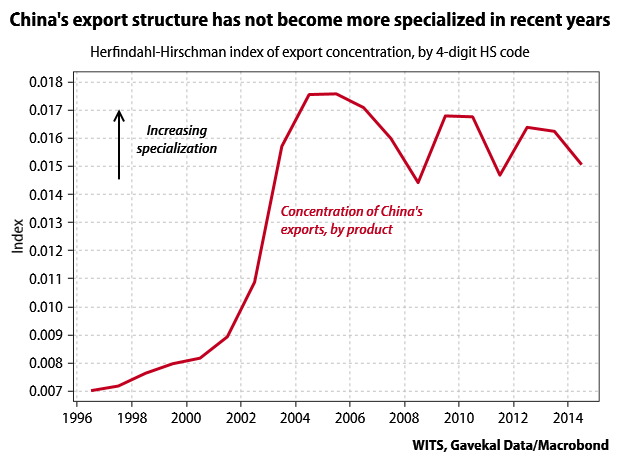
I found this a very striking idea, as one of the (many) things about China’s economy that has puzzled me in recent years is the apparent lack of specialization in its exports. There was fairly dramatic structural change in China’s exports up until about 2007, but since then the export structure has been largely stable. Exports have been growing, and China’s global market share has been rising until very recently. So China has generally been steadily becoming a more successful exporter. But as this has happened it has not shown much sign of becoming more specialized in particular types of products, which is usually one of the things that happens in countries that are successful exporters.

I had speculated that global demand was a limiting factor here: in the aftermath of the financial crisis, global demand for the kinds of things that China wants to specialize in–capital goods and equipment–has probably not expanded rapidly enough for China to have exported a lot more of those goods. But perhaps, as Carsten suggests, the issue is more fundamental, and one we have not really encountered before: China’s export industries might already large enough, relative to total world demand, that even a very successful export performance will not show up as much specialization. This is one to ponder further.

export share

Update. Here is a more precise measure of export specialization — a simple Herfindahl-Hirschman index of concentration, calculated at the 4-digit HS level (it’s the sum of the squares of the share of each product in the total). This actually shows export concentration has been bouncing around in a range since around 2003-04, so it looks less like a cyclical post-crisis phenomenon.

HHI-exports-product

The African drone manifesto

I wasn’t quite sure what to expect when I started reading J.M. Ledgard’s little e-book Terra Firma Triptych, but I loved his novel Submergence, and that was enough for me to pick up the new book once I became aware of it (thanks to Slate). It is indeed a triptych, two parts lyrical travel writing about Africa, and one part development economics and drone manifesto–a combination I am fairly sure so other writer has ever attempted.

The writing is characteristically beautiful and heartfelt, and the first two sections do actually lay the groundwork for his discussion of why drones could revolutionize Africa: because the land transport is so terrible. The combination is surprising and the argument convincing; here’s a few samples:

I think about this every day, how things shudder on land in Africa, and how they might slip faster in many directions if only they were pushed into the sky. …

There is no room for techno-utopianism in our bare-fisted future. However, it is important to understand that Africa is coming online just as robotics is coming online. As fast as Africa develops, robotics will develop still faster. Robotics may have negative implications for workers in industrial countries, since tasks such as mopping floors and pushing carts can be performed more cheaply by robots. But in nonindustrial countries, robotics can buy you efficiency that you could not otherwise afford. When it comes to flying robotics, radical breakthroughs are possible. …

The last-mile drone delivery of the kind envisaged by Amazon Prime Air and other developers—a tub of sorbet on a suburban lawn—is a rich-world indulgence that does not make sense in off-grid Africa. What is needed here are cargo drones capable of flying loads over mountain ranges, across the largest lakes, along the seashore, and up isolated estuaries and mangroves, saving lives and creating economic opportunities. … Commercial cargo drone routes will begin to appear in Africa around the year 2020. They will boost economic productivity by flying high-value goods over and over again. The cargo drones will deliver to oil and gas installations, mines, farms, conservancies, churches, hospitals, and government outposts.

Ledgard, a longtime foreign correspondent, thinks African adoption of drone technology will be much like its adoption of mobile-phone technology: extremely rapid, and to some extent compensating for a failure to adopt earlier technologies:

Over the last decade reporting out of Africa, I came to see that the most important story was not a news story at all. It was the mass adoption of mobile phones—a technology capable of reordering time and space in even the poorest communities. It was not inevitable that Africa would have access to cellular communications. Development experts argued that mobile phones would always be too expensive for the poor, and besides, how could an African village that was incapable of looking after a grain silo be expected to look after a cell tower? But the price of mobile phones came tumbling down, and financial deals involving the towers showed that there was cash to build out a system. Even the mobile phone operators could not see the possibilities. They underestimated their own market. For instance, the 2003 business plan for the Kenyan telecom Safaricom was to get to half a million mobile phone subscribers by 2013. These would be traders, priests, taxi drivers, prostitutes—people willing to pay a premium to stay in touch. But Safaricom now has 21 million users. To emphasize: the uptake of the advanced technology was forty-two times greater than expected.

Geoff Ryman’s science fiction for development economists

Lots of economists like science fiction, but science fiction that directly engages with the issues that economists think about is actually pretty rare (this list of science fiction novels for economists is, to my eye, more just a list of good science fiction). Paul Krugman once made a case for Charles Stross’ Merchant Princes series as being essentially about development economics, since the books dramatize the interaction between societies at very different technological levels. I read the first novel in the series because of his recommendation, but found it rather more lightweight than Krugman’s post suggested, although still enjoyable.

For a science fiction novel that really is about development economics, I recommend Geoff Ryman’s Air: Or, Have Not Have, a 2004 novel that I read over the holidays and very much enjoyed. Ryman is British and seems to be not that well known in the US, though Air was nominated for and received a number of awards when it came out. The premise is simply stated in the very first sentence:

Mae lived in the last village in the world to go online.

The book is set in a fictional but very plausible Central Asian country, where an imagined technology is being introduced by a combination of a clueless government, a bumbling United Nations and a scheming local businessman. Already that makes it more realistic than much science fiction, and Ryman is very good at village life and the interlocking of personal and business relationships in small-scale societies. What makes this book so good is how it explores the social and personal consequences of new technology. Without giving too much away, here’s a sample from early in the book that illustrates how he does this:

The men in the club chose what movie they wanted. Since the satellites, they could do that. Satellites had ruined visits to the town. Before, it used to be that the men were made to sit through something the children or families might also like to watch, so you got everyone together for the watching of the television. The clubs had to be more polite. Now, women hardly saw TV at all and the clubs were full of drinking. The men chose another kung fu movie.

Like any good novel, it’s more moving and more complicated than a summary of the premise can convey, but I think much of it will ring true to anyone who has spent time in developing countries. I’m retroactive adding Air to my list of the best books I read in 2015. Ryman has apparently written some other books based on Cambodia, which I have not read but now look forward to checking out.

A portrait of a Beijing park

I really enjoyed the article in The Economist‘s Christmas issue on Beijing’s Ritan Park–one of the few pieces of journalism I’ve read that really captures the flavor of daily life in the capital city. I lived near Ritan Park for a few years and frequented it regularly, and though I live near a different park these days, going to parks continues to be an important part of my routine. Here is a sample:

In every country tribes converge on parks at particular times of day. In the West, early-morning dog-walkers are succeeded by lonely buggy-pushing mothers, then lunchtime joggers. After school come running, shouting children, then lounging and smoking teenagers. A Chinese park’s rhythms are different. Dogs are banned. Most runners are gone by 10am (the activity is new enough to China that some jog in work boots and jeans). Teenagers, burdened with homework, are rarely seen during the week.

But Ritan Park has its own tribes, nonetheless. One is the bird-lovers. Every day Mu Xionglu, a former factory worker, comes to “walk the birds and walk myself”, meeting friends in a quiet corner, each with two thrushes shrouded by blue cloths. They unveil small wooden cages and hang them on trees, “to let the birds sing together and feel as if they’re in nature again”. An hour is enough for the birds to let it all out, he says.

You should read the whole thing, as it resists easy summary.

Tibet’s Potemkin economy

For a different angle on China’s regional economic differences, here’s Tiff Roberts with a good piece on a very under-covered story: the structure of the Tibetan economy. The gist:

For the past two decades, Tibet’s economy has outperformed China as a whole. Its growth has averaged 12.4 percent annually over that period, compared with a national average of about 10 percent and Beijing’s 2015 target of 7 percent. But these statistics are misleading: The Tibetan miracle is the result of massive subsidies that have done little to foster productive enterprises in the territory of 3.15 million people.

Since China annexed Tibet in 1951 and its religious and political leader, the Dalai Lama, fled into exile in India, the central government has sent more than 648 billion yuan ($100 billion) to the region. …Andrew Fischer, a professor at the International Institute of Social Studies in The Hague and an expert on Tibet, says subsidies from Beijing dwarf the local economy, amounting to about 112 percent of economic output, which was 80.8 billion yuan in 2013. Fischer says it’s “more than one would see in a highly aid-dependent African country.”…

One side effect of Beijing’s subsidize-and-invest policy is that Tibet is afflicted by a version of the profligacy that helped lead to China’s own slowdown. The region is plagued by inefficient and money-losing state-owned enterprises. As of 2013, they accounted for about 22 percent of all companies in Tibet, compared with 2 percent in all of China, according to a recent research paper written by Jin Wei, an expert on China’s ethnic minority policy at the Central Party School in Beijing. The state-run companies in construction, mining, and the tourism industry also exacerbate ethnic tensions. They are not big employers of Tibetans, the majority of whom make their living as herders and farmers. …

“I don’t dare predict what day Tibet will be able to develop independently,” says Ma Jinglin, vice director of the Development and Reform Commission of Tibet, a government body. “It takes time to build industries that will create blood for ourselves, rather than getting a blood transfusion.”

The bizarre structure of the Tibetan economy is obvious from even a cursory glance at the data. My index of the economic influence of state-owned enterprises ranks Tibet as the fourth-most SOE-dominated province, after Beijing, Qinghai and Gansu. Since SOEs are often the preferred channel for the government to accomplish economic goals, this is a pretty good index for most purposes. But where Tibet is unique is the level of direct government spending in the economy, i.e. not mediated through SOEs. Government spending accounts for 40% of Tibet’s GDP, while 10-15% is the more usual level for other provinces. In a cyclical sense this is beneficial, as Tibet is hardly feeling the current slowdown at all: it reported 9.8% real GDP growth for the first three quarters of 2015. But the reason they’re not feeling the slowdown is that they didn’t have a real economy to begin with. It’s a bunch of civil servants in Lhasa, some investment projects done with central government money, and, sadly, not much else.

Govt-share-provincial

More on the Manchurian Recession

Jane Perlez has a nice piece in the New York Times reporting on the woes of a remote coal town in Heilongjiang province. After a long time out of the media spotlight, China’s northeast is certainly getting its share of coverage lately (see previous examples here and here) thanks to its position as the epicenter of the country’s industrial slowdown.

The mine’s owner, the Longmay Group, the biggest coal company in northeastern China, announced in September that it planned to lay off 100,000 workers. The elimination of about 40 percent of the work force at 42 mines in four cities is the biggest reduction in jobs that anyone could recall in this steadily declining rust belt near the Russian border.

China has managed mass layoffs at creaky, state-owned businesses like Longmay before, averting the threat of strikes and unrest by suppressing protests and offering payouts and job training.

But that was when the economy was booming and could readily absorb displaced workers. The test the government now faces in this depressed coal town and in other hard-hit areas across the country is whether it can head off labor discontent in a slowing economy.

Longmay has so far delayed the bulk of the layoffs, cutting only several hundred older workers who held nonessential jobs. Last month, the government of Heilongjiang Province, which owns Longmay, announced a $600 million bailout that would help the company repay its bonds. But analysts see the infusion as short-term relief that will not prevent the inevitable reckoning.

The coal industry is hurting nationwide, as coal prices have fallen nearly 60 percent since 2011, said Deng Shun, an analyst at ICIS C1 Energy, a consultancy based in Shanghai. And Longmay, he said, produces far less coal with extra workers than newer, more efficient companies.

“They are quite worried about social unrest, so they delay,” he said. “These layoffs should have happened two years ago.”

The piece focuses on the potential labor market impacts of layoffs at coal mines and other troubled industries. While the coal industry has been shedding jobs over the past couple of years, mines have also tried to minimize layoffs by cutting wages and working hours. But given the catastrophic financial condition of many coal mines, it’s unclear how long these measures can be sustained. A lot of this depends on how much help local governments give, and one way to interpret the unusual public announcements of large layoffs is as a strategy for the mines to pressure the authorities for more financial support (which Longmay received, as noted above). Still, the general view that the future will hold more layoffs rather than fewer is hard to argue with.

coal-jobs

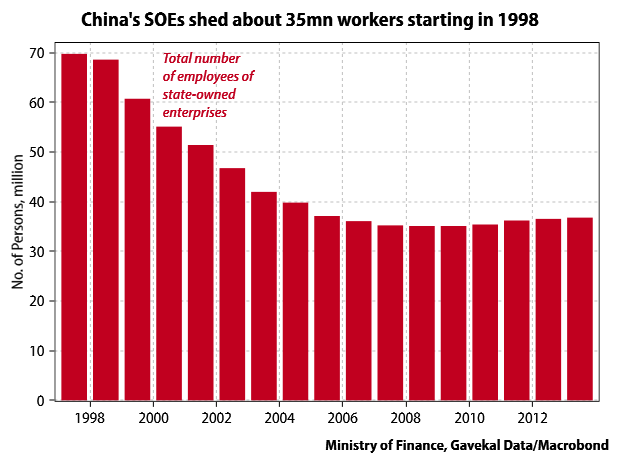
Some of the concerns about the impact of these layoffs come from what the Harvard sociologist Martin Whyte called “the myth of the social volcano” (which he attacked in a book of the same name): the idea that Chinese society is rumbling pool of discontent that will erupt as soon as they run out of the opiate of economic growth. While I do think we are going to see things get worse in China’s labor market, and that things could get very tough in places like Heilongjiang, I really don’t think the result is likely to be mass protests, endemic violence or whatever it is people mean by “social unrest.” For one thing, the informal support networks in Chinese society are much stronger in my experience than in, for instance, America (which is having its own epidemic of social unrest at the moment). For another, the country went through a much more serious round of labor market stress starting in the late 1990s, when tens of millions of people were laid off from state-owned enterprises in every sector, without experiencing mass unrest.

SOE-layoffs

The best music I heard in 2015

This is a list of my favorites among all the recordings I heard for the first time this year, not of things commercially released in 2015 (same rules as my books list). I commend you to Ted Gioia’s best of 2015 list for something more current; the list below is purely a product of my own idiosyncratic listening habits. Unsurprisingly, it’s heavy on the jazz, but I have a few other things in there to mix it up. Alphabetical by artist:

  • Henry “Red” AllenWorld On A String. One of the definitive statements of swing era jazz, never mind that it was recorded in 1957 rather than 1937. Incredibly creative solos from Allen and collaborators, including Coleman Hawkins and Buster Bailey.
  • Gary Clark, Jr.Live. A charming young man with a straight-up monstrous guitar sound; while his studio records feel a bit overproduced, this bluesy live setting is ideal. The ghost of Hendrix is definitely hovering nearby, but he would be smiling I think.
  • The GladiatorsStudio One Singles. A long string of roots reggae classics; this collection is more consistent than either their album Trenchtown Mix Up, or the other widely-available collection Bongo Red.
  • Ice Cube – Death Certificate. When the NWA movie came out this year I went back to the records, and the truth is that NWA’s songs don’t hold up that well these days. Ice Cube’s solo stuff really does, however. And somehow I missed this one the first time around: funky, slamming production and hard-hitting rhymes.
  • Andrew JaumeMerapi. A French jazz saxophonist and guitarist improvise with a Javanese gamelan orchestra in a rare but successful mixing of the traditions. A completely ravishing sound; I had been waiting for this album, without knowing it, for years.
  • Thelonious MonkBig Band And Quartet In Concert. Despite having been a Monk fan for many years, I am still discovering great recordings: the long, complex big band arrangements are unique and wonderful, and the quartet statements are definitive.
  • Tiny Parham1928-1930. An unjustly neglected figure of 1920s jazz, Parham’s complex arrangements draw on the same well of exotic “jungle” effects as early Ellington.
  • Ernest Ranglin – Jazz Jamaica From The Workshop. A 1962 session featuring several Jamaican giants playing not instrumental reggae but  proper jazz. The guitar virtuoso Ernest Ranglin is the star; he would go on to fruitfully combine jazz with reggae on albums like Memories of Barber Mack, which I also enjoyed a lot.
  • Moacir Santos – Coisas. Wonderful jazzy miniatures by a largish ensemble led by the Brazilian composer, from 1965. Far superior to his 1970s outings on Blue Note.
  • Sly StoneI’m Just Like You: Sly’s Stone Flower 1969-70. The mellow, minimalist funk of Fresh-era Sly Stone is one of the great sounds in pop music. This collection of singles is like discovering a whole new Sly album from that crucial period; essential.
  • TaumbuEncantado. My most random musical discovery of the year (heard it on the radio in Mexico), a really lovely and creative album of Latin jazz.
  • Lucky ThompsonTricotism. Thompson is one of my favorite tenor saxophonists, with a flat-out gorgeous sound. This classic session features him with minimal accompaniment, the better to showcase his tone.
  • Hozan Yamamoto – Ginkai (Silver World). A Japanese shakuhachi master joins a jazz group for an atmospheric mixing of the traditions. Obscure but worth searching out.

For reference, here’s a link to my 2014 music list.

What will China do about its zombie companies?

One of the more interesting developments in official Chinese discussions about the economy has been the appearance of the term “zombie companies”; Premier Li Keqiang himself has repeatedly used the term. It’s a loose shorthand for a problem that everyone knows about but is difficult to precisely define: money-losing companies that seem to stay alive far longer than economic fundamentals warrant. This problem is particularly acute in the commodity sectors: a global supply glut has driven down prices of iron ore and coal to multi-year lows, levels where China’s relatively low-quality and high-cost mines have difficulty being competitive. And yet they continue operating despite losing money, because it is easier to keep producing than to completely shut down. An excellent story this week in the China Economic Times on the woes of the coal heartland of Shanxi quoted one executive saying, “If we produce a ton of coal, we lose a hundred yuan. If we don’t produce, we lose even more.”

The incentive problem is very clear. If many companies shut down, output would fall and prices would rise, and the remaining companies would be more profitable. However every company wants to be one of the companies that is left standing rather than one of the companies that shuts down, and so they do everything they can to continue operating. They can also usually count on help from banks and local governments, who want to avoid the financial and social impact of a large employer closing. This is why there are increasing calls for the central government to break the logjam and organize the closure of excess capacity that market mechanisms should be producing. Indeed, I translated on this blog a very interesting proposal from the State Council’s Development Research Center on how to do exactly that.

The fact that top leaders are now talking openly about zombie companies could indicate some progress on this issue. So here’s another relevant translation: a recent interview with Feng Fei, a senior industrial official. Feng is also one of China’s top scholars of industrial policy, and in fact spent many years at the DRC. In October he was elevated to one of the vice-minister jobs at the Ministry of Industry and Information Technology, which has bureaucratic responsibility for most of the sectors with lots of zombie companies. His interview with Caijing magazine is short but to the point. He diagnoses the problem and its consequences very clearly, but hedges a bit when asked what the government is going to do. However he seems to indicate that the current preference is to deal with zombie companies by encouraging stronger companies to take them over–which I think is not as good a solution as the one the DRC has already proposed.

Reporter: Why is the exit of “zombie companies” being discussed now? What is the background to this question?

Feng Fei: There is not yet a consensus view about “zombie companies.” My understanding is that “zombie companies” refer to companies that have been losing money for a long time, and which have no hope of turning around or smoothly exiting the market. Currently the problem of “zombie companies” is very prominent, and this is related to three major issues in the economy.

First, China’s economic growth has entered a “new normal.” Downward pressure on the economy has increased, and the external environment for business is getting tougher. There are some companies whose technology, management and so forth are relatively poor, and who are finding it difficult to adapt to the new situation and to market changes, and as a result have fallen into serious trouble.

Second, there is serious excess capacity in some industries, resulting in a continuous decline in product prices and a fall in corporate profits. There are some sectors in which all companies are losing money, and operations are very difficult. For instance, in the third quarter of this year, the steel industry’s profit margin on sales was only 0.05%, and the sector’s total profits declined 97.5%; nearly half of the companies in the sector are loss-making.

Third, the market system is not robust: there are still some institutional obstacles that result in “zombie companies” finding it difficult to exit according to market rules.

Reporter: In more specific terms, what harm do “zombie companies” bring to China’s economy?

Feng Fei: The existence of a large number of “zombie companies” hinders China’s economic transformation and the upgrading of its industrial structure, and also increases macroeconomic risks.

First, these companies are holding on to a lot of resources, hindering the effective resolution of excess capacity. “Zombie companies” have low profitability, but take up a lot of land, capital, energy, labor and other resources, and prevent these resources from flowing to more profitable sectors, resulting in a serious waste of resources. You could even say that if “zombie companies” do not exit the market, the problem of excess capacity cannot be fundamentally solved, and it will be very difficult to achieve structural adjustment and industrial upgrading. Only if enough companies exit will there be enough companies entering.

Second, it undermines the market principle of survival of the fittest. Because of social stability considerations and other issues, there are efforts to preserve “zombie companies” and give them blood transfusions. This results in unfair competition, and could even cause a Gresham’s Law phenomenon [in which the bad drives out the good].

Third, it may lead to financial risks. “Zombie companies” have a lot of debt, which if not dealt with in a timely manner will result in an increase in banks’ non-performing loans. When you add in the complex chain of inter-enterprise debt, the problem becomes serious, and could lead to systemic risk. Therefore the State Council is paying great attention to this issue, and has required [us] to handle the “zombie companies” issue.

Reporter: If it is so urgent for “zombie companies” to exit the market, why has this been a difficult issue for so long? Why is it hard to establish a mechanism for market exit?

Feng Fei: “Zombie companies” can be dealt with in two ways, through market-oriented mergers and restructuring, or bankruptcy according to law. The handling of “zombie companies” will be more through restructuring, and less through bankruptcy, and will also ensure social stability. In terms of these methods, China has considered the design of the system, but has faced some difficulties and problems in terms of actual operation, and a complete system for market exit has not yet been formed.

First, in the restructuring and bankruptcy processes, there are difficulties with the placement of workers, the debt burden, and historical issues, which increase the cost of restructurings and bankruptcies. This is an obstacle to “zombie companies” exiting the market.

Second, some local governments interfere in the normal process of bankruptcy and market exit because of considerations related to preserving jobs, maintaining social stability, or the worries of banks and other creditors about bad debts.

Third, China’s “Bankruptcy Law” needs to be further clarified and refined. Although it has already been revised several times to adapt to the market economy, there are still some regulations that are more like general principles.

Fourth, in the context of increasing downward pressure on the economy, many sectors do not have a clear outlook, and firms face financing difficulties, which means they have little interest in pursuing mergers and corporate restructuring.

Finally, the current economic situation increases the risk and the consequences of corporate bankruptcies, which means that many parts of society are very wary toward bankruptcies and restructuring.

Reporter: According to the State Council, the Ministry of Industry and Information Technology is in charge of researching and promulgating policies on “zombie companies.” What is your plan for this work?

Feng Fei: MIIT will step up its research and survey work, find out the true situation, and figure out the major difficulties and problems in “zombie companies” exiting the market. In conjunction with relevant departments, we will research policy measures to handle “zombie companies,” improve the market, legal and policy environment, and improve the exit mechanisms for “zombie companies.”

The exit of “zombie companies” requires a proper relationship between the government and the market. The role of government is mainly to provide the necessary support for displaced workers, not to rescue companies, and to make the exit as smooth and quick as possible. At the same time, we will adhere to the policy of “more mergers, fewer bankrutpcies,” so that more exits of “zombie companies” happen through mergers and restructuring. This will result in appropriate placement of workers, reduce the impact on society, reduce the economic risk, and raise the quality and efficiency of economic development.