
It is rare that the preoccupations of economics bloggers and the priorities of Chinese bureaucrats overlap. But yet it has come to pass, in the form of a July notice from China’s State Council declaring what sounds like an all-out bureaucratic assault on occupational licensing. “All localities and departments should further strengthen their efforts and continue to focus on cancelling occupational licensing and certification requirements,” the document reads. “Professional qualifications that lack a legal basis, whether established by government departments, national industrial associations or academic societies, must all be abolished.” The notice also terminates 62 types of occupational licenses recognized by the central government, for professions like “web advertising broker” (nope, that doesn’t sound like something you really need a license for to me either).
While this admittedly obscure announcement has drawn little public commentary that I’m aware of, it’s interesting that it comes at a time when excessive occupational licensing has become a moderately prominent policy issue in the US. Indeed, in July the White House published a report on occupational licensing that notes that “there is evidence that licensing requirements raise the price of goods and services, restrict employment opportunities, and make it more difficult for workers to take their skills across state lines.” The proliferation of licensing requirements in the US has drawn criticism from commentators and bloggers on both the left and the right, making it an unusually non-partisan issue.
The State Council’s move seems to be less a response to the grassroots and more of a top-down initiative, specifically Premier Li Keqiang’s recent campaign to slash various types of administrative red tape. According to a background paper by the labor ministry, central government agencies had 618 different types of occupational licenses by end-2013, and local governments another 1,875. The recent announcement is actually the third of its kind; in 2012 the State Council canceled 265 types of licenses, and then eliminated another 149 in 2013. With the latest 62 cuts, the central government has reduced by a third the number of occupational licenses under its control. There was no word on what local governments have done.
The trimming back of occupational licensing also seems related to recent government measures to reduce the employment costs created by mandatory social insurance programs (which I wrote about previously). Both are measures that could help increase employment by lowering the barriers and costs that employers face when hiring. It is probably too much to say that these moves portend a radical deregulation of the Chinese labor market, but I for one did expect to be writing two posts about supply-side labor market reforms in China in the space of two months.
Although I doubt that many people in the US are paying attention to the nitty-gritty of Chinese labor market regulation, it is fun to speculate about the potential demonstration effect here. I generally don’t have much truck with most attempts to use the example of China to argue for changes in US public policy–for instance in arguments that US is losing global leadership in renewable energy because China has much bigger subsidies. I don’t think that particular institution of China is something the US should be emulating; it probably led to a lot of renewable energy equipment (particularly wind turbines) being purchased before it could be effectively used by the grid, and it won’t be long before it is rendered obsolete by even newer technologies. But my personal experience of both countries leads me to believe that the problems of excessive occupational licensing are likely to be bigger in the US than in China–mainly because the US actually enforces these kind of rules, whereas in China there is usually a way around them. A nationwide effort by the US to identify and eliminate pointless occupational licensing requirements, which is just what China has been doing for a couple of years now, does not sound at all like a bad idea.
 From these figures, it is easy to get the impression that China’s central government is just rolling in money and not spending any of it–so no wonder local governments have to borrow so much just to make ends meet! Yet this impression is totally false. What is the central government doing with all this revenue? Simple: giving it back to local governments. Of the 6.45 trillion RMB in revenue that the central government collected in 2014, it sent 5.16 trillion back to local governments as transfers (it also spent 2.25 trillion itself, so it was running a deficit). These enormous transfers account for about 60% of total local government revenue, and are the main method by which money is redistributed from richer provinces to poorer ones. If these transfers are treated as what they really are–the main source of local government revenue–then the apparent mismatch disappears:
 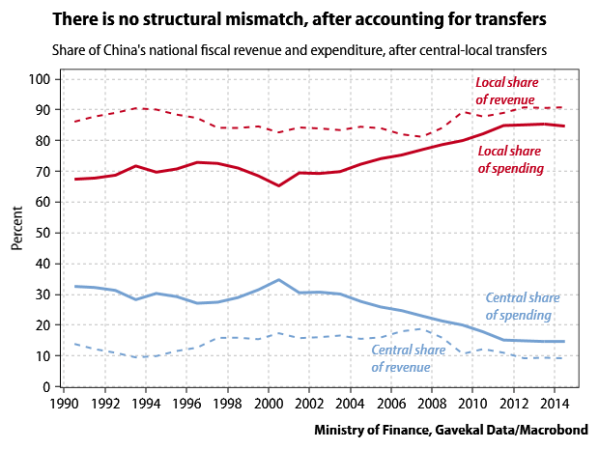 So while it is fashionable these days to blame excessive centralization of revenues for the mess in Chinese local government finances, this clearly is not a sufficient explanation. Yet it is equally clearly the case that there are real problems in local government finances, and that many localities have to resort to extra-budgetary or extra-legal means to raise money, for infrastructure projects as well as other spending. So how to understand this? As Linda Chelan Li and Zhenjie Yang put the question in a recent
 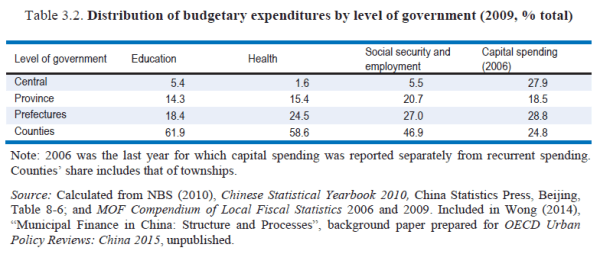 So the lowest-level governments do in fact have many fiscal obligations and often not enough resources to meet them. The better recent research on China recognizes this more complex reality. Li and Yang’s article demonstrates it through a case-study approach that documents how higher-level local governments undercut those below them, while the OECD’s


 The Tangled Woof