Are Xi and Trump really so different?

The contrast last week between Xi Jinping giving a pro-globalization speech at Davos and Donald Trump giving his “America First” inauguration speech has captured the imagination of the chattering classes. It has led to the unusual spectacle of the arch-nationalist Steve Bannon and the arch-globalist Martin Wolf actually agreeing on something. Here’s what Bannon told the Washington Post:

“I think it’d be good if people compare Xi’s speech at Davos and President Trump’s speech in his inaugural,” Bannon said. “You’ll see two different world views.”

And here’s Wolf’s latest column:

Xi Jinping, president of China, made a speech last week on globalisation at the World Economic Forum that one would have expected to come from a US president. At his inauguration, Donald Trump made remarks on trade that one would never have expected to come from a US president. The contrast is astounding.

I think there is less to this contrast than meets the eye. A lot of the intellectual class is predisposed to see an epic battle of ideas between globalization and nationalism, and so that is what they saw in the headlines from the speeches. But it has been clear for years that Xi Jinping is one of the premier nationalists of our day: his “China Dream” rhetoric is a not very distant cousin to Trump’s “Make America Great Again.”

In reality, Xi’s speech at Davos had plenty of nationalist self-interest; it was just packaged in a different wrapper. Xi praised globalization not because it is good in the abstract but because globalization has made China rich and powerful.

In the Chinese view, globalization has worked for them not because they blindly embraced Western economic theories, but because they managed the process of globalization appropriately, with a keen eye to China’s national interests:

China has become the world’s second largest economy thanks to 38 years of reform and opening-up. A right path leads to a bright future. China has come this far because the Chinese people have, under the leadership of the Communist Party of China, blazed a development path that suits China’s actual conditions.

Other countries can and should be doing the same:

We should act pro-actively and manage economic globalization as appropriate so as to release its positive impact and rebalance the process of economic globalization. We should follow the general trend, proceed from our respective national conditions and embark on the right pathway of integrating into economic globalization with the right pace.

China has therefore succeeded not because globalization gave them something, but because China has been clever and hard-working in taking advantage of its opportunities:

Such achievements in development over the past decades owe themselves to the hard work and perseverance of the Chinese people, a quality that has defined the Chinese nation for several thousand years. We Chinese know only too well that there is no such thing as a free lunch in the world. For a big country with over 1.3 billion people, development can be achieved only with the dedication and tireless efforts of its own people. We cannot expect others to deliver development to China, and no one is in a position to do so.

Implicit in this line of thinking is that countries for whom globalization has not been a success–a group that Trump and Bannon seem to think includes the US–have only themselves to blame. They didn’t do it right; China did. Trump seems to agree, as he wants to renegotiate US trade deals.

Because China has successfully managed globalization, it thinks globalization is a good thing and wants it to continue. And this is why Xi’s speech is ultimately one of nationalist self-interest. This is not an altruistic conception. In particular, China sees the next stage of its development as involving the spread of its corporations out of its home market and around the globe. So Xi wants to make sure that new barriers are not thrown up in their way:

In the coming five years, China is expected to import $8 trillion of goods, attract $600 billion of foreign investment and make $750 billion of outbound investment. Chinese tourists will make 700 million overseas visits. … we hope that other countries will also keep their door open to Chinese investors and keep the playing field level for us.

If Xi is now trying to present China, however implausibly, as a defender of a liberal global economic order, it’s because he wants something from the rest of the world.
Who lost the battle for Manchuria?

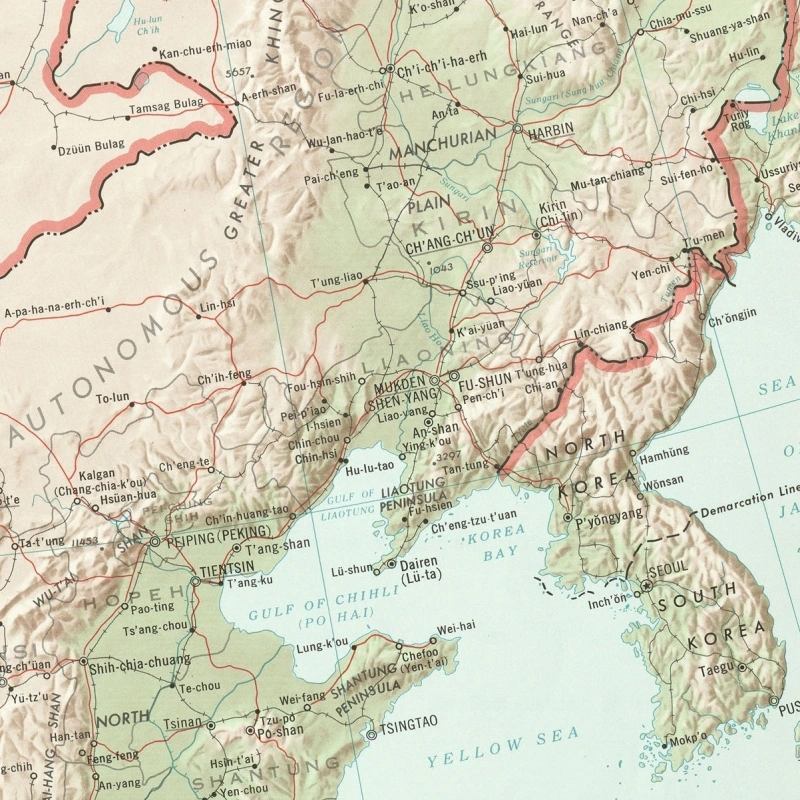
A lot of mythology surrounds the Chinese Communist Party’s peasant origins and guerrilla tactics. But the Communist victory over the Nationalists in the civil war was not a mass uprising around the country, but a military campaign that started with victories in northeast China–Manchuria–and moved south from there. (There are some historical echoes, as when the Mongols and, later, the Manchus, conquered China, they also came from the northeast.) Here is Andrew Walder in his China Under Mao:

Victory was actually attained through conventional warfare fought between large modern armies, involving massive mobilization of material and human support for each side. Guerrilla warfare permitted the CCP to survive and expand during the Japanese invasion, but this survival strategy placed minimal demands on peasants to supply Communist partisans with food, material support, and recruits. Once the civil war began, the CCP abandoned guerrilla operations. As its armies poured into Manchuria after Soviet forces occupied the territory, Mao turned to a strategy of total mobilization for revolutionary war. The Red Army, renamed the People’s Liberation Army (PLA) in 1945, grew from 475,000 in 1944 to 2.8 million by 1948. …

The final years of the civil war resembled the Soviet army’s conquest of Eastern Europe in the last phases of World War II. The PLA rolled south from Manchuria and adjacent regions of North China, conquering vast regions that had never before been under CCP control, and regions like Tibet and Xinjiang that had not been governed by any Chinese state since the fall of the Qing dynasty.

Since the Communist victory was truly a military victory, many have looked to military causes to explain it. Chiang Kai-shek himself, in a book published after the war, focused attention on a series of events in 1946, around the city of Siping in Jilin province. Communist forces had occupied the city but were then dislodged by the Nationalists; at the same time, however, both parties were negotiating with the American envoy George Marshall, and a ceasefire was declared shortly afterward the Communist troops fled Siping. Chiang of course agreed to the ceasefire but in hindsight felt it was a mistake that allowed the Communists to regain the initiative:

This was a war that Chiang had lost in 1949, but which might have come out very differently, Chiang argued, if the Second Battle of Siping and its aftermath had been handled differently. The battle itself, Chiang said, had been “another decisive battle against the Communist troops.” As he described it, the three hundred thousand men under Lin Biao’s command had been utterly defeated: “More than half the Communist effectives became casualties.” Reports from the front, he said, “all agreed that barring some special international complications the Chinese Communists would not be able to fight anew after the terrific punishment they had just taken at the hands of the Government forces.”

Then there came the ceasefire and the suspension of [Nationalist general] Du Yuming’s pursuit of the Communist forces. Chiang believed that if his armies had continued their pursuit, “Communist remnants in northern Manchuria would have been liquidated.” Without a base area in northern Manchuria, the remaining Communist forces in Manchuria would have been deprived of Soviet support and “a fundamental solution to the problem of Manchuria would have been at hand.” Instead, “the morale of Government troops in Manchuria began to suffer” and Lin Biao rebuilt his forces in northern Manchuria. “The subsequent defeat of Government troops in Manchuria in the winter of 1948,” said Chiang, “was largely due to the second ceasefire order.” In this view, Siping was the decisive battle that could have been— if only a ceasefire, negotiated by George Marshall, had not intervened. Defeat had been snatched from the jaws of victory.

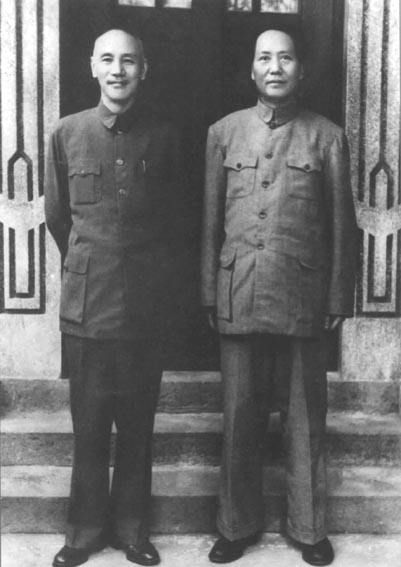
Chiang Kai-shek and Mao Zedong in 1945

Chiang Kai-shek and Mao Zedong in 1945

That is from Harold M. Tanner’s The Battle for Manchuria and the Fate of China: Siping, 1946, which reconstructs the events leading up to and following the battle, and tries to answer the question of whether Siping was truly the turning point that ensured Communist victory in the civil war. While Senator Joseph McCarthy also blamed Marshall’s intervention for “losing China,” a number of more reputable historians have also seen Siping as a key turning point. Tanner however concludes that Chiang’s hope was a false one, in part because the Soviet Union was quietly but effectively supporting the Communists, and both the Nationalists and the Americans were afraid of getting into a direct confrontation with the Soviets:

The Truman administration had decided that while the United States would support Chiang Kai-shek, there would be limits to the extent of that support. Chiang desperately wanted the United States to take a more active role in supporting his government and his army in their struggle against what Chiang portrayed as the Soviet Union’s imperialist designs on Chinese territory. The Truman administration, however, was determined not to get directly involved in the Chinese Civil War, and especially not to challenge the Soviet Union by getting drawn into the struggle in Manchuria.

America was willing to transport Nationalist armies and to supply substantial amounts of weapons and ammunition, but, as we have seen above, American equipment alone could not give the Nationalists a substantial advantage on the battlefields of Manchuria. Even if the United States had been willing to do so, extending unlimited military aid to an army that was pursuing a fundamentally flawed strategy and a government that was proving incapable of winning the political struggle is not likely to have changed failure into success. In any event, the United States did not have unlimited resources to expend on Chiang’s government. Truman’s decision to limit support for Chiang was based on his assessment of American interests and capabilities, including American commitments elsewhere around the globe, and the very real possibility that American embroilment in China could lead to conflict with the Soviet Union.

Marshall’s decision to push for a ceasefire in June 1946 was made in this context, as well as on the basis of his assessment (backed up by the intelligence reports available to him) that the Nationalist Army was simply not capable of achieving victory in Manchuria. Chiang agreed to the ceasefire not only because Marshall was pressuring him to do so (although this was certainly an important factor), but also because he was aware of the limitations of his own armies, the challenges of further operations in North Manchuria, and the possibility that military operations north of the Songhua could elicit a dangerous reaction from the Soviet Union.

The Communist victory in China’s civil war, in this analysis, is ultimately the result of the Cold War and thus of how the Second World War ended. In fact, Peng Shuzhi, a Chinese Trotskyist, made much the same argument back in 1952:

Placed in an unfavorable position in the international situation created by the Second World War, American imperialism was obliged to abandon its aid to Chiang and its interference with Mao. At the same time, the Soviet Union, which had secured a superior position in Manchuria at the end of the war, inflicted serious damage to Chiang’s government and offered direct aid to the CCP. This enabled the latter to modernize its backward peasant army. Without this combination of circumstances, the victory of a party like the CCP, which relied purely on peasant forces, would be inconceivable.

For example, if Manchuria had not been occupied by the Soviet Union but had fallen entirely under Chiang’s control, Chiang Kai-shek would have utilized the economic resources and the Japanese arms in Manchuria to cut off direct connection between the CCP and the Soviet Union. This would have blocked the USSR’s armed support to the CCP. Similarly, the situation would have been quite different if direct intervention against the CCP by American imperialism had been possible. Under either of these two circumstances the victory of Mao Tse-tung would have been very doubtful.

To approach this from another direction, we could recall the defeat of the CCP’s peasant army in the Kiangsi period, 1930-35, when the bourgeois KMT’s power was considerably stabilized as a result of continual aid from imperialism, while the CCP was isolated from the Soviet Union. From this we can also derive sufficient reason to justify the conclusion that today’s victory of the CCP is entirely the result of the specific conditions created by the Second World War.

China raises its target for private-sector hospitals

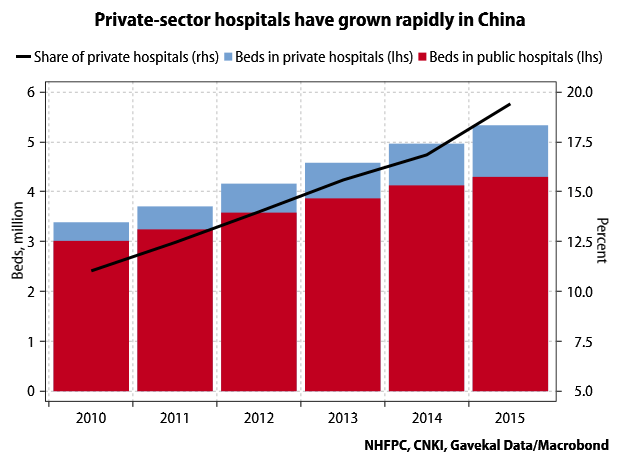
Amid the generally disappointing news on economic reform out of China, one signal I have been keeping an eye on is the government’s intentions on healthcare. A significant component of the previous five-year plan for healthcare, which ended in 2015, was a commitment to raise the private sector’s share of hospital beds to 20% of the national total. In the event they didn’t quite make the target–the final figure was 19.4% for 2015–but I still thought it was a promising way to use China’s planning system to drive liberalization and not just higher output. Healthcare is a fast-growing part of the economy and one where the private sector’s role is obviously increasing, so it is one of the more positive stories in China at the moment.

As many of the healthcare system’s problems, such as corruption and inequality, can arguably be traced to the overwhelming dominance of state-owned institutions, some within China have argued for targeting a much larger private-sector role. But there is an active debate: an authoritative report recently questioned the need to have a quantitative target for raising the private sector’s market share. A regulatory system designed for state institutions is arguably not able to ensure quality as private institutions rapidly proliferate, and scandals and public distrust of private hospitals are a clear issue. So it was not at all clear what would happen to this initiative.

Now the 13th five-year plan for healthcare has finally been published (full Chinese text here), and it does retain a target for raising the private sector’s market share. The new target is to raise private hospitals’ share of total hospital beds to above 30% by 2020 (the plan does not actually use the word “private,” which remains a loaded term in China, instead referring to hospitals “managed by society,” i.e. not the state). This is not a radically higher figure that would force drastic restructuring of the whole healthcare system, but it does maintain a clear, transparent and public commitment to a greater private-sector role. I would call this pretty good news, especially given that there has recently been some backward movement on state-owned enterprises and some other issues.

Public and private hospital beds

How stoves and lamps led to a turning point in China’s reforms

Here is a nice little piece of oral history covering some important episodes in the early history of China’s economic reforms. The translation below is an excerpt from a longer interview with Yang Qixian, a scholar who participated in the reform process in the 1980s (Chinese original here). I like it because it includes both some vivid practical experiences and some theoretical insights.

Yang Qixian

Yang Qixian

First, the practical:

In the summer of 1982, Yang Qixian, as a member of the working group formed by the State Commission for Restructuring Economic Systems, went to Changzhou, Jiangsu province to push forward the pilot project for comprehensive reform. At that meeting, there were two things that drew his attention and left a strong impression: the glass chimneys for kerosene lamps, and the “tiger stoves.”

As Yang recalled, because at that time the electricity supply was inadequate, many families used kerosene lamps. The glass chimneys for the kerosene lamps were a commodity whose supply was planned, with the price fixed at RMB0.06. Because they couldn’t make money [at that price], enterprises did not want to produce the lamp chimneys. One residential community could get a quota allocation of one or two every few months, which would then be distributed. The lamp chimneys would first go to the hands of the community leader or production team leader, who could give them to whoever they wanted. Because there was a shortage of lamp chimneys, when people wanted to buy one they would have to treat the team leader to some food and booze; only by having a good relationship could they get the quota. The members of the working group on the comprehensive reform pilot discussed this phenomenon, and decided to liberalize the prices of some small commodities that were not of critical importance, and allow enterprises to organize production according to market demand.

The Changzhou comprehensive reform pilot used the kerosene lamp chimneys as an experiment, and the effect was of course very obvious: the supply shortage was solved very quickly. Yang Qixian recalled that after the price of kerosene lamp chimneys was liberalized, it rose to RMB0.2, a big increase from RMB0.06. “We asked people if they were upset about the price increase, and they said no. The reason they weren’t upset is that before they could sell three eggs for RMB0.06 and buy one glass chimney, now they can sell three eggs for RMB0.2, which can still cover the cost of one chimney,” Yang said. Afterward, the working group wrote a short report about the experiment, and Hu Yaobang [at the time, General Secretary of the Communist Party] immediately approved it; he felt this was a very good example, and that the prices of small commodities should be gradually liberalized.

The situation of the “tiger stoves” was similar to the kerosene lamp chimneys. At that time, for people to boil water they had to fire up the coal stove. Because coal was in short supply, in order to conserve coal they would organize “tiger stoves” [in the area around Shanghai, a traditional name for a local store providing hot water, tea and even baths]. The water jugs were lined up on the stove, and once the water boiled you only had to spend RMB0.01 to fill a jug and take it home.

But tiger stoves could only be run by a collective, and so there were only a few in each city. When people wanted hot water, they would have to walk a long way–it was really not convenient. In the Changzhou reform trial, the working group decided to allow individuals to run tiger stoves, and also allow them to buy coal. Because of this loosening, the number of tiger stoves multiplied, and the price did not rise. People did not have to go so far to get hot water. The working group also wrote up this example in a report, and Hu Yaobang approved it, saying that small businesses should not be excessively restricted, and must be liberalized.

It is quite amazing that a discussion about hot water supply in one city of one province went all the way to the top of the Communist Party hierarchy.

Next, a more theoretical insight:

Another event that made a deep impression on Yang was the International Symposium on Macroeconomic Management held in September 1985, which was a landmark in the history of China’s reform and ideological emancipation. Because it was held on a boat called the “Bashan,” running from Chongqing to Wuhan, the media and scholars have called it the Bashan boat conference. …Foreign experts attending the meeting included Alec Cairncross from the UK, James Tobin from the US, Otmar Etminger from West Germany, Michel Albert from France, Janos Kornai from Hungary, Kobayashi from Japan, as well as Edwin Lim and Adrian Wood from the World Bank. Representatives from China included Xue Muqiao, An Zhiwen, Ma Hong, Liu Guoguang, Gao Shangquan and other scholars and workers, for a total of more than 30 people. As one of the organizers, Yang Qixian drafted the conference synthesis report.

Yang recalled that, although it was only a seminar, and the meeting was not long, it still had a far-reaching impact. The reason is that in the earlier stages of reform and opening up there was a lot of controversy about what the goal of reform should be. In 1984, the Third Plenary Session of the 12th Central Committee clearly put forward the concept of a “planned commodity economy.” But how exactly should a commodity economy be run? What should be the target and the model? What reforms are needed to establish a commodity economy? At that time their views affected us greatly.

For instance, Kornai of Hungary suggested that there were only two kinds of macroeconomic management in the world: one regulates mainly through administrative methods, the other regulates mainly through market methods. The first category can be divided into direct administrative regulation, such as the Soviet model, and indirect administrative regulation, such as the Yugoslav model. The second category can be divided into completely uncontrolled market regulation and market regulation under macroeconomic management. Kornai said that China should follow the model of market regulation under macroeconomic management. “These ideas were a great inspiration to us at the time, and later the target model of our reforms basically followed this line of thought,” Yang said.

These stories are great, and very appealing in their straightforward simplicity, though hindsight probably makes the decisions seem easier than they actually were at the time (the Bashan boat conference and Kornai’s influence have come up before on this blog, in this post).