China wants those low-end industries after all

The usual goal of industrial policy is to, by supporting or protecting a particular industry, allow it to more quickly achieve the economies of scale necessary to be competitive. China has plenty of experience with this type of industrial policy: witness how it has scaled up in the manufacturing of solar power, lithium batteries, and electric vehicles to a size that dominates global markets. But the official rhetoric on industrial policy is now turning to a different and less well-trodden path: pursuing economies of scope as well as scale. Or, to put it in less technical terms: China’s government wants to preserve and improve competitiveness in a wide range of different industries, not just specialize in the most profitable ones. It sounds like a simple change, but it’s a significant one for China’s trading partners.

As is usual in China today, the signal of this change in priorities has been delivered by the man at the top, Xi Jinping. At the May meeting of the Central Commission on Financial and Economic Affairs, one of many steering groups he chairs, Xi laid out his vision of a “modernized industrial system.” He explained that such a modernized system has three key characteristics: it is “complete” ( 完整, also translated as “comprehensive”), “advanced” (先进) and “secure” (安全). The most novel of these objectives is “completeness,” and Xi briefly explained what that objective means in practice: “We must keep promoting the transformation and upgrading of traditional industries, and not take them as ‘low-end industries’ to be simply eliminated.”

On its surface, this could sound like one of the invocations of the importance of blue-collar manufacturing jobs now common in other countries on both the populist right and left. In fact, this statement is an intervention in a specific Chinese policy debate that clearly indicates a reversal of the previous direction. China’s turn toward high-technology-focused industrial policy well predates Xi, and actually began in the prior administration of General Secretary Hu Jintao and Premier Wen Jiabao (see Barry Naughton’s excellent short history of industrial policy for more).

In the mid- to late 2000s, “upgrading the industrial structure” was a regular buzzword, and official support for “emerging” and “strategic” industries ramped up. At the same time, though, the government tried to restrict resources going to less-desirable industries, usually defined as those that are highly polluting, energy-intensive, or in excess capacity. These efforts reached a peak in 2008; here is some representative language in Wen’s government work report from that year:

It is essential to appropriately control the scale of fixed asset investment and improve the investment structure. We will maintain strict control over the availability of land, credit and market access, and pay particular attention to strengthening and standardizing supervision of new projects to ensure they meet all the conditions for launching. Haphazard investment and unneeded development projects in energy intensive and highly polluting industries and industries with excess production capacity will be resolutely stopped, and market access will be tightened and capital requirements will be increased for industries whose development is discouraged. Work on illegal projects will be resolutely stopped.

In this vision of industrial upgrading, there is both positive and negative discrimination: the government pursues policies that favor high-end industries and disfavor low-end industries. Such a vision is based on ideas of national specialization and integrated global trade. It’s influenced by the “flying geese” model originally articulated by a Japanese scholar and popular among development economists in the 1980s and 1990s. The idea is that, as nations advance up the technological ladder, they leave behind production of low-value or commoditized products, which then creates opportunities for lower-income countries to industrialize by making those goods. Nations at different income levels specialize in making different kinds of products, and by trading with each other everyone becomes better off.

Xi’s vision of “completeness” or “comprehensiveness” does away with this. Rather than allowing China’s low-end industries to shift to other, lower-income countries, and then importing those products, the idea is to maintain the ability to produce the full range of goods within China. Low-end industries are not abandoned but become targets for technological upgrading in order to preserve their competitiveness. As the Chinese economist Xu Zhaoyuan explained in an exegesis of Xi’s remarks:

We cannot allow traditional industries to transfer abroad too quickly. This requires continuous strengthening of policy support for the upgrading and transformation of traditional industries, improving product innovation and efficiency to enhance their competitiveness, while also continuously reducing the cost burden of the real economy, especially reducing various transaction costs. 

The background assumption is clearly no longer that nations can specialize to take advantage of an open global trading system, but rather that they need to minimize external dependencies and vulnerability to trade disruption. The Chinese economist Yu Yongding called it part of China’s response to the US decoupling campaign:

Re-emphasizing the importance of comprehensiveness is a reaction to the new geopolitical reality. While China cannot and should not produce everything – autarky is impossible for a modern economy – it should be able to quickly launch or increase production of critical goods, as needed.

China does indeed have a very broad range of manufacturing competence: according to Yu, “China ranked among the world’s top three exporters (by volume) in 2,400 of 4,000 categories of intermediate goods traded globally between 2017 and 2020.” More simply, there are very few goods that China does not make. I looked at China’s exports broken down by 4-digit HS code; out of 1,241 categories, there were zero exports in fewer than 50, a share that has remained largely constant over the past decade.

In a sense, then, achieving a “complete” industrial industrial system would just mean maintaining the status quo. On the other hand, as China is probably only a few years away from qualifying as a “high-income” country on the World Bank’s definition, one might expect that rising incomes would have at least some impact on China’s cost structures and competitiveness in making in different products.

As is often the case with these high-level slogans, it’s not totally clear what the practical implications of Xi’s policy shift are going to be. It would not be that unreasonable for Xi to say, “I don’t think we should have government policies that actively try to shut down particular industries, because those industries employ Chinese people and earn money and there’s just no good reason to get rid of them.” It would be somewhat less reasonable, certainly from the perspective of China’s trading partners, for Xi to say “Instead of just subsidizing the high-tech industries of the future, I think we should subsidize every single industry that China has so that China can have a comparative advantage in making everything.”

At the least, the rhetoric of “completeness” does not offer a lot of hope that other countries are going to be able to benefit from China’s growth by selling it stuff. The “flying geese” theory is now criticized, not totally unfairly in my view, for contributing to the hollowing-out of industry in the US and other high-income countries. But it did offer a basis for mutually beneficial trade with the developing world: as high-income countries lost competitive advantage in some industries, the low-income countries gained it, and could use those industries to raise their own incomes.

China these days is trying to knit together a coalition of other developing countries also opposed to US dominance of the global system. But its official economic theory does not offer much of a basis for what it likes to call “win-win” ties with other developing countries. China wants to keep producing itself all the stuff that poorer developing nations in Africa, Asia and elsewhere might want to sell it. China acknowledges a need to import necessary raw materials, and that’s about it. Is this maximum mercantilism really an attractive vision for an alternative global economic order?

The political position of the private sector

Are China’s private-sector businesspeople unhappy about living under a Communist government? That is the increasingly explicit contention of some commentators on China’s current economic troubles. The idea is that Xi Jinping has reversed the Communist Party’s recent historical accommodation with the private sector, leaving entrepreneurs fundamentally uncertain about their future prospects. If business owners do not believe they can earn a profit without risk of intervention or confiscation by the government, then they will not invest, and the economy will not grow. As Adam Tooze put it in a typically thoughtful overview of this school of thought, the key contention is that “the problems of China’s economy are political and though they center on Xi they go beyond him and concern the entire system.”

Bill Bishop’s Sinocism newsletter of July 19 has a useful summary of some of the Party’s recent ideological pronouncements that “may have caused some skepticism in the private sector.” Among the most explicit was a 2020 document (English translation here) that detailed measures to “continuously strengthen the Party’s leadership over the private economy” and “educate and guide private economy practitioners to…unswervingly listen to and follow the Party.” While the document also discusses the Party’s duty to support private businesses and respond to their concerns, it is fair to say that it does not envisage a hands-off relationship in which the private sector is allowed to go about its own affairs.

Xi’s politicization of the private sector’s role in Chinese society is often contrasted, implicitly or explicitly, with the high-level accommodation of the interests of the private sector that existed under previous leaders. In 2001, Jiang Zemin famously welcomed private entrepreneurs into the ranks of the Communist Party and pledged that the Party would respect and support their interests, under his slogan of the “Three Represents.”

This dramatic ideological shift has sometimes been interpreted by critics on the left, inside and outside China, as a “neoliberal turn” in which the state served as the handmaiden of private capitalists. In reality, Jiang’s concerns were not so different from Xi’s: his goal was also to ensure that the private business sector would not evolve into a political opposition (in general, Jiang’s role in setting the fundamental parameters of China’s post-1992 political economy is often underrated).

The historian Frank Dikötter, in his recent book China After Mao: The Rise of a Superpower, points out that while the Three Represents did open Party membership to entrepreneurs, it also began a push to extend Party cells into private businesses:

Although few people knew exactly what the formulation meant, the general idea was that the party should not dilute its own political power and must ensure it remained in the vanguard of every area of life. This included the country’s ‘advanced culture’ as well as the ‘fundamental interest of the majority of the people’. A third principle posited that the party should ‘represent the foremost production forces’.

Foreign experts gasped with admiration, as the Three Represents included a decision to end a ban on party membership for private business people. But in typical Orwellian doublespeak, the campaign was designed to extend the hand of the state, not retract it, most of all in the private sector. Since tens of thousands of state enterprises were becoming shareholding companies, shedding millions of jobs along the way, the party insisted on maintaining control. The Three Represents meant that party cells must be established even within private businesses, subjecting them to closer party supervision.

Some of Jiang Zemin’s comments from the time on the issue of the Party and the private sector are reproduced in Volume III of his Selected Works. In May 2000, he visited Nanjing, Suzhou and Shanghai–some of the historical centers of China’s private businesses–and held discussions about “Party building,” meaning the establishment of Party cells in private businesses. Here are a few of the key passages, which also highlight the need to ensure private companies support the Party line:

There are nearly 1.5 million private enterprises and more than 31 million individual industrial and commercial businesses (getihu) nationwide, employing more than 82 million people. In terms of either economic strength or the number of people, the weight is not light. … This has raised a new topic for us, which is how to strengthen the party’s leadership in these fields, and effectively unite and organize the masses in these fields around the party. …

It is necessary to promptly carry out the work of party building in non-public economic organizations. Carrying out party building work in non-public enterprises is a new field. In recent years, some places have actively explored and achieved some results. But in general, the development is very uneven, obviously lagging behind the requirements of the development of the situation. According to incomplete statistics, currently 83.3 percent of private enterprises in the country have no party members, and only 1.4 percent of the total number of enterprises have established party organizations. …

Today’s private business owners have developed under our Party’s reform policy and the call to get rich first, and many of them are laborers. The Party organization should actively do a good job of uniting, educating, and guiding them in accordance with policy, unite them around the Party organization, and make them support the establishment of Party organizations in enterprises, support the Party’s various policies, operate enterprises according to the law, care for and protect employees’ rights and interests, and contribute to the country and society.

Surveys by the All-China Federation of Industry and Commerce document that the share of private companies with a Party cell rose sharply after the initial launch of the Three Represents slogan in 2000. Xi has also emphasized Party-building in the private sector, and has presided over a lot of political messaging and actions designed to enforce the idea that private businesses have a duty to be loyal to the Party and support the Party’s policies. But this is not a new idea, and private businesses have had a couple of decades, if not more, to get used to it.

To me, the historical evidence suggests Xi’s ideology probably does not differ a lot from his predecessors in terms of the private sector’s political position in Chinese society. And therefore I’m not sure that such ideological messaging is the real problem affecting private business in China today. What I do think is different under Xi, and where he has created instability and uncertainty, is his articulation of the goals that China’s political system is trying to achieve.

As Xi has repeatedly said, sometimes with evident frustration for those who still have not gotten the message, what he is trying to do is reorient China’s political system away from the pursuit of economic growth at all costs. From his perspective, that pursuit created a lot of political problems that need to be corrected: corruption, waste, loss of Party discipline.

But one of the political benefits of the orientation toward economic growth is that it offers a fundamental assurance that the interests of the Party and the interests of private businesses are aligned. If growth is the goal, then ultimately the Party wants companies’ revenues and profits to go up, and that is the same thing the companies want. If growth is not the goal, then the Party’s interests and the interests of private businesses can diverge. And that prospect could reasonably trouble businesses who understand their political position.

Stimulus is never just temporary

As China’s data continue to disappoint, there is a persistent theme in much of the outside commentary on its economic woes: that China is for some reason failing to take the “obvious” step of sending stimulus checks to households. The implicit argument is that the US handed out massive subsidies directly to households, got a great post-pandemic recovery and everything turned out fine. China did not deliver subsidies to households, and that’s why everything is very much not fine.

Why is China, still, not taking this course in spite of the positive example of the US? Of course, an obvious answer is that the people in charge don’t think the US example was that positive, and anyway aren’t particularly prone to think of the US as a model to emulate. The merits of the pandemic fiscal-policy response are still pretty contested in the US. Plenty of people think of the stimulus as a fiscally irresponsible gamble that ultimately had pretty disruptive macroeconomic effects, because of the huge interest-rate increases that were required to bring inflation under control; my perception is that many people in China share these views. Still, the case for stimulus is probably getting stronger rather than weaker at the moment as China falls further away from potential growth and full employment.

My suspicion is that part of Chinese policymakers’ reluctance to use direct transfers to households as a short-term stimulus stems from a fear of setting a fiscally destabilizing precedent. If debt-financed transfers failed to generate a sustainable recovery, the money would be wasted. But if transfers succeeded in generating a good burst of growth, that could have even bigger longer-term effects. It would mean that, the next time China falls short of potential growth and full employment, the political pressure to roll out household transfers again would be overwhelming. What started as a one-off policy response could become entrenched as the expected response to any growth slowdown, and would add to government deficits and debt over many years rather than just one.

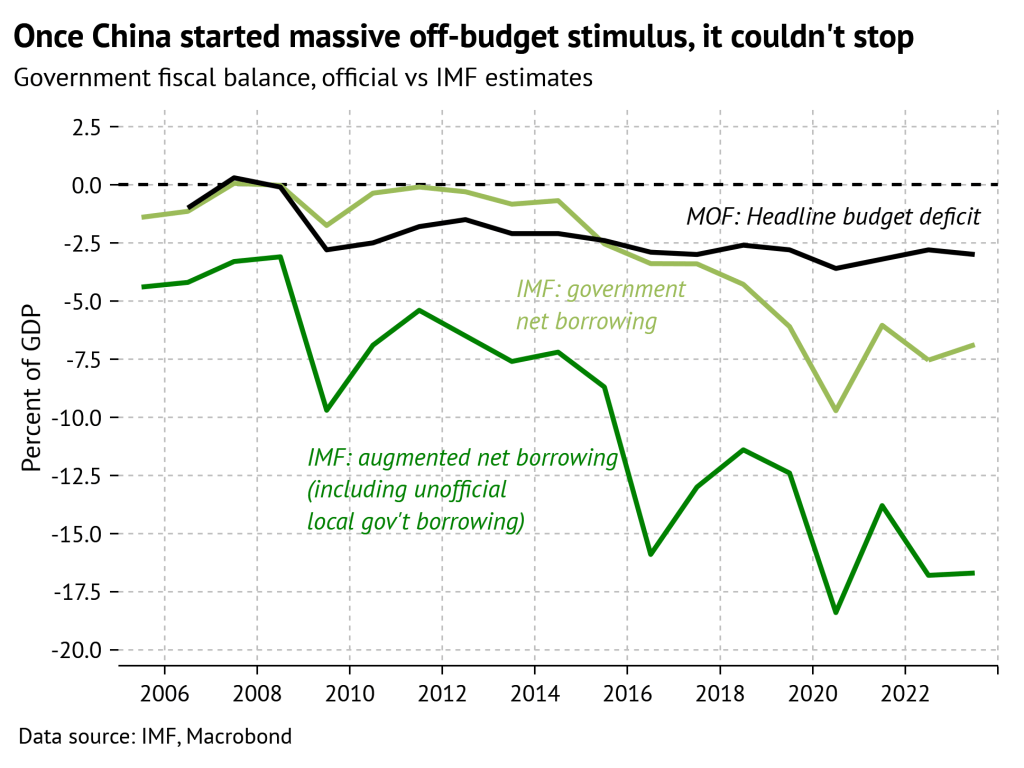
Why should this hypothetical possibility be a serious concern for Chinese policymakers? Because it is exactly what happened after the 2008 financial crisis. An unprecedented global shock led to an unprecedented policy response, as the central government encouraged local authorities to use off-balance-sheet borrowing to fund a wave of public works projects. If that had been a one-off measure, it would have been a powerful example of effective and unorthodox policymaking. Instead, the infrastructure stimulus institutionalized fiscal irresponsibility on a massive scale: a decade and a half on, the off-balance-sheet local borrowing is even bigger relative to the economy than it was in 2008, according to IMF estimates. It would be hard to find a better example of Milton Friedman’s quip that “nothing is so permanent as a temporary government program.”

China’s political system therefore does not have a good track record of being able to take away the punch bowl in good economic times in order to be able to share out more punch in the bad times. The dubious legacy of the 2008 stimulus means that China now needs fiscal consolidation to get long-term debt dynamics under control–at exactly the moment that it once again faces a shortage of aggregate demand.

Striking the right balance between the structural and cyclical issues is indeed quite difficult. Maybe the right answer is in fact that the cycle needs more attention at the moment, because a failure to address the loss of growth momentum would allow hysteresis to set in and create even more long-term costs for the economy. But it is perhaps understandable that the people inside China’s system are reluctant to experiment with new forms of fiscal stimulus before they have gotten the old ones under control.

The persistence of markets under Mao

What accounts for the extraordinary rise of China’s private sector after the economic reforms that followed Mao’s death? The 1980s were a pivotal decade for China in many ways, as the rapid growth of the private sector transformed the structure of a still officially socialist economy. In 1987, Deng Xiaoping famously said that the explosion of private-sector activity in the countryside in particular came as a surprise to him:

In the rural reform our greatest success — and it is one we had by no means anticipated — has been the emergence of a large number of enterprises run by villages and townships. They were like a new force that just came into being spontaneously. …If the Central Committee made any contribution in this respect, it was only by laying down the correct policy of invigorating the domestic economy. The fact that this policy has had such a favourable result shows that we made a good decision. But this result was not anything that I or any of the other comrades had foreseen; it just came out of the blue.

Of course, the township and village enterprises–which is to say, private companies avant la lettre–did not actually come out of nowhere. They drew on China’s long traditions of commercial enterprise, and people’s experience with living and operating in a market economy before it was suppressed in the 1950s. In an interesting new paper, “Markets under Mao: Measuring Underground Activity in the Early PRC” (the link is currently open-access), Adam Frost and Zeren Li offer quantitative evidence to suggest that hidden market activities continued at scale even through the height of the Maoist period:

There was already substantial market-based activity prior to the launch of economic reforms. Even after the “socialist transformation” of the Chinese economy was ostensibly complete, Chinese citizens continued participating in “underground market activity,” i.e. private acts of exchange that occurred outside of systems of planned allocation and distribution and which were intentionally concealed from the state. A broad host of actors, ranging from rural people who “abandoned farming to take up commerce” to merchants who specialized in the illicit wholesale trade of ration certificates, devised novel strategies to evade state control and engaged in consensual private transactions. While these individuals often filled critical voids in the economy, they were collectively maligned as “speculators and profiteers” and, for three decades, were the recurring targets of mass campaigns. Yet, even at the height of the Cultural Revolution when anti-capitalist sentiments reached their zenith, “speculation and profiteering” were never wholly suppressed.

The authors use local administrative documents recovered from flea markets to compile data on 2,690 cases of “speculation and profiteering” that authorities prosecuted in two areas, the rural county of Chun’an in Zhejiang and the city of Zhenjiang in Jiangsu. These records often list what items the “speculators” were accused of selling, and at a what price. The value of the transactions was usually pretty substantial:

The mean case value (i.e. the estimated total value of activity described in each case) is about 334 yuan for Chun’an and 362 yuan for Zhenjiang. To put these figures into perspective, in 1955 the national average income was 102 yuan for an urban worker and 94 yuan for a rural farmer, and income levels remained stagnant for most of the 1960s and 1970s. In other words, the mean case involved activity that represented three years’ worth of consumption for the mean worker. Given that prosecuted individuals probably succeeded in concealing some portion of their gains, this figure is likely only a fraction of the true quantities of goods, cash, and ration certificates involved in each case.

The authors use various assumptions to estimate the total size of underground market activity from these figures. The results depend so much on assumptions that the exact figures are not particularly meaningful, but the range of estimates is consistent with contemporary estimates of the “shadow economy” of illegal transactions in most countries–perhaps suggesting that Maoist China was more economically normal than its ideology would indicate. This finding is also interesting:

We observe that the average spread between the purchase and resale price of items in underground market transactions was relatively low and remained so throughout the entire period of observation. There was, on average, no more than a 19% mark-up on items that were bought and resold in underground markets. These figures suggest that the maximum perceived risk of capture was low, even during the height of the Cultural Revolution.

The low black-market premium also suggests these kind of underground transactions were widespread enough that the scarcity value was not extreme, and that underground traders faced enough competition that they could not charge exorbitant prices. The repeated campaigns against “speculation and profiteering” that generated these administrative documents therefore do not seem to have been particularly successful. When the formal prohibitions on these private transactions were lifted in the post-1978 reforms, many Chinese people had plenty of experience with trading and business that could be quickly put to use.

Frost and Li’s account lines up with my own thinking about the reasons for the early success of China’s economic reforms–although when I pondered this question before, I focused more on the fact that China did not actually spend that much a time as a full-fledged socialist economy (see my previous post, “How long was China Communist?“). The time from the forced nationalization of private firms in the mid-1950s to the re-legalization of urban and rural private sectors in the early 1980s was barely three decades. By contrast, socialist prohibitions on private enterprise in the Soviet Union lasted two full generations, long enough to wipe out any previously existing base of skills and knowledge formed in the private commercial economy (which was not that developed in tsarist Russia anyway).

These two explanations seem fully complementary to me: China’s socialist prohibitions on private transactions were neither complete enough to truly stamp out market-based activities, nor did they last long enough to for the population of people with experience running businesses in a market economy to die off. Once the state began to tolerate markets again, the hidden traditions of private enterprise could come out into the open.

Peak globalization and China’s EV exports

The rise of electric vehicles is one of the most interesting and consequential changes in the world’s industrial structure to come along in some time. Among other things, it has enabled the Chinese government to fulfill its long-held dream of becoming a globally competitive producer of passenger cars; in a very short period of time, China has become a major exporter of electric vehicles. The International Energy Agency has some useful summary statistics in its Global EV Outlook:

China is a leading exporter of electric cars, representing over 35% of electric car exports, as well as of batteries. Europe is China’s largest trade partner for both electric cars and their batteries. Indeed, over the past year the share of electric cars sold in the European market coming from China increased from about 11% in 2021 to about 16% in 2022.

Over the past five years, the share of global electric car exports coming from China has increased more than eightfold, with China becoming the largest exporter in 2021 and the gap further widening in 2022. The share of electric car exports from the United States peaked in 2019 and has since fallen below the levels exported from China, Korea and Europe.

This is an undeniable success for China’s strategy of building up a complete domestic supply chain for the batteries and other components going into electric vehicles. But it’s a success that has also depended on partnerships with multinational companies. According to EV Volumes, China exported about 580,000 electric vehicles in 2022, of which 407,000, or around 70%, were “Western brands.” (Just to give an idea of the speed of growth, exports in the first half of 2023 have already topped 500,000 units,)

By far the most important of those Western brands is Tesla, which according to the IEA accounted for about 40% of China’s EV exports in 2022. Another 20% of China’s EV exports were from European companies; this should include the Renault-Nissan group and BMW. (The remaining 10% are probably “Western brands” that are Chinese-owned: SAIC owns the British MG brand and makes MG-branded EVs in China, while Geely controls Volvo and Polestar, whose EVs are made in China for export).

The success of China’s EV exports is therefore inseparable from the decisions of multinational companies to make China their base for global EV exports (and of other countries’ willingness to allow a level of Chinese investment in their auto industries that China would not have allowed for foreign investment in its own auto industry).

Those decisions go back some years. BMW’s joint venture in China started making EVs as far back as 2013, started producing the iX3 in 2020 and opened another $2.2 billion EV plant in 2022. The Renault-Nissan group announced an EV joint venture with Dongfeng in 2017; it started out making models for the domestic market, but is also now making the Dacia Spring for export to Europe.

Tesla’s major investment in its Shanghai factory came a bit later, only after China’s decision to remove the requirement that foreign automakers operate through joint ventures. This liberalization took effect in 2018 for EVs and in 2022 for other vehicles. In addition to its direct effects on exports, Tesla’s entry into China is also generally credited with injecting new dynamism into the domestic market:

Despite all that government support, sales of EVs remained weak until 2019, when China let Tesla open a wholly owned factory in Shanghai. “It took this catalyst…to boost interest and increase the level of competitiveness of the local Chinese makers,” said Tu Le, managing director of Sino Auto Insights, a research service specializing in the Chinese auto industry.

Electric vehicles were less than 5% of domestic vehicle sales until 2020, really took off in 2021, and have surged since then to around 30% of domestic sales. According to another analyst:

Tesla’s brand appeal helped nudge more consumers to switch from gas-powered cars. A supply chain built around Tesla now feeds a wave of improving homegrown EV makers. “If you’re China: thank you Tesla for waking up the part of the market which was sleeping, which was retail consumers,” said Bill Russo, founder and CEO of Automobility, a Shanghai-based strategy and investment advisory firm.

The current success of China’s EV industry therefore has to be seen as a success of globalization–the flow of international capital seeking out the most efficient location–not just for domestically focused industrial policy. It’s the interaction between those two factors that has given China’s EV exports their rather unusual composition.

But in 2023, after the trade war, the Ukraine war and the collapse of US-China relations, the international structure of China’s EV exports also looks like the peak of a particular form of globalization that will not be reached again anytime soon. In 2013 or 2017 it was definitely not controversial for a Western multinational to choose China as the global export base for a major new product; in 2023 it certainly would be. In the current political climate it is very hard to imagine Western multinationals making such decisions again without hesitation.

The global rise of China’s EV industry looks like it is just getting started. But the model that kick-started that rise may not be available for repeat use.

Some cadres cannot keep up

Some of Xi Jinping’s most revealing comments about economic policy have come when he is ostensibly not talking about the economy at all. Official media have recently published a speech he gave on March 1, 2022 at the Central Party School, in which he mainly talks about ethics, ideals, responsibilities–the heavy burden that young Communist Party cadres must bear in their careers.

But it also contains some fairly frank remarks about the conduct of local government officials. Xi has made it his mission to reorient China’s political system away from the decentralized pursuit of growth-at-all-costs, and he is frustrated that not everyone is on board:

Most cadres can actively adapt to the new development requirements, but some cadres cannot keep up. Some think that development is about launching projects, doing investments, and expanding scale, and even still regard highly polluting and energy-consuming projects as an important means of promoting economic growth. Some over-borrow to build and blindly expand businesses. Some methods are simple and crude: the “one size fits all” campaign-style reduction in carbon emissions led to large-scale power shortages and seriously affected enterprise production and people’s livelihood. And so on.

The criticism of local-government debts and wasteful investments, long tolerated and even encouraged by the central government, is notable. Later on in the speech he draws on his own experiences in local government to make a broader point:

When I was working in Ningde [in 1988-89], the central government carried out rectification in response to intensifying inflation and the serious problem of duplicate construction. Ningde’s economy was affected as a result, and some cadres didn’t understand and complained. I said that this part of eastern Fujian must comply with the overall design for the whole province and the whole country; if the current macroeconomic adjustment work requires sacrificing some local interests, this should be willingly accepted.

Today, some cadres still have a parochial mentality. When something happens, they think first of departmental interests, local interests, and small-group interests. They play games with the Party Center’s decisions, selectively implementing them, or using fraud to hide their lack of compliance. ….Leading cadres must think about problems and do things from the perspective of the overall situation and strategy. All work must be based on the implementation of the Party Center’s decisions, and cannot damage the interests of the whole for the sake of local interests, or damage fundamental and long-term interests for the sake of temporary interests.

These comments reinforced my feeling that Xi’s economic strategy is ultimately political. He is not mainly opposed to the decentralized local pursuit of growth because he thinks it is a sub-optimal way to run the economy, or because it contributes to imbalances and inefficiency–the kind of critiques that economists make. Rather, he doesn’t like it because it has undermined Communist Party discipline and increased corruption. Growth-at-all-costs turns out to have had a high political cost, in the context of China’s top-down Leninist system.

As Joseph Fewsmith’s excellent book Rethinking Chinese Politics argues, this problem was evident from the very beginning of the reform era, and indeed was inevitable given the nature of reform:

There are tensions built into Leninism that reform unleashes. In particular, the role of cadres changes. No longer the object of mass political campaigns to control their behavior or able to use political campaigns to control the behavior of others, local cadres pursue economic development and often self-enrichment. Doing so often requires developing close relations with other cadres and developing ties with economic actors in society. Local networks and corruption are an inevitable consequence of reform. In short, a degree of party dysfunctionality is a part and parcel of reform. Local cadres become less responsive to higher-level commands and conflict with society is a by-product of politically directed economic reform. That reform erodes control and discipline in Leninist systems is wholly predictable. The impact of reform on Leninism was visible from the start.

Xi’s centralizing agenda is perhaps best understood, Fewsmith argues, as an attempt to “reinvigorate” Leninism, pushing back against the loss of Party discipline rather than accepting its inevitable decline into a welter of competing interest groups.

Fear drives industrial policy

Some accounts of the worldwide return of industrial policy treat it as a turn of the tide in the battle of ideas, the victory of a new way of thinking about the best way to manage economies. But it’s clear what has really shifted the position on industrial policy in the US, EU, and elsewhere are security concerns that did not mainly emerge from economic debates.

While it’s customary for people in government to use circumlocutions like competition, challenges, and concerns in public, everyone knows what the real issue is: that the US and China might get into conflict, and if they do that would blow up the global economy. To reduce exposure to that risk, political leaders want national economies to be organized differently than they are now.

The centrality of security fears was also the pattern in an earlier episode of the emergence of interventionist industrial policy, as I was reminded when I recently stumbled across a 2001 paper, “Threat perception and developmental states in Northeast Asia,” by a Chinese social scientist, Zhu Tianbiao. He argues that the distinctive top-down economic policies of Taiwan and South Korea emerged historically as a response to the threats from mainland China and North Korea respectively. He quotes Park Chung-hee, the Korean general who took power in the 1961 coup and instigated the industrialization drive, as saying: “With a strong enemy across the 38th parallel, this economic struggle takes precedence over combat or politics.”

What I thought was useful about the paper was his suggestion that it is only a particular type of perceived security threat that ends up motivating an industrial policy push. Industrial policy makes sense as a response to a security threat only if the threat is severe enough to require direct government involvement in economic decision-making, and long-term enough so that the resulting economic development will have time to achieve some effects. If the security threat is ambiguous or uncertain, it is hard to achieve the political consensus for a major change in economic policy. And in the case of a severe and immediate security threat, that is to say actual combat, the pushing and prodding of industrial policy would be beside the point: there would be wartime mobilization instead.

Zhu argues that it was only after South Korea and Taiwan emerged from the aftermath of conflict, and the US retreated somewhat from Asia, that their distinctive industrial policy took shape.

US support in both cases made it possible to expect that there would be no immediate war, allowing the leaders of Taiwan and South Korea to think in terms of economic development. At the same time, there was uncertainty associated with US support. It was therefore the combination of expected short-term calm and the uncertainty about long-term outside support that gave rise to the quest for economic independence in Taiwan and South Korea, and made rapid industrialization their top priority.

Similarly, he argues, both Taiwan and South Korea shifted away from highly interventionist policies in the 1980s and 1990s when their security threats became less severe. China under Deng Xiaoping became less threatening: the PLA stopped bombing Taiwan’s outlying islands, and the government started courting Taiwanese investors instead. North Korea did not become less threatening, but the credibility of its threats declined as its economy fell further behind the South; the US also stationed more troops in South Korea and conducted regular exercises.

The receding security threats helped open up economic policymaking to different ideas and interest groups. Although China under Mao had a very different response to Cold War-era fears of invasion–the Third Front was much closer to war mobilization–the easing of those security fears also set the stage for its economic liberalization (for more, see my older post China’s security fears and the Cold War economy).

Those historical episodes suggest industrial policy is likely to remain a prominent part of economic policy in Western countries as long as their security fears are elevated. If there’s a silver lining suggested by those precedents, it may be that the focus on industrial policy means governments judge the threat to be severe, but, thankfully, not immediate.

Breaking down China’s manufacturing

I got involved in a Twitter discussion with Brad Setser and others over the nature and causes of China’s high share of global manufacturing. This prompted me to go through some tedious statistical work to establish some basic facts for my own satisfaction. The results are now more or less final, so I am going to outline them here.

We know that China has a high share of manufacturing in its GDP, with the sector’s value-added accounting for about 28% of total value-added at last count. This is higher even than other manufacturing champions like South Korea (25%), Germany (21%) and Japan (20%), let alone the relatively de-industrialized economies like the US (11%), UK (10%), Brazil (12%) and South Africa (13%). Since China is such a large economy, accounting for about 19% of global GDP, its manufacturing sector is also very large relative to the world economy. As of 2021, China accounts for 31% of the world total of manufacturing value-added, according to the UN national accounts database.

Why is China’s manufacturing sector so large? In part, China is making goods for its own use, so its large manufacturing sector reflects the growth in China’s own demand. In part, China is making goods for use by others, so its large manufacturing sector also reflects its success as an exporter. We can start answering the question by quantifying the relative contribution of those two factors.

I did this by using the OECD Trade in Value Added (TiVA) database. Among other things, the database breaks down China’s manufacturing exports by whether the value-added originates domestically or abroad (in the form of imported goods and services used to produce exports). Although there is some change over time, about 80% of the value of manufacturing exports ends up contributing to domestic value-added. Once we know the amount of domestic manufacturing value-added generated by external demand, we know that the rest must be generated by domestic demand.

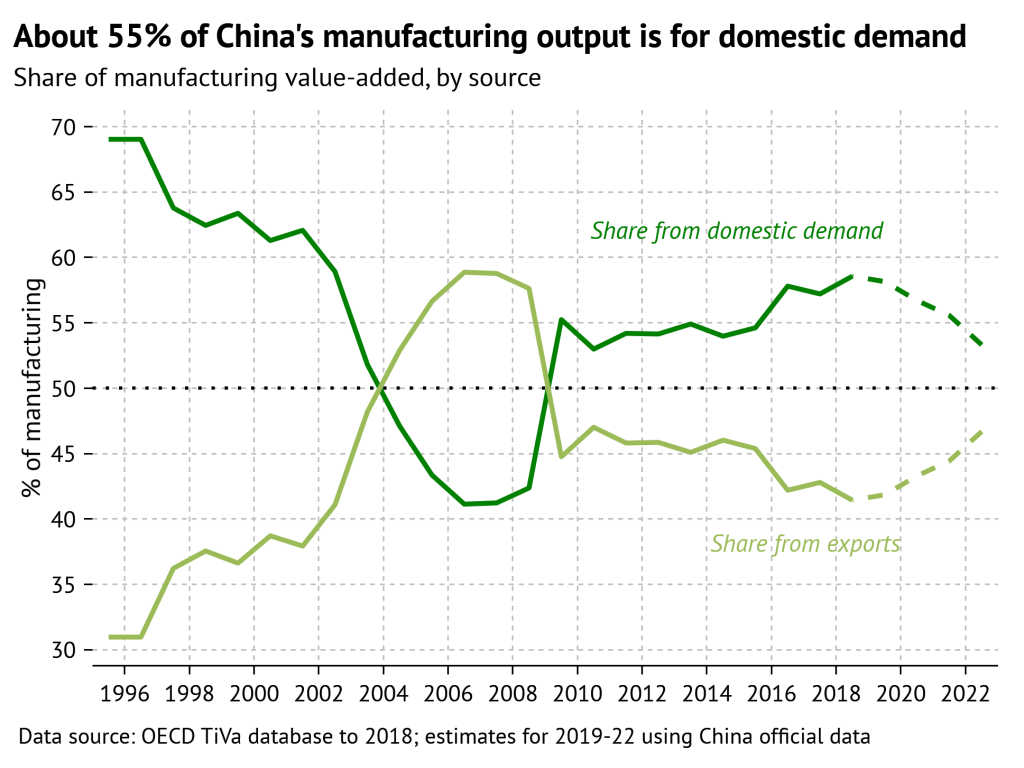
Doing this simple calculation shows that in recent years, about 40-45% of China’s manufacturing output has come from exports, while 55-60% has come from domestic demand. This pattern was established in 2009 by China’s massive property-and-infrastructure stimulus in response to the 2008 global financial crisis. Since then, the level of investment activity in the economy has stayed very elevated. So we can say that China’s manufacturing sector is indeed mainly oriented to domestic demand, but it’s definitely true that the contribution from exports is quite large. A 55-45 split in an economy of China’s size is a pretty significant reliance on external demand. And that reliance has increased more recently. The current edition of the OECD TiVA database ends in 2018; extending the estimates to 2022 shows that the export contribution has probably picked up quite a bit due to the pandemic export boom.

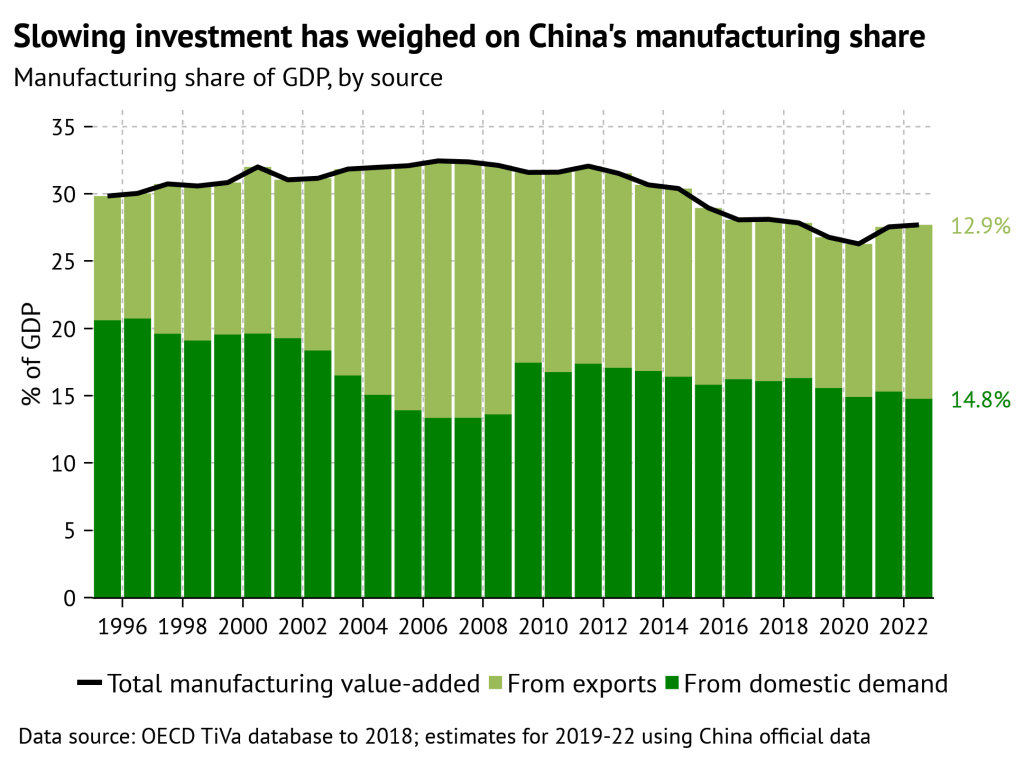
Nonetheless, China’s manufacturing share of GDP has declined since around 2010, meaning that manufacturing value-added has grown more slowly than the rest of the economy. The value-added breakdown shows that most of that slowdown has come from domestic demand, probably investment. What’s surprising is not so much that China’s investment boom has cooled off from the stimulus-driven peaks after the financial crisis, but that the slowdown has been so gradual. From about 2015-19, a slowdown in exports also contributed to the declining manufacturing share, but the pandemic export boom boosted the external demand contribution again. In a counterfactual world without the pandemic export boom, China’s manufacturing share of GDP would most likely be noticeably lower today.

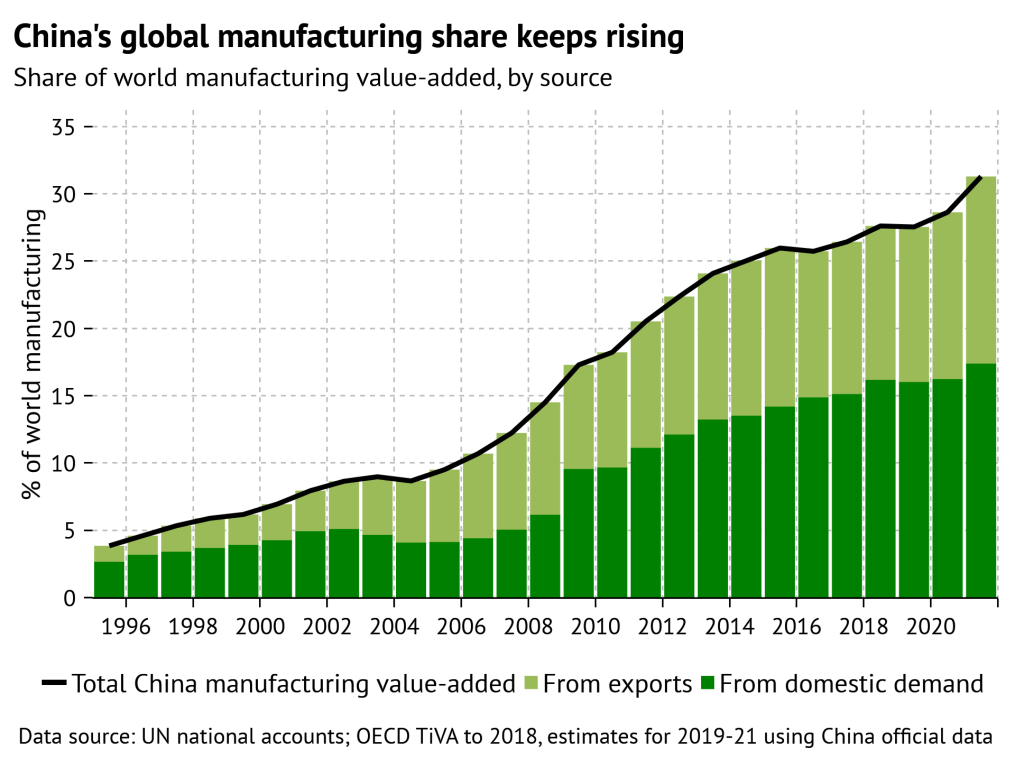
The breakdown between exports and domestic demand can also be used to shed light on China’s share of global manufacturing (using world manufacturing value-added as the denominator rather than China’s own GDP). This shows a steadily rising trend, meaning that while China’s manufacturing growth did slow down relative to the rest of China’s economy, it continued to be faster than manufacturing growth in the rest of the world. But the drivers of the increase shift over time in ways that reveal the changing patterns of growth.

From 2000-2008, China’s share of global manufacturing rose mostly, though not entirely, because of growth in exports: this was the export boom caused by the mass relocation of manufacturing capacity to China after its WTO entry. Export value-added rose to 8.4% from 2.7% of the global total, while domestic value-added rose to 6.1% from 4.3%. From 2008-2019, export value-added rose further to 11.5%, while domestic value-added rose much more, to 16%. Again, this is the post-financial crisis investment boom. Over 2020-21, export value-added rose to 13.9% while domestic value-added rose to 17.4% (the UN database that supplies the global total of manufacturing value-added hasn’t yet updated to 2022).

Whether China can sustain its pandemic-era gains in exports is obviously an important global macro question. Some of that boost was due to surges in demand in the US and elsewhere that are now retreating. But some of it was due to supply-side developments, like China’s emergence as a major vehicle exporter, that could be more durable. Success on the export front would certainly help support China’s share of global manufacturing and its manufacturing share of GDP. But the crucial factor is really whether China can sustain the super-elevated levels of investment that have driven domestic demand for manufactured goods. Given the unwinding of the property boom and the complete buildout of many forms of infrastructure, this seems increasingly unlikely. Broadly, the fading of the post-crisis investment boom is why I think China’s manufacturing share is probably going to decline again (see my earlier post, “Re-de-industrialization“).

Technical note. Making these calculations using the OECD TiVA database was pretty straightforward. Extending them into more recent years using China official data was a bit tricky. The total for China manufacturing value-added in the TiVA database was basically the same as in the NBS national accounts. However, the value of manufacturing exports is not the same; the TiVA database is built on top of international input-output tables that try to make different countries’ trade figures consistent. Usually, the value of China’s manufacturing exports in TiVA is around 80% of the value of manufacturing exports reported by China Customs. I’m not sure what the reason for this is, but it seems to suggest the headline value of manufacturing exports is overstated. Using the Customs value of manufacturing exports generated a residual for domestic manufacturing demand that was implausibly small, so I adjusted it to be consistent with the TiVA data by using the ratio between the Customs figure and the TiVA figure.

Modern central banking in the modernization drive

Shortly after being reappointed as the governor of China’s central bank, Yi Gang gave a speech in Beijing with the rather dull title of “Building a Modern Central Banking System to Contribute to Chinese Modernization.” As is obligatory with the speeches of most Chinese officials, it opens and concludes with references to the important decisions of the Communist Party and the major slogans of the moment.

The key term in the title of the speech is one of these coinages from Xi Jinping: the more precise translation would be Chinese-style modernization (中国式现代化), as it refers not simply to the modernization of China but modernization done China’s way. It’s one of the umbrella terms for his overarching project of achieving national greatness.

The bulk of the speech consists of Yi summarizing the central bank’s major policy priorities and justifying how it has pursued them. The temptation for foreign readers is to skip over the political sloganeering at the beginning and end and focus on the technical content in the middle.

Indeed, this was the approach that Yi himself took when he gave a more elaborate version of the same presentation, in English and with charts and references to the economics literature, to an audience in the US. Yi favorably compared the gradualist methods of the People’s Bank of China, which moves interest rates rarely and in small intervals, to the dramatic recent swings in Federal Reserve policy (see the writeup in The Economist for more on this angle).

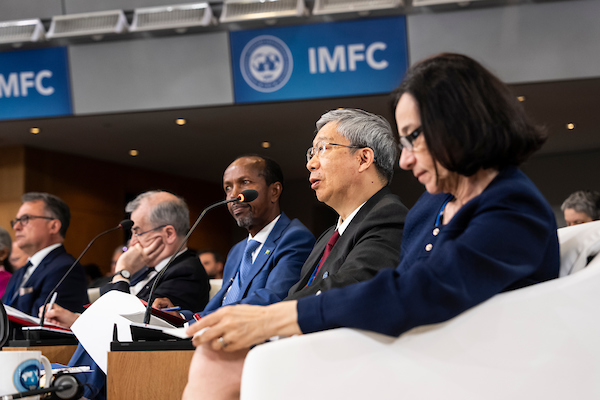
Yi Gang on April 14, 2023

But abstracting Yi’s speech from the Chinese political context in this way risks blinding us to the some of the significance of what he says. How Yi positions the central bank’s technical policy priorities relative to the overarching goals of the Communist Party leadership is a very important part of his speech. What I think he is doing is nothing less than trying to ensure that modern central banking and financial regulation can be implemented in the Chinese political context.

To maintain political buy-in from the leadership for his preferred policies, Yi needs to convince them that these policies do in fact serve the overarching political goals set by Xi. He starts off his speech by citing the official mandates of the People’s Bank of China, as written in Chinese law. Based on the text of the law, he asserts that

Preserving currency stability and financial stability are the two central tasks of the PBOC. On this point, everyone has increasingly reached a consensus in recent years. By properly accomplishing these two tasks, we can promote full employment and economic growth, which better serves Chinese-style modernization.

That is pretty direct and clear: the traditional goals of the PBOC and the consensus of technical experts are not in conflict with the current political agenda, but actually support it. Yi further elaborates that the concept of currency stability includes stability of consumer prices and stability of the exchange rate, both of which are not only beneficial to the population at large but help the nation achieve long-term goals:

Stable consumer prices and exchange rates serve to safeguard the pocketbooks of consumers, so that the money in their hands won’t depreciate. Fundamentally, this is a people-centered effort to safeguard the interests of the broadest possible majority of the people. …

Price stability and the basic stability of the renminbi exchange rate at an adaptive and equilibrium level provide strong support for us to realize the strategic goal of Chinese-style modernization. 

At the end of the speech, Yi acknowledges that the new agenda laid out by Xi at the Party Congress and other high-level meetings requires at the Party Congress “means new requirements” for the work of central bankers. But fundamentally what he is saying in this speech is that these new requirements can be met by the same old policies. The key ones he highlights in the speech are: a less controlled and more market-determined exchange rate, strict regulation oriented towards preventing financial risk, and a conservative monetary policy biased against dramatic moves.

This emphasis on stability and continuity is probably why Yi’s speech got little attention in the press. He did not propose anything new, and largely emphasized recent accomplishments. But that is the point he wants to make: these policies have been successful in making China stronger, so they should continue. You don’t have to agree that his argument is correct on the merits to understand that he wishes to preserve the PBOC’s autonomy and policy preferences in an era of heightened politicization and grand campaigns.

It’s not hard to imagine how some of Xi Jinping’s priorities could potentially have big implication for macroeconomic policies. He has a vision of a whole-of-society effort to refashion China’s industrial base to make it less vulnerable to external shocks. His “dual circulation” concept calls for reducing China’s economic dependence on the rest of the world while increasing the rest of the world’s economic dependence on China.

To pursue these ideals, some officials could perhaps argue for an aggressively undervalued exchange rate, that keeps exports competitive and deters domestic spending on imports, or a much looser monetary policy, to ensure industrial upgrading has plenty of resources. That stuff hasn’t happened, perhaps because Xi favors strict supervision and control in finance as in other areas. But it’s still an open question how existing macroeconomic policies will adapt to the political requirements of Xi’s so-called “new era.”

Beijing Q&A on growth and security

 In Beijing earlier this month, I bumped into some former colleagues from the foreign press corps, and was invited to come talk to the Foreign Correspondents’ Club of China. As a former officer of the FCCC, I could not turn down such an invitation. Below is a transcript of that session on May 3; it was all Q&A, pretty lively, and we covered a lot of ground. I’ve cut out a few bits where my answers were short or unilluminating, and smoothed out the speech for easier reading.

· · ·

Q: Andrew, maybe we start with this. I saw you wrote a piece the other day about the Politburo on the state of the economy last week and which I also found very interesting. So what are the other key takeaways from this meeting? The signals seem to be more mixed, not really upbeat, enthusiastic but more sober as far as I understand.

A: I think there are a few key messages from the Politburo meeting.

The first was basically to deliver a positive assessment of the economy: they said very clearly that the economy is performing better than expected. I guess it depends whose expectations that is relative to, and I think they mean their own expectations as of late last year. If we think back a bit, remember that a lot of people worried that there would be multiple waves of Covid outbreaks and that the economy wouldn’t really get going until Q2. And in fact Covid wrapped up pretty quickly and things started to get back to normal just before Chinese New Year. So overall, the first quarter was better than expected for that reason.

The corollary to the better than expected outcome is that they don’t need to necessarily juice the economy a lot more. The economic policies that they’ve taken over the past year have been pretty extensive, but I think a lot of them didn’t really have a chance to work cause of the disruption from Covid lockdowns. There’s a cumulative effect of various things they’ve done in terms of loosening property market policies, cutting interest rates, expanding credit growth. Basically all of that stuff is hitting the economy now as a delayed impact over several months. I think their assessment is that this stuff is working, it’s feeding its way through into the economy, and we don’t necessarily need to pump it up a lot more since growth has already accelerated.

And then another key message was really to reassure people that the disruptions of the last couple of years will not return. So you’ve seen in the rhetoric very clearly over the last few months this repeated mention of support for the private sector, even specifically support for the internet platform companies that were the target of severe regulatory action in 2021. That’s a pretty clear shift in the signaling on this particular issue.

There is a longer term question that everybody acknowledges, and I think it’s interesting that the Politburo also acknowledged it in the communique. Yes, we’re having this bounce back in consumption. Everybody can see that, it’s a natural process. Obviously people have been prevented from consuming as normal for quite some time. So we should expect that they come back and do some of the things that they’ve been wanting to do for a long time. But is that really enough to drive sustainable growth for the economy over more than the very short term?

Q: What we’ve seen over the past few weeks is more like an overshooting of consumption as people want to travel again. Over the next few weeks, we might see a moderation, and see that this was more or less revenge spending and then things will normalize. I’m thinking of unemployment rates among the youth, and I’m thinking of lagging household income growth. And then at the same time we’ve seen private investments are still pretty low. So that this ends up like an L-shaped recovery, which will then moderate very fast during the second half of the year probably.

A: Yeah, that’s one view. My view is a little bit different, and is maybe a little more optimistic than that. I don’t think consumption is overshooting right now. If we look at different indicators of consumer spending, they’re still below where they should be based on the pre-pandemic trends. Right? If we just assume that those growth rates had continued, then household spending should be up here, and instead it’s still about here.

So, I don’t think that consumption is overshooting. I think it’s in the process of getting back to trend. And there’s still more room for consumption to continue to improve in coming months. In the very short term, there is this kind of snapback dynamic. There’s probably a lot of pent-up demand in the first quarter, and maybe some of that comes off a bit in April. But early indications are that the travel for the May Day holiday was also pretty good. So maybe things pick up again in May. I’m not the expert on this kind of micro forecasting of what the Chinese economy is doing week by week. But my basic view is that the rebound in consumption has started and it still has some way to run rather than already being exhausted.

And I think the prospects for the second half of the year are actually a little bit better. One reason is that in this initial phase of reopening from Covid, you’re seeing what I would call trickle-down consumption.

You have the high-income households, the people who were able to wait out the lockdowns working on their laptops from home, whose salaries were not cut, who didn’t lose their jobs. They have household savings, and they have the same income that they had before Covid, or even higher, and just haven’t been able to consume as normal. They have come out in force in the initial stages. And as they spend more on recreation, services, travel, all that stuff, they support employment in service sectors and create more jobs. Then you’ll see some of those gains trickle down to lower parts of the household income distribution.

So I think in the first half of the year you have this initial boom of spending from the upper half of the distribution. We’re already seeing signs that the the job market is improving, unemployment is coming down. Business surveys show that companies are hiring more and worth paying higher wages. This stuff takes effect with a little bit of a lag, and I think it will show up more obviously in the second half of the year.

· · ·

Q: One interesting thing that was in the readout from the Politburo meeting, and you also mentioned it during your first answer, that there’s a commitment that they’re not going to repeat the mistakes of the past, like on internet platforms and private business and so on. How can we be really sure that this is not going to happen? I mean, we’ve just seen very loud commitments to foreign investment and they want foreign companies to come in. At the same time they’re raiding the offices of foreign companies. And so there’s always, in my view at least, a gap between the official rhetoric and then what’s going to happen on the ground and in the provinces and cities.

A: Yeah, that’s obviously a very fair point. I think generally there’s an issue with authoritarian regimes making promises about what actions they will take in the future. Because by the nature of the regime, their actions are not bound by any external constraint. So it’s hard for them to credibly commit to not doing certain things. They may feel like not doing them now, but if they feel like doing them later, there’s nothing to stop them basically.

I guess my view on this is a little bit cynical. There’s a school of thought out there that that the new administration led by the new Premier is trying to bring back a quote unquote pragmatic, quote unquote business-friendly, style of policy making. I think that’s true in kind of a short-term tactical sense. I don’t think it’s true in a long-term strategic sense.

The the top guy has been pretty clear that he wants to reorient the way the Chinese bureaucracy functions away from the all-out pursuit of economic growth and towards the pursuit of a different set of goals. And I think the style of policy making that people now conventionally describe as pragmatic and business-friendly was really an artifact of that previous policy orientation — where every government official at every level knew that they had to do anything they could to support economic growth. And that’s not the regime that we’re currently in.

· · ·

Q: Can the youth unemployment problem be solved in coming years? Or is it some kind of structural problem? There’s more and more young people coming to the job work market from the universities every year.

A: I think high youth unemployment right now is a cyclical problem, not a structural problem. I think it’s a result of basically everything that happened during Covid with all the lockdowns that destroyed a lot of service sector employment, which is precisely the kind of jobs that young people tend to take at the very early stage of their career.

Right now I think that youth unemployment is just kind of a more volatile indicator of overall unemployment. It’s higher than total unemployment. But as total unemployment comes down, I think youth unemployment should also come down. That’s based on the argument that I just made, that the improved consumer spending on services is going to create jobs, or restore jobs that were destroyed over the last three years, since there is some recent improvement there.

I think there is a structural mismatch in the Chinese labor market. I’m not sure if high youth unemployment is exactly the right diagnosis for it. Basically you’ve had a huge expansion of university education over the last couple of decades. So right now the system is producing a lot of people who, because they have university degrees, want to be white collar employees. And that is the whole point of having a university degree: that you can be a white-collar salaried employee and work with your mind and not with your hands. But in fact, a lot of the jobs that the economy is creating are more blue-collar jobs where you do work with your hands and not with your mind.

So I think there is a kind of a structural mismatch. I’m not sure there’s a mismatch in terms of the number of people, but there is a mismatch in terms of people’s expectations about what kind of jobs that they’re entitled to as a result of their own efforts, and then what kind of jobs the economy is actually offering.

· · ·

Q: Can I just go back to what you were saying about the overall policy direction and to ask you what do you think foreign investors ought to think about common prosperity, what it means for them? You can also tell us what you think it means.

A: One interpretation of the rhetoric on common prosperity is that the government wishes to have a more explicitly left-wing, socialist, social democratic, call it what you will, type of policy and be more aggressive in redistributing incomes. Some people are worried about that because they see a lot of China’s success as having come from pursuing relatively more liberal, free-market policies rather than these kinds of measures that we’d associate with European social welfare states.

I don’t think that’s what common prosperity actually is. So if people are worried that there is going to be new government program to expand the welfare state and redistribute income, they can rest assured that, at least in my view, that’s not going to happen.

I think the common prosperity rhetoric is more political signaling from the top. It’s more a kind of political campaign to signal the administration’s adherence to socialist values.

It is, strangely enough, not really connected to specific policy discussions. In fact, if you read the debates about common prosperity domestically, there’s a lot of people who are saying, well, we have this goal of common prosperity, that means we should implement measures like, better unemployment insurance, or a better pension system. And yet there doesn’t seem to be any actual interest in or movement toward doing these things.

So I don’t think the common prosperity rhetoric is a sign of a so-called leftist tilt in Chinese policymaking. The actual substance of it is a bit harder to interpret, I think, for outsiders. But again it is, in my view, more of a political campaign that’s oriented around symbolic gestures rather than substantive changes in economic policy.

· · ·

Q: What’s going on in the property market?

A: Property, always a super interesting question for China. I think the surprise in the first couple months of this year is that property market sentiment was actually pretty decent. Sales were up quite a lot, and prices are rising in most of the cities. Again, I think there’s this pent-up demand issue where a lot of stuff snaps back immediately after the reopening. Maybe it doesn’t last quite as long, and property sales have tailed off a bit from where they were in January and February. But they’re still running decently above last year’s level.

So it does seem that in fact property is going to be a growth contributor for China this year, which is not something that a lot of people necessarily expected last year when we went through the biggest property market correction in modern Chinese history.

The outlook past this year I think is a little more equivocal. It’s our view and the view I think of pretty much everyone that the fundamental demand for housing in China is probably at or past its peak. It’s probably not a growth sector for the economy in the future. So it’s going to be stable or declining as a share of the economy, which means it’s going to be be subtracting from growth rather than adding to it, on average, in the future.

This year sales are likely to be okay. Construction is not that great. But if sales have a good year, and property developers’ financial situation improves, they’ll leave it more cashed up. So you can maybe have decent construction into next year as well.

But again, I think these are short-term cyclical dynamics. If you look at the government’s signaling on property policy, it’s pretty consistent. Of course they realize that last year was kind of a mess, and they want to get out of that mess, and get the market back to more normal levels of activity.

But they’ve been engaged in an effort over the last several years to actively try to wean the economy of its reliance on real estate, and to bring down levels of leverage of property developers and generally shift the balance of the sector away from private-sector profit maximization and towards more fulfilling a public-service role where there’s more construction of social housing, rental housing and other stuff that’s not as purely profitable as the private luxury market stuff. So I think the direction of travel for the property sector is pretty clear by now.

Q: What can China do in terms of finding new growth sectors for the economy to replace property and real estate? And then the second question is what could China do to prepare its economy for the possibility of conflict over Taiwan?

A: These are both great questions. And in fact, they’re the same question, at least I think from the perspective of the government. So what I thought was the most interesting about the both the Politburo meeting that we just had, and also a lot of the other rhetoric that’s been coming out of the government, is that after the Party Congress, the leadership seems intent on reorienting government priorities towards this geopolitical competition with the US.

And the overriding economic priority is to build up the economy so that it can survive, prosper and prevail in that competition. Of course that means increasing scientific and technological self-reliance, which they have talked about ad nauseum for several years now. And we’re also now seeing this language about building a modernized industrial system, and this seems to have some security connotations.

What I think is going on is that the government essentially wants to drive growth by investing in a whole-of-society effort to reshape the Chinese economy for this geopolitical competition with the US. They think that not only is this a national security priority, but it is also something that can be a growth driver for the economy.

The first of those is something that we’ve known already over the last couple years. And what I think is interesting is that they gave this indication that they see this refashioning of China’s industrial base not just as a security issue, but also as the core of their economic policy.

Q: A related question is do you feel also that the economy is changing more into a war economy? Especially if you look at what’s happening at the countryside, more stress on producing, let’s say rice and less on producing tea, et cetera.

A: I don’t think I would describe it as a war economy. But what we do see is a generalized focus on national security, what they call the holistic national security concept which encompasses many different areas including food security, which is obviously a very close interest of Xi’s, energy security, technological security, and so on and so forth.

I think it’s a general effort to harden the economy against external shocks. I wouldn’t go so far as to say it’s an effort to put the economy on a war footing. I don’t see evidence of that. But it is based on the recognition that China is operating in what they view as a more uncertain, more hostile world. It’s their responsibility to protect the economy from external forces.

· · ·

Q: China has a 17% value added tax. So if you reduce the value added tax, would that help increase consumption?

A: I’m going to kind of dodge the question and say I don’t think they’re going to do that. The reason is that China actually has very few reliable sources of tax revenue. Their tax structure is quite unusual. It’s heavily reliant on the VAT, the corporate income tax and then various transaction taxes including taxes on property and other stuff like that.

If you look at the government revenue structures of the US and European countries, they get a lot of revenue from the individual income tax, and that’s basically what they use to fund welfare states. China has made a political decision of long standing that they’re not going to have substantial direct taxation of household incomes.

And so that creates some constraints for them in terms of what they can do with government revenue. They’ve already cut corporate taxes substantially over the last several years. I can’t remember the figures off the top of my head, but the taxation of companies as a share of GDP has gone down substantially since 2016.

And they have, as you know, a lot of future obligations. They’ve got this burden of the aging population to deal with. They’ve got this massive local government debt problem, which the central government is probably going to have to use its own financial resources to solve.

Basically in the future they need more tax revenue, not less. So I think it’s pretty unlikely that they would substantially cut the VAT because it’s their best source of tax revenue.

· · ·

Q: Just a short question on the GDP growth target. Do you think they’re ever going to get rid of it?

A: I think this is an interesting question. One of the things that Xi Jinping did at the Party Congress in 2017 was to signal a shift away from the focus on GDP growth as the be-all and end-all of China’s political objectives. And so it’s kind of interesting that, in that context, they still retain a GDP growth target. Even though the political messaging around the target and the administrative structure around it is quite different.

People have different theories about this. One of the theories is just that there’s a lot of inertia in the Chinese system and actually a lot of different departments in the Chinese government need the GDP target as a kind of a reference. They need to have some kind of number to base their plans for the coming year on. If they don’t have a GDP target then what number are they going to use? You need some kind of anchor for just the internal forecasting and budgeting work of the government. Since you have to have some target, since there has to be some kind of internal reference, you might as well keep it.

There’s also been for been for many years, as you know, a view that having the GDP target was distorting, that it created incentives for local governments in particular to act in destructive ways. I actually remember many times when I was on the other side of the microphone and calling up various economists to ask them for quotes, and they would always say, oh, you know, China has to get rid the GDP target and transition to a market-based economy and blah, blah, blah.

I think actually the GDP targets serve as a useful discipline on the government. They are to some extent a remnant of the previous regime in which government policy was oriented around the pursuit of economic growth, and the need to ensure economic growth acted as kind of a disciplining mechanism on government decisions. So if they knew that doing X would have a large negative impact on economic growth, that was a good reason for not doing X. And then if you don’t have a GDP growth target and you don’t have the necessity to drive growth so much, then you might go ahead and do X anyway, and that wouldn’t be good.

So I think in the Chinese political system, the GDP growth targets do serve a useful function in terms of putting some guardrails around the government’s intervention in the economy. My view, maybe it’s a bit against consensus, is that keeping them for the moment is actually not a bad thing.

· · ·

Q: If I understand right, you said earlier that the government in China wants to drive the growth by investing in preparing the society and economy for political competition with United States, self-reliance on food, energy, science, technology, et cetera. If suddenly they are putting a whole lot of energy and resources into making themselves self-reliant rather than focusing on making money and getting foreign factories in, isn’t it going to be more costs than profit? It’s going to be a huge gamble right now. So the question is does the Chinese focus on increasing self-reliance and economic security impose a cost on the economy, relative to a more open trajectory?

A: The standard economist’s answer to this would be absolutely yes. The reason that you have this globally distributed division of labor in the semiconductor industry and many other sectors is that you have a high degree of specialization in different functions across different geographies. By arranging things in this way, everyone can do what they’re best at, and then the overall profitability and efficiency of the system is maximized.

So what China is doing in terms of trying to replicate domestically capabilities which already exist outside of China is in a sense duplicative investment. Is it really going to benefit the economy to invest in doing these things which don’t really push the frontier of human knowledge forward, but just kind of repeat and duplicate what already exists? Probably that is a lower productivity trajectory for Chinese investment.

But as you know, the reason that they are doing this is that they see even greater risks that they would be denied access to these critical inputs, to critical materials and the ability to build up their technological base. So it is worth spending some money to avert that risk in the future. I think that’s ultimately a political judgment rather than an economic judgment. The reasons why they are doing that are pretty clear. And they are not imaginary, these are real issues for them.

· · ·

Q: I was wondering could you say something about the impact of de-risking from China, which we are hearing about all the time, not just in tech but in many sectors. I think last year, a quarter of European companies said they were considering shifting their investments, but considering and doing as of course, a different thing. As far as you can tell, is it happening on a big scale, does it have an impact on the overall economy?

A: This is a tricky one. The data on this stuff are hard to read to be honest. The IMF had a study in the most recent World Economic Outlook report which looked at FDI data and found some evidence that there was a shift at the margin away from China as a destination for investment. That’s probably the best look at the underlying realities that I’m aware of right now.

I would say, based on my conversations with foreign businesses and what I’ve seen here that there is a general shift away from using China as a global export base and more towards being in China to serve the Chinese market.

Multinationals have always had multiple strategies relative to China. Obviously China is the world’s second-largest economy, it’s not going away. If you want to be a globally successful producer of consumer or producer goods you need to have a presence in the Chinese market. So for many companies that hasn’t changed, nor can it change in a reasonable way.

But there’s been another aspect of that, which is using China as a manufacturing base to supply markets outside of China. The trade war with the US, various supply chain disruptions, the general perception of higher geopolitical risk due to the bad state of US-China relations, I think all of that all can change people’s thinking on this.

There’s a shift at the margin here. None of this stuff happens very rapidly. Factories take a long time to build. So this is a multi-year process process. And I don’t think you’re going to see dramatic exits from China. But I do think there has been a real shift in people’s understanding of the balance of risks relative to China that’s going to affect their presence here.

· · ·

Q: You mentioned that you’ve been noticing that national security has been driving the leadership. Is there a coherent model that the government has in mind of a a national security focused economic strategy?

A: Hmm, I’m going to say no. But there’s a grand Chinese tradition of figuring things out as you go along, right? Crossing the river by feeling the stones. So I think they know the direction that they would like to go in. And so they will try to figure things out as they head in that direction.

Again going back to the Politburo meeting last week and the readout from that, one of the interesting things is that they they highlighted the success of China’s electric vehicle industry. What is now getting global notice is the EV exports surge, particularly into Europe. And also you’re seeing the domestic EV brands really take over the domestic market and the legacy foreign automakers are quite worried about their prospects here. So I think it’s reasonable that China sees that as a success for industrial policy. They moved ahead with investing in a a new economic sector, and attained a leadership position that they can now leverage to support the overall economy.

I’m not sure that the EV industry is a model that’s easily replicable. Generational transitions in the single most important durable consumer good don’t come along very often. So there’s not necessarily another consumer product that’s comparable to cars that’s going to go through a comparable technological transition out there.

Also, and I think this goes back to the question about de-risking, one of the reasons you’ve seen the success of the EV industry and particularly of EV exports is that China was chosen as a global manufacturing base by global producers, most notably Tesla but also some of the other European brands. So the EV exports from China are not all Chinese brands, there are foreign brands in there. And that reflects decisions about supply chains that were made many years in advance because it takes a long time to build factories and put together the whole industrial chain.

I think, given the current geopolitical situation in the world, that it’s hard to envisage multinational companies deciding to make China the global export base for whatever their next big product is. Maybe that decision was understandable five or six years ago. I think it would be a lot harder to make that kind of decision now.

So the particular model that China followed in EVs, which was heavily domestically focused but also relied on this global manufacturing base, I think will be harder to do again in the future.

Q: I was quite struck when you characterized the potential growth drivers in China around self-reliance and national security. You go back a couple years to the five-year plan, there was really a strong theme about investments in basic research, science and technology. And obviously that can work pretty well with the way that you characterized the potential growth drivers in China.

Another way of characterizing that is a movement up the value chain into higher value manufacturing, higher value jobs. There was, at that time, almost a sense that policy makers saw this industrial change as a bit of a silver bullet for some of the economic woes: Invest more in high value industry to transform China from low value manufacturing to high value manufacturing, high paying jobs.

Now, I think you’ve sort of touched on the fact that there isn’t a coherent model yet, or there’s a variety of models. There’s the EV model and the chip model and the aircraft manufacturing model. They’re all pretty different. I guess I was wondering, what do you think China’s prospects are for moving up the value chain longer term, noting the challenges you’ve laid out?

A: So is moving up the value chain a focus of policymakers? Absolutely. But I think one thing that’s implied by the more intense focus on national security that we see now relative to even a few years ago is that it’s not just about moving up the value chain. It’s about keeping the entirety of the value chain within China, or at least, under effective control by China.

So I think there’s a slightly different conception here. Yes, China wants to occupy the high end so that they can compete effectively at a global level with the advanced economies. But also, I don’t think that they’re as relaxed maybe as they would’ve been in a previous generation about seeing some of that low end stuff go away. Maybe they’re going to feel that there’s a more of a need to keep those kind of basic components within China security and controllability purposes.

Moving up the value chain, this kind of rhetoric, is based on the theory of globalization, where you have have this geographic specialization at different points in the supply chain. So as one country moves to the high end of the supply chain, another country can come in and occupy you the medium and lower ends. And then you have high levels of global trade to make the whole thing work.

If, as both US and Chinese leaders have seemed to signal recently, we are moving into an era where countries don’t take globalization for granted, they don’t take high levels of trade for granted and they see a higher necessity of controlling for risks and uncertainty, then it implies a kind of a different orientation towards the position in the value chain. And not necessarily to vacate positions in the value chain as they move up.