The where and why of East China

The easternmost parts of China are in fact pretty far east–from there it’s only about 500 more miles east to reach Japan, which is closer than Beijing. The area would be in the same time zone as Korea, if China did not ignore time zones and force everywhere to run on Beijing time. But the easternmost parts of China, which are in the provinces of Heilongjiang and Jilin, are not East With A Capital E: they are not in the officially defined region of East China which every schoolchild learns and which shapes every map and statistical release. Somewhat bizarrely, the easternmost parts of China are in fact designated as being part of “Central China.” Once I finally absorbed just how weird this is, it became clear to me that these regional categories are not simple descriptions of geographic reality but something more complicated. So why is eastern China not the same thing as East China?

east-west-central

As I learned from a classic article by geographer Cindy Fan (JSTOR link), the modern definition of “East China” is in fact an industrial policy program from the early years of the reform era. According to Fan, the current West-Central-East scheme of dividing up the provinces originated in the Sixth Five-Year Plan (1981-85), and was formalized in the Seventh Five-Year Plan (1986-90). The main purpose of the division was to give more favorable treatment to the coastal provinces and focus on developing foreign trade. (As you can see from the map, “East China” includes any province with a coastline, some of which of which are as far west as “Central” provinces.) This decision represented a backlash against the regional policies of the Mao era, which had spread state-sponsored investments–like the infamous “Third Front” military-industrial projects–across the interior in an attempt to narrow regional economic gaps. It was eventually realized that these investments had been generally bad and produced few returns. So rather than try to remove the coast’s historic advantages, the government decided to capitalize on them, and hope the resulting growth would lift the interior provinces as well. Which it more or less did.

The pendulum started to swing back toward favoring the interior provinces in 1998 with the launch of a program to “develop the west.” Concern about uneven development and regional inequality has been a persistent feature of Chinese Communist economic thinking, and these concerns had been put on hold rather than forgotten during the two decades or so of coastal favoritism. The western development program indeed had an old-school feel,  focusing on state-sponsored investments, though more in infrastructure than heavy industry or defense. And it was quickly followed by similar programs to “revive the northeast” and to promote the “rise of central China.”

Although I don’t want to go into too much detail about these programs, it does seem pretty clear that all these measures supporting investment in inland provinces did in fact lead to a lot more investment in inland provinces. There was lots of press coverage about the boom in the western provinces, which were growing faster than the east. In fact we can see that the much-discussed rise in China’s investment share of GDP is most intense in the inland provinces (the investment share of GDP at the provincial level is not consistent with the same figure at the national level, in part because the national figures attempt to correct for overstated investments in the provincial figures.) To me it seems quite plausible that at least some of this distortion is the result of all these regional development programs.

regional-investment-share

So one of my big questions about the current government has been whether the pendulum will swing back the other way–whether they will, as in the 1980s, get tired of making lots of poor investments in the inland provinces. The general rhetoric of giving a greater role to market forces could certainly imply a lower priority for these regional development programs, which by their nature try to stand in the way of the market forces that tend to reinforce gains in the coastal provinces. There are some interesting signals: in this year’s government work report Premier Li Keqiang said “we will support the eastern region in taking the lead in development”–which certainly sounds like a return to the 1980s-era policies. On the other hand, he continued to endorse the regional development programs for the west, northeast and central regions, which are promised more government funds. But given how hard the current downturn is hitting some inland provinces, in part because of their heavy dependence on mining, my bet is that East China is going to reclaim its leadership position anyway.
Can a closed internet be good industrial policy?

The latest round in the seemingly inexorable tightening of restrictions on internet use in China has gotten a lot of press coverage. And indeed, the mass of mechanisms blocking internet users in China from many major global sites and services, collectively known as the “Great Firewall,” hits people like me and foreign journalists hard, since we are physically located in China but have to stay linked to the outside world for professional reasons. It’s a terrible situation that keeps getting worse. While I could complain more about this, I’d rather try to think through some of the questions it raises. The spark for this is some recent Chinese statements justifying the internet controls, not for the usual political and moral reasons, but for economic ones–that they helped create China’s very large and successful internet companies.

The idea that Chinese internet companies are only successful because they can hide behind trade barriers is a pretty common view among foreigners here: how could a Chinese search engine out-compete Google if Google was not blocked? But most of my friends who work in the Chinese internet industry have always dismissed this line as uninformed, biased Western propaganda. They tend to say that the big American internet companies lost the China market because of their own mistakes. I’m a lot more sympathetic to this view than I used to be; my company has published detailed profiles of Alibaba and Tencent (sorry, subscribers only), and their history definitely supports the idea that these firms are successful because they came up with unique services that worked very well in China. People who don’t understand those companies, in my experience, consistently under-estimate how much business-model innovation they have done; in fact Alibaba and Tencent do not do at all the same thing as Google/Facebook/whoever. So it’s funny to see some quasi-official voices now coming out to say, in essence, those critics were right and in fact our internet companies do depend on market barriers erected by government policy.

Here are the two sources for this. Wen Ku, an official at the Ministry of Industry and Information Technology, had to answer a question at a press conference about the tightening of internet restrictions, and came pretty close to saying that can be justified because of how they help domestic companies (my translation):

In China, the Internet sector has developed very well, some good companies have growth rates of around 40-50%. Everyone can see Alibaba’s achievement in getting listed in the US. All of this comes from the Chinese government ensuring there is a good policy environment for the development of internet companies. Internet development in China must be in accord with China’s laws and regulations, and any unhealthy information should be managed according to Chinese laws.

In case those bureaucratic circumlocutions did not get the point across, the Global Times newspaper, a reliable purveyor of nationalist screeds, then made the claim much more directly in an editorial (again, my translation from the Chinese):

China’s Great Firewall is in fact a success, it has created the reality of China’s internet development today. China has produced network giants like BAT (Baidu-Alibaba-Tencent), they fulfill the vast majority of Chinese internet users’ needs, and are even expanding abroad. This is possibly an unintended consequence of the Great Firewall. If there was not this kind of management, then China today would perhaps be dominated by “Google China”, “Yahoo China” and “Facebook China”.

So here’s the big question: are these folks right? Is blocking global internet companies from offering all their services in China actually a good industrial policy, that is justified because it helps foster Chinese internet companies? And would this in turn mean that the Great Firewall, paradoxically, allows for more innovation and competition in the internet globally, because it is not dominated by an American oligopoly? I think this worth actually thinking about rather than dismissing out of hand. As much as I would like to be able to use my Gmail more easily, it’s not obviously the case that everyone in China would be better off if there was in fact no big domestic internet sector and everyone just used Google.

In essence the argument seems to be one for import-substituting industrial policies; by blocking the import of various internet services, China can create domestic companies and jobs that otherwise would not exist. Yet I do not think this argument is correct, and the reasons go back to the same ones that led import substitution policies to often fail in other industries and other countries. As my old colleague Joe Studwell showed very clearly in his book How Asia Works, the industrial policies that have been successful in Asia have in fact not been about blocking imports; instead, they encourage exports.

Blocking imports typically does not do much to encourage domestic companies to raise their game and improve technology. Particularly in lower-income countries, domestic markets are often small and underdeveloped, and are easily dominated by local tycoons or oligopolies that can turn policy and regulators to their advantage. Rather than increasing competition, import substitution reduces it, and lowers the incentive for domestic companies to meet or match the global technological level–they don’t have to, because they a captive market. So instead of giving domestic companies a free ride, good industrial policies force them to go out and compete in the global marketplace, where they can’t survive solely on the favoritism of regulators and have to adapt and innovate.

This is not to say that some Chinese internet companies do not prosper because of the government’s barriers; there is a whole sub-industry of companies offering local equivalents of global internet services. But it would be a mistake for the Chinese government to think that because they have both 1) some large successful internet companies, and 2) the Great Firewall, that having more of 2) means they will also get more of 1). The history and logic of industrial policy suggests they will not. A better course, again based on parallels with industrial policy for other sectors, might be to reward internet companies that are successful in selling their services outside of China. Though there is probably not much actual need for the government to do this, given the enormous slums sloshing around in venture-capital funds looking for the next big thing in the Chinese internet.

Ultimately, though, I doubt economic or industrial-policy motivations are really behind the policy of restricting access to the global internet, so I wouldn’t expect these criticisms (even when articulated by someone more influential than me) to have much effect. The politics are much more important.

Why is Justin Lin still obsessed with 8% growth?

Justin Yifu Lin, the former chief economist of the World Bank, has a piece out on Project Syndicate giving a fairly rosy outlook for China’s future growth. Basically, he thinks China can still grow at 8%, but the government is going to be prudent and conservative and set its growth targets a bit lower. This should be no surprise to anyone who has been paying attention to his public statements over the years: ten years ago he thought China had very high growth potential, and he still thinks that today.

Now Justin is perhaps the best-known Chinese economist in the world, and I am not, but I found his piece troubling in a couple of respects. It’s odd that he expresses so much certainty about a topic–future growth rates–about which there really is not a lot of certainty. What is odder is that Justin seems to be even more certain about future growth than the Chinese government, which has not officially aimed for 8% growth since 2012. I think this focus on delivering a positive message about growth prospects means that his piece ends up not being a particularly good guide to the current economic debates within China, as I’ll try to explain.

So how can we be so sure that China can grow at 8%? Here is Justin’s explanation, which is based on ideas about convergence and catch-up growth:

In 2008, China’s per capita income was just over one-fifth that of the United States. This gap is roughly equal to the gap between the US and Japan in 1951, after which Japan grew at an average annual rate of 9.2% for the next 20 years, or between the US and South Korea in 1977, after which South Korea grew at 7.6% per year for two decades. Singapore in 1967 and Taiwan in 1975 had similar gaps – followed by similar growth rates. By extension, in the 20 years after 2008, China should have a potential growth rate of roughly 8%.

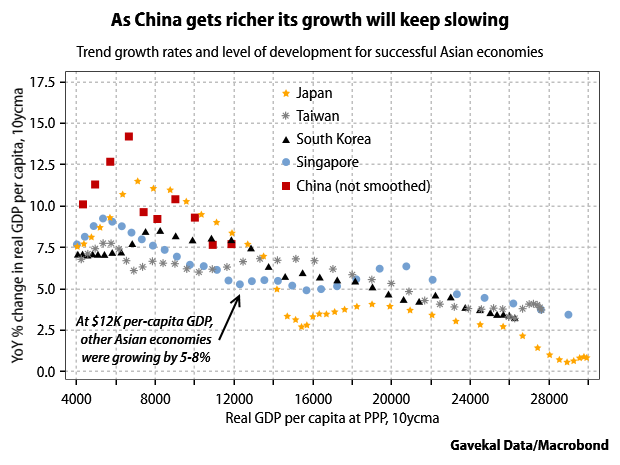
That is not the only plausible interpretation of the historical evidence, but it is certainly a possible one (I have previously written about research that supports a different and less optimistic interpretation.) My own view is that the track record of other successfully industrializing Asian countries implies that China’s potential growth in per-capita GDP is more likely to be in the 5-7% range for the next several years (see the chart below for the visual evidence). These historical patterns are not iron laws of development, of course, but they are helpful given that there is no particularly good way of estimating a potential growth rate for a rapidly-changing economy like China’s. But the limitations of this technique are obvious, since it is based purely on comparisons of the level of per-capita income and ignores all other factors, including the possibility that China does not end up following the same development trajectory as Korea, Taiwan, etc. The point is that this historical evidence certainly not enough to rule out the possibility that China’s future potential growth is less than 8%, even before we consider all the other factors that could be at play.

Asia-growth-potential

The more interesting part of the argument is that Justin supports government growth targets that are below 8%, both last year’s 7.5% and presumably the widely-expected downshift to a 7% target for 2015. (He doesn’t even address the debate about whether government growth targets are a good idea in the first place, which is rather amazing in itself, but let’s leave that to the side for now.) This is a bit confusing: Why should the government deliberately try to run the economy below its capacity, thereby generating less employment and slower income growth than could otherwise be achieved, without the cost of higher inflation? Here’s his answer:

The US, Europe, and Japan are likely to experience continued sluggish performance, inhibiting China’s export growth. As a result, Chinese growth is likely to fall below its potential of 8% a year. As policymakers plan for the next five years, they should set China’s growth targets at 7-7.5%, adjusting them within that range as changes in the international climate dictate.

In other words, he thinks potential growth based purely on domestic conditions should be 8%, but once you take into account weak global demand, potential growth is actually a bit lower. Now it is certainly true that if demand for China’s exports is weak, then China’s growth will be slower than it would be otherwise. But it’s a bit convenient that the only factor he admits that might possibly be a drag on China’s potential growth rate is the poor management of other economies. There are of course plenty of other things going on inside China that could be a drag on future growth–like the end of a decade-long housing boom that is sapping investment growth, or a high debt level that makes it more difficult to run expansionary policies in the future.

Once you recognize that there are in fact big changes happening in China’s domestic economy, another explanation for why slower growth is desirable becomes much more convincing (at least to me). That is the need to encourage structural change. The current structure of China’s economy is not the structure that it will need in the future, mainly because of the end of the housing boom: all the indications are that future demand for housing, and associated goods like construction materials, will be lower in the future than it is today. So to run the economy at full capacity today would mean reinforcing the current industrial structure. But really, government policy should be trying to enable a shift toward the future industrial structure. To put it differently, to run the the economy at full capacity today, given the enormous existing capacity for building housing and supplying the needed materials, would mean stimulating an artificially high level of housing demand. Therefore to allow the economy to run somewhat below capacity is the right decision, because this does not send false signals about future demand to investors in housing and the makers of construction materials.

I think this is in fact the government’s actual justification for targeting lower growth. While decoding Chinese government jargon is not the easiest task, current official statements clearly recognize that there is excess capacity, and that the solution is to change the industrial structure, not stimulate demand. If you squint you can see that argument implied in these lines from the communique of the Central Economic Work Conference in December (my translation):

Currently the supply capacity of traditional industries is far in excess of demand, so the industrial structure must be optimized and upgraded. … The marginal effect of overall stimulus policies is clearly decreasing. We need to deal with excess capacity, and also explore the future direction of industrial development through market mechanisms.


Is bigger really better for China’s GDP?

Over the last few months there’s been a fair amount of news about China’s GDP statistics, all of it pointing in one direction: China’s level of output and income was larger than we previously thought. This has been pretty much universally taken as good news for China, and generally as reinforcing the China-is-big and China-is-taking-over-the-world narratives in the press. But there are some other more sobering implications that are also worth pointing out.

In October, the IMF released updates to its World Economic Outlook database that incorporated the latest estimates of purchasing-power parity exchange rates. This pushed China’s per-capita GDP at PPP in 2013 from $9,828 to $11,868. It’s not everyday that economies grow 20% overnight! The change unfortunately also resulted in a lot of guff about how China had suddenly become the world’s largest economy, which is mostly nonsense: PPP exchange rates are really intended to help compare living standards across countries. For most purposes, the total size of an economy is something that’s much more meaningful at market prices.

China objected to the new PPP estimates, apparently mostly because it didn’t want people to think it was the world’s largest economy. Mostly this seems to be a political rather than technical objection: China often finds it advantageous to present itself as a developing country with lots of poor people rather than a major global economic power (of course, it is both). And given how the press keeps harping on the China-as-largest-economy theme, those jitters seem justified. However it’s not clear what the technical quibbles actually are, and it it seems much more likely that the new PPP numbers are in fact more accurate. Economists including Robert Feenstra and Angus Deaton have pointed out problems in the 2005 estimates that would have over-estimated the PPP exchange rate, and under-estimated GDP, which seem to have been corrected in the latest work.

PPP revision effect on per capita GDP

But Chinese statisticians rather reinforced the trend when in December they published the results of their own economic census, a quinquennial effort where they go around the country and try to make sure they have an accurate count of businesses and their output. This resulted in GDP estimates for 2013 being revised upward by 3.4%, or about $308 billion. In the Chinese context, this was in fact not a huge change, even though it is equivalent to finding another Malaysia lying around. So apparently it’s okay for Chinese GDP to be a bit bigger, just not a lot bigger.

All this is perhaps more than just a storm in a statistical tea cup, as much fun as it is to debate the technicalities. China’s income level does have implications for how its economy might perform in the future. This is because fast-growing emerging economies like China benefit from what is called “catch-up growth”: they can grow more quickly than the US and Europe by adopting technologies and practices from them. Because China doesn’t have to invent everything itself, but can rapidly absorb past inventions from other countries, it can grow faster than countries where those inventions are already widespread. But catch-up growth has this property: the more of it you’ve already done, the less of it you have left to do. The fact that estimates of China’s income level keep getting higher means that China has in fact done more catching up than we realized–about two years worth, to be precise (i.e., per-capita GDP in 2014 is now at a level that China was previously not forecast to reach until 2016). So the more successful China has been at catch-up growth, the closer the future gets when China is just an ordinary economy that does not grow at supercharged rates.

One illustration of this general tendency is the research Barry Eichengreen and his Korean co-authors have done on growth slowdowns. They find that there has been a pattern for economies to shift to a permanently slower rate of growth around $10-11,000 of per-capita GDP, and sometimes again around $15-16,000. So the fact that China is currently around $12,000 per-capita GDP means that its growth slowdown over the past few years is likely to have been a permanent downshift, and not a temporary episode that will be followed by more fast growth at the previous rate. While this is certainly my own view, it has been a contentious one within China, where some prominent local economists insist potential growth has not slowed down. The winds shifted last year, when the Chinese government’s official rhetoric about getting used to a “new normal” for the economy marked an acknowledgement that 10%-plus GDP is indeed a thing of the past. But the patterns from Eichengreen’s research also suggest China could well have another downshift in growth in a few years time, and this is certainly not the official line. So probably the most important implication of the fact that China’s economy is bigger than we thought is that the slower-growth future is closer than we thought, too. This of course is a mark of success, not failure.

Asian growth slowdowns by income level

Here’s some clear thinking about the causes of the Industrial Revolution

For some reason, there has been a spate of commentary recently about the Industrial Revolution on the economics blogs I follow. From my perspective this has been great: I am an enthusiastic if amateur reader of economic history, and putting together a comprehensive account of this event is one of the great, incomplete projects of social science.

Dietz Vollrath’s excellent Growth Economics Blog sets up the discussion very nicely by contrasting two canonical and competing views of the drivers of the Industrial Revolution: Joel Mokyr’s idea-centric argument that an English culture of innovation laid the groundwork for an explosion of new technologies, and Robert Allen’s hard-nosed factor prices argument that high wages in England simply created stronger incentives to adopt new technologies. For me his great contribution is pointing out that these two arguments are not in fact in contradiction:

There are two different questions about the IR in Britain that we want to answer. First, why did several particularly important innovations take place in Britain, and not in other places? Second, of all the innovations available, why were they adopted first (or with greater speed) in Britain than in other areas of Europe?

Ultimately, Mokyr’s thesis is an answer to the first question, and Allen’s thesis is an answer to the second question. This is more or less the same point made independently by Anton Howes on his very good blog:

Allen’s theory is therefore one that best explains bias in the adoption of Britain’s numerous inventions (both in Britain, and abroad). … For a fuller explanation of the IR, though, we need to go right to the inventive source – why was there so much more invention in Britain to be adopted in the first place?

Well, that’s a shocker all right: one of the most complex and important historical events of all time turns out not to have a single cause or a simple explanation. And to complete the roundup of recent blog posts, inequality guru Branko Milanovicpoints out that the England-had-high-wages explanation is itself incomplete, because we still need to know why England had higher wages than other places. He links to a recent paper that argues the root cause is “the difference in the response to the Black Death-driven increase in real wages.” In other words, that it goes back to social and political institutions. The details are interesting but I won’t repeat them here. At any rate I now feel much better equipped to tackle some more Industrial Revolution scholarship.

Does any of this have contemporary relevance? Sure. The problem of explaining how modern economic growth came to pass in the first place two hundred-plus years ago is of course a very different problem than that of explaining how  economic growth can be sustained and replicated in today’s world. But there are some obvious parallels that arise: is it more important for China, say, to develop a Mokyr-style “culture of innovation,” or should we focus instead on Allen’s relative prices?

One could for instance make an Allen-style argument that the sharp rise of labor costs in China in recent years has created a much stronger incentive for companies to adopt labor-saving technologies. In that case, higher labor costs would not be the death knell for China’s international competitiveness that some say they, but rather the trigger needed to push productivity and income to the next level. I haven’t decided whether I believe this or not–there are some complexities given that China has had cheap capital as well as cheap labor–but it’s not obviously absurd and bears thinking about.


How to compete with state-owned enterprises

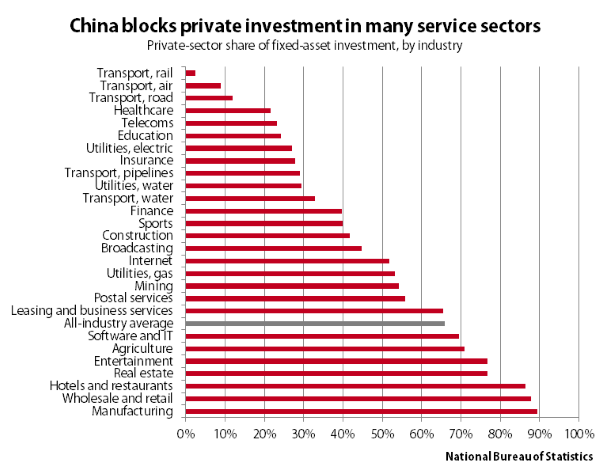
The WSJ has another good article about SOEs in China, this one focusing on Hainan Air’s efforts to compete with the three big state-owned airlines. Air transportation is one of China’s most state-dominated industries, with private-sector firms accounting for less than 10% of investment in the sector (but a somewhat larger share of passenger volume, according to the WSJ’s graphic). In manufacturing by contrast private firms account for 90% of capital spending.

private_sector_fai

So if we are going to see movement to a more liberalized economy in China, then what we should look for is signs of private firms getting more access in these state-dominated sectors. Hainan Air seems to be a pretty well-managed firm (I’ve always liked their service), and as the article shows has tried many different ways to break out of the ghetto of second-tier airports and routes that regulators have placed it in.

But the short version is that Chinese regulators are not bending over backwards to help a private-sector competitor. What this example shows is how the oligopoly of the three big carriers does not have to be mainly maintained by an explicit regulation or law, but can be enforced pretty effectively just through a series of discretionary government decisions. I suspect this is the case in a lot of China’s state-dominated sectors: SOE market power domination is not so much written into law as the result of an inherited industry structure and repeated government action to prevent change to that structure. Of course, there are also examples like the salt industry, where there are written regulations that will have to be changed if recent pledges to open it up to more competition are to be realized.

What this means is that liberalization is going to be hard work for China — it’s not simply a matter of repealing legislation that discriminates against private firms, but requires lots of detailed work to change entrenched practices and priorities in many different industries and parts of the bureaucracy. Personally, I think liberalizing these state-dominated service sectors is the most important economic reform that China could carry out. In contrast to signs of excess capacity in heavy industry, there are still obvious bottlenecks in delivery of many services, like healthcare. And given China’s now reasonably high incomes, a lot of the future growth in consumer spending is going to go to services. So shifting more investment into what should still be relatively high return sectors would help keep China’s overall growth rate from falling too sharply. But it’s not going to happen quickly or easily.

How strategic are China’s state firms?

Dinny McMahon of the WSJ has an excellent profile of a giant but obscure Chinese state-owned enterprise, Sinomach. I have been fascinated by SOEs since I first moved to China, and over the past couple of years I have also spent a lot of time digging into the finances and other technicalities of how the SOE sector works. Dinny’s piece nicely captures a lot of the key facts about the SOE sector today: 1) far from being world-straddling corporate giants, most Chinese SOEs are poorly performing companies suffering from a combination of arbitrary political goals and poor management; 2) a lot of “SOE reform” happened from 1998-2003, but not a lot has happened since, and there is a lot of room to further overhaul these companies — which indeed the government is now trying to do; 3) the government’s support for SOEs is based on the premise that they will develop “strategic” technologies to boost national security and competitiveness, but in fact the actual achievements in this area are decidedly subpar. (Those interested in more data and detail on these issues can look at the paper on SOE reform I wrote for the Paulson Institute.)

To close, here’s one lovely tidbit from the Sinomach story:

Despite China having passed through more than three decades of reform, Sinomach’s Erzhong unit—set up by China’s Red Army in 1958—still adheres to many of the traditional customs of the country’s major state-owned firms. It still pays retirees a living stipend, and runs a sports center with two swimming pools and a television station. Staples of the station’s programming, which is only available on the factory grounds and to people living in residential zones once owned by the company, include a U.S. English teaching program from the early 1990s and training programs for operating and repairing machinery and electrical equipment.

Where to find China’s recession

One of things I’ve often heard said about China over the years is that 3-5% growth would be equivalent to a recession, since they are used to growing at 8-10%. That may be true at a national level, but at the local level you can now find places that are in outright recession by anyone’s standards. Mark Magnier at the WSJ did some nice reporting from Jixi, an isolated coal town in the far east of Heilongjiang province, about an hour’s drive from the Russian border. It’s a treat for me to see this otherwise obscure town get a dateline in a major newspaper, since I have been to Jixi a few times.

Jixi was the the slowest-growing city in China in 2013, and things have gotten even worse this year: the local economy has shrunk 3.7% (and yes, that’s negative 3.7%, not growth of 3.7%) and capital spending has fallen by more than 20%. These are obviously horrible numbers, and the cause is also pretty obvious: coal prices have been in the toilet for a couple of years already, and the city is basically built around a big coal mine and doesn’t have much else going on. So it’s not representative of the Chinese national economy, which has a lot more going on than coal. But as I’ve pointed out before, China’s mining belt is in fact pretty large and a bigger part of the economy than many people realize. Jixi may be an extreme example, but China has a lot of coal towns, and most of them are in trouble too.

Is there more to Jixi’s problems than just a coal bust? Sure, any city built on top of a coal mine is going to decline when the coal runs out. But it’s certainly my own impression that Jixi and other places in Heilongjiang have not done a good job on using the windfall gains from the past decade’s resource boom to develop more broadly. There’s a nice quote in Mark’s piece which I think captures some of the distinctive old-school central-planning flavor you find in Heilongjiang (even agriculture is still more state-dominated up there, with large state farms and collectives):

Heilongjiang was the first to start the planned economy and is the last to give it up, said Jiao Fangyi, economics and business dean at Heilongjiang University. We have great ample natural resources, but the good times are over. Its like were begging for food from a golden bowl.

Find a city, find myself a city to live in

I talked to Kevin Hamlin of Bloomberg recently about urbanization; Kevin’s big story is out and he was kind enough to quote me. The piece is about the debate among China scholars over the best strategy for urbanization. While we may think of urbanization as a natural process, government policy plays a big role in China given the institutional restrictions on urbanization through the hukou system, and heavy state involvement in urban planning and investment. China’s policy over the last decade or so has been to favor a “distributed” model of urbanization that tries to encourage population flows to smaller cities, and reduce the concentration in megacities. I think the most charitable explanation for this choice is that they want to distribute the economic gains from urbanization more widely across the country. The justification you hear more often is that big cities are too big and crowded and just can’t get any bigger; it is hard to be charitable about this view, since it seems to put a higher priority on the people who already live in Beijing and Shanghai and earn high incomes than on the people who don’t live in Beijing and Shanghai and don’t earn such high incomes.

My view, which I think is shared by a number of foreign observers, is that the current policies of favoring small cities just don’t make that much sense, and aren’t particularly effective anyway. The economic gains from urbanization come from the economies of scale and scope (and network effects, etc) offered by big cities, so there are more of those gains in big cities than in small ones. This is reflected in labor markets, and so migrants in search of higher wages go to bigger cities rather than smaller ones. Obviously China is a big place and not everyone is going to be able to live in Beijing, Shanghai or Guangzhou/Shenzhen. But with better planning and infrastructure those cities could cope with larger populations. Instead using that money to build infrastructure and housing in smaller cities that have difficulty attracting new migrants seems a much chancier proposition that is much more likely to result in spending being wasted. I am pretty disappointed that all the fuss about urbanization since Li Keqiang took over as Premier has not resulted in a deeper rethinking of this issue. The new urbanization policies announced earlier this year look a lot like the old urbanization policies, in that they call for restraining growth in big cities and encouraging growth in small cities.

The woes of China’s mining belt

Tiff Roberts over at Bloomberg Businessweek gave a nice write-up of a recent piece I did looking at how the impact of lower energy prices on China differs depending on where you are in China.This provides an excuse for me to reproduce one of my favorite maps for a wider audience:

energy-dependence-map-2011

While we stereotypically think of China as a huge consumer of energy and commodities, it is in fact also a big producer of same (one way in which China resembles the US).  Within China, this is essentially a regional phenomenon: the center, south and east are mainly resource consumers (and are inhabited mainly by ethnic Han Chinese). The northern and western provinces are where all the resources are produced (and where ethnic minority populations are larger).

One of the interesting things I learned from this map is that in economic structure terms Heilongjiang and Xinjiang are not that different, even though conventional geography and economic analysis never puts them together. Xinjiang is usually considered an exception to everything in “core China”, because it is so clearly a frontier territory, with different ethnic and economic dynamics (same goes for Tibet). Heilongjiang by contrast is uncomplicatedly part of “core China”. But in fact both have local economies with a high degree of resource dependence. And in historical terms it was not all that long ago that Heilongjiang was not part of “core China”: it is one of the three modern provinces covering the territory of Manchuria, which in the 19th century was an ethnic enclave for China’s Manchu rulers, then a booming frontier region when migration was opened up to Han, then a de-facto colony of Japan. Heilongjiang is obviously much more integrated now but I wonder if its earlier history offers any parallels to some of the dynamics we’re seeing in Xinjiang today