What is socialist about “socialism with Chinese characteristics”?

Deng Xiaoping’s classic slogan is wonderful because of its strategic ambiguity: just what are those Chinese characteristics anyway? And this slipperiness has led to a tendency to think of “socialism with Chinese characteristics” as a kind of dodge, a way of saying, yeah, China is really capitalist but we just don’t want to admit it, wink wink nudge nudge. I’m not sure that was ever correct, and no one less than Xi Jinping himself seems to be urging us not to think that way. In his now-famous speech on Deng’s legacy, Xi had a pretty good one-liner: “Socialism with Chinese characteristics is socialism, and not some other -ism.” And Xi repeated that line again in his speech on Friday for the 95th anniversary of the founding of the Communist Party.

Yet for a speech that was billed as heavily ideological, and whose theme was supposedly the eternal verities of Marxism, there is not a huge amount of ideological content to be found. To me the speech feels not so much ideological as highly nationalist. Xi says the Communist Party’s main achievement is not realizing socialism in one country, or some other Marxist shibboleth, but “the march of the Chinese nation with its more than 5,000 years of civilization toward comprehensive modernization.” There is plenty of Deng-style pragmatism (“Whether socialism with Chinese characteristics is good depends on the facts, on the judgment of the Chinese people”) and focus on economic growth (“Development is the Party’s top priority in governing and reviving the nation, and is the key to solving all of China’s problems”).

So it would be easy to interpret “socialism with Chinese characteristics” as just meaning whatever makes China rich and strong. And such an interpretation would be pretty consistent with Deng’s own fundamentally nationalist perspective. Yet I’m not sure we can really view the Communist Party as pure maximizing pragmatists completely unconstrained by history or ideology–surely it does make a difference that the Party comes out of the socialist tradition? Of course, the most obvious consequence of the Party’s historical trajectory is its commitment to authoritarian rule. The political meaning of “socialism with Chinese characteristics” is so obvious that it hardly needs stating: the continued rule of the Chinese Communist Party. Or, as Xi put it on Friday, that the “choice of the Chinese Communist Party to lead China’s great revival is correct.”

But I’ve also been wondering whether there are other, more purely economic consequences: what do Chinese leaders think are the fundamentals of socialism that they cannot abandon and still call themselves socialist? So far, I’ve come up with two answers. And as so often, one of Deng’s own pithy comments provides the best summary. In a 1985 interview with American journalists, Deng said: “In the course of reform we shall make sure of two things: one is that the public sector of the economy is always predominant; the other is that in developing the economy we seek common prosperity, always trying to avoid polarization.” I think that’s exactly right.

I would propose, then, that in practical terms the “socialism” part of “socialism with Chinese characteristics” means 1) a continued large role for state-owned enterprises, and 2) generous regional development policies aimed at offsetting the inequalities produced by market forces.

That the Communist Party is committed to SOEs will probably not surprise many people. Still, it’s worth recalling just how deep the historical roots are. The economic model that China’s post-1978 leaders have been working with owes a lot to Lenin’s New Economic Policy of the early 1920s in Russia. To recover from the excesses and economic disasters of the early Bolshevik period, Lenin proposed a mixed-economy model, in which market mechanisms and private firms play a major role but SOEs occupy a strategic position (the famous phrase “the commanding heights” is often attributed to Lenin at this time, but it appears only in fragmentary form in his collected works; Nikolai Bukharin, the theorist of the NEP, should probably get the credit). This mixed model did not last long in Russia, but it has persisted for some decades now in China. Given that Chinese Communist Party documents still refer to “the basic economic system with public ownership playing a dominant role,” I am probably on pretty safe ground in saying that the Party feels that it cannot give up SOEs.

The regional development angle may be a bit less obvious. But I think it also has deep roots in a different strand of socialist thought: Maoist egalitarianism. Here a good guide is John G. Gurley’s 1970 essay “Capitalist and Maoist Economic Development,” a treatment of Maoism that is unusually sympathetic. Gurley introduced a distinction between capitalist “building on the best” (investing in the places and people with the greatest comparative advantage) and Maoist “building on the worst” (deliberately investing in the places and people that are disadvantaged). Here’s how he summarizes the difference:

Capitalist development, even when most successful, is always a trickle-down development. …. In many ways, then, Maoist ideology rejects the capitalist principle of building on the best, even though the principle cannot help but be followed to some extent in any effort at economic development. However, the Maoist departures from the principle are the important thing. While capitalism, in their view, strives one-sidedly for efficiency in producing goods, Maoism, while also seeking some high degree of efficiency, at the same time, in numerous ways, builds on “the worst.” … Maoists build on the worst not, of course, because they take great delight in lowering economic efficiency, but rather to involve everyone in the development process, to pursue development without leaving a single person behind, to achieve a balanced growth rather than a lopsided one.
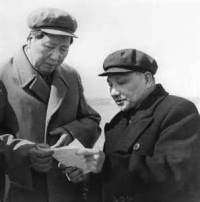
Mao and Deng

Mao and Deng

Deng was very explicit that his reforms rejected Maoist egalitarianism in its pure form; what he derided as “everyone eating from the same big pot” was a recipe for poverty and backwardness. But he also made clear that his acceptance of some economic inequality was purely instrumental; as he told Mike Wallace“We permit some people and some regions to become prosperous first, for the purpose of achieving common prosperity faster. That is why our policy will not lead to polarization, to a situation where the rich get richer while the poor get poorer.

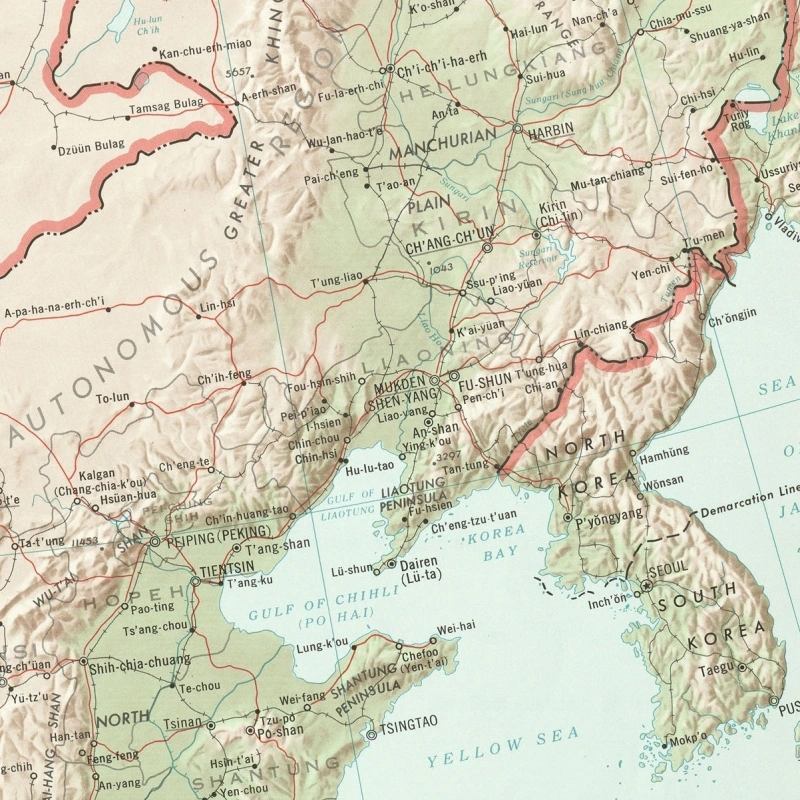
So at the level of principles egalitarianism was not totally abandoned. And one of the most consistent ways in which this principle has been expressed is in repeated efforts to boost China’s less developed regions: from the inland development projects of the 1960s and 1970s, to the “Great Western Development” project launched by Jiang Zemin in 1999, to the “Revitalize the Northeast” campaign under Hu Jintao after 2003. All of those plans were very clearly in the spirit of “building on the worst.” In the latest egalitarian gesture, the State Council announced, just before the Party’s July 1 anniversary, an aid program for the isolated mountainous areas where Communist revolutionaries sheltered during the civil war.

So a large role for state-owned enterprises and regional development plans are features, not bugs, in the China economic model. Unfortunately a lot of the obvious waste, inefficiency and misallocation in the Chinese economy in recent years are also attributable to these features. If I’m right about the political importance of these two policies, then fixing those problems could be quite challenging.
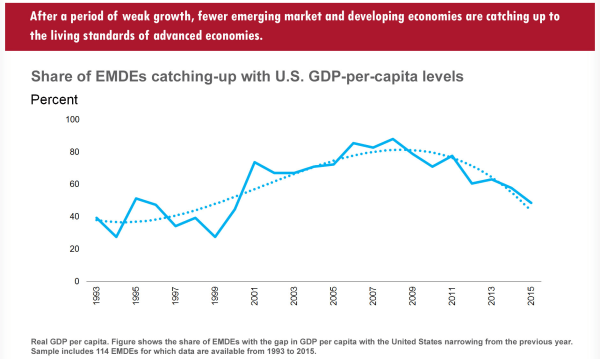
Explaining catch-up growth with China and commodities

The World Bank’s latest Global Economic Prospects report may be a 194-page document, but most of the attention it got was for one little infographic. The Financial Times focused its coverage on the chart, and the Economist also made it one of their charts of the day. As the bank helpfully made the underlying data available, it is easy to reproduce, so here is the original:

World-Bank-EM-catchup

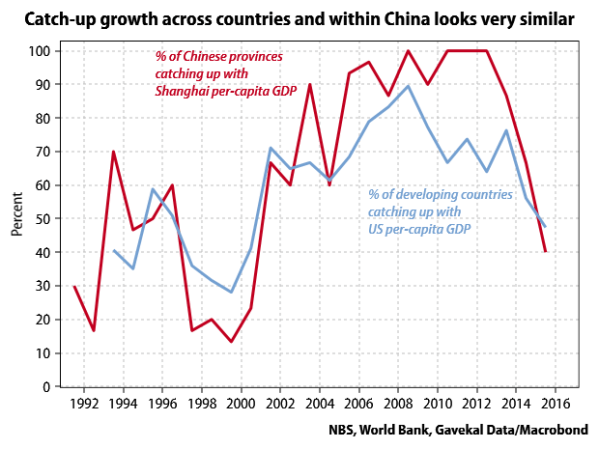
That’s indeed a very nice chart, showing that catch-up growth is not a constant phenomenon, but one that has risen and fallen over the last couple of decades. I like the chart too, but when I first looked at it, I thought: I’ve seen that curve somewhere before. Because I’m interested in regional growth patterns, I have been looking at catch-up growth within China: how quickly have poorer provinces been closing the income gap with the wealthier provinces? (I chose Shanghai as the reference point, since it has been the most developed part of China for many decades.) And when I took my provincial catch-up data and overlaid it with the World Bank’s global data, this is what I got:

catch-up-comparison

I would say those trends are pretty much the same: fewer places experiencing catch-up growth in 1997-2001, a widening of catch-up growth to more places from 2002-2012, and more recently a sharp fall off. So that’s pretty interesting: catch-up growth within China, and catch-up growth across lots of other developing countries, seems to follow the same pattern.

One possibility is that catch-up growth is just a function of growth, and so when global/China GDP growth is slow, catch-up growth is less widespread. But this doesn’t explain why catch-up growth has faded so sharply in the last couple of years: while both global growth and trade volumes are not doing that great, they also have not gotten suddenly worse. What has declined very sharply are commodity prices, thanks to an oversupply generated by producers who thought China’s housing construction boom would go on longer than it actually did. So I think commodities may be more important for the pattern of emerging-market catch-up growth than the World Bank acknowledges.

This does not mean that I’m arguing commodity exports are actually a great thing and that it’s really too bad that commodity prices have fallen. I firmly agree with the conventional wisdom that commodity exports are not an effective or sustainable way for developing countries to become rich. But remember what is being measured in these lovely charts: not the number of people whose incomes are converging with developed-country standards, but the number of countries (basically a diffusion index). And my intuition would be that more developing countries are, if only by default, commodity exporters, simply because the alternative development model–exporting manufactured goods–is in fact quite hard to do.

The data support this intuition. If I split developing countries into two baskets, manufactures exporters and commodity exporters, on the simple criterion of having more or less than half their exports in manufactured goods (a concept I borrowed from Jon Anderson), the majority of developing countries are in fact commodity exporters. For the low and middle-income countries in the World Bank’s World Development Indicators database, only 33 of 96 countries had more than 50% of their exports in manufactured goods in 2011. The same pattern holds internally within China: while most of China’s population is concentrated along the coast, most of its provinces are not. Of China’s 31 provinces, only 10 are officially classified as “Eastern.” The diffusion index for catch-up growth within China will therefore be dominated by the central and western provinces, and these provinces have more commodity-driven economies. To be precise, I estimate that the mining and metals share of GDP is higher than the national average in all but four of the 21 central and western provinces.

This pattern of catch-up growth is not just a statistical artifact, but gets at a real phenomenon. The same economic role has been played by a group of provinces within China’s borders, and a large group of countries outside China’s borders. Both prospered by supplying materials for China’s housing boom (the underlying cause of the commodity boom), and both are seeing that prosperity erode now that the housing boom is fading. I keep discovering that housing is the answer to many economic questions about China; it seems that Chinese housing also explains a lot about the patterns of global growth.

What is nationalism anyway, and why is it so powerful?

I’ve had nationalism on the brain lately–thinking about the history of Chinese nationalism, reading about Russian nationalism–so I was predisposed to interpret the UK’s vote to leave the EU as being driven by nationalism. I found Fintan O’Toole’s essay arguing that the Brexit movement was an undeclared English (not British) nationalist movement very convincing, and it looks quite prescient in light of the actual results. Yet a number of my British colleagues and friends did not agree that the term nationalist applied.

I realized that I was not operating with a clear definition of nationalism, without which I was not going to win that particular argument. So my task is to come up with one–an objective definition of nationalism as a social phenomenon, that does not use the term as a rhetorical synonym for patriotism, or racism, or right-wing politics, or what have you.

Ernest Gellner

Ernest Gellner

The classic definition comes from Ernest Gellner, the great anthropologist and philosopher, who argued that nationalism is about political legitimacy: legitimate government requires that the boundaries of the state and the boundaries of the nation/people/ethnos coincide. One state per nation, one nation per state:

Nationalism is primarily a political principle, which holds that the political and the national unit should be congruent.

This principle is now so widely accepted–“self-determination of peoples” is right there in the UN Charter–that it is easy to take for granted. But it was and is a revolutionary argument, and Gellner used it to explain the breakup of the 19th-century European empires (and later the Soviet Union) into smaller, more ethnically homogeneous states.

Secession from an entity that is too large or foreign to be legitimate is the quintessential nationalist political movement. The most principled arguments for Brexit–self-government and the supremacy of Parliament–are thus in fact the most nationalist (again, I am not using nationalism as a pejorative term but as a descriptive one). If starting point is that the nation-state is the proper form of government then it is indeed hard to see the EU–a state without a nation–as a fully legitimate government.

John A. Hall, in his biography of Gellner, notes a few issues with Gellner’s original formulation. First, the focus on how European empires split into smaller countries means it may not be as helpful in understanding nationalism in large countries whose borders are not particularly contested. A theory of nationalism that does not explain Chinese, Indian, Russian or Japanese nationalism is probably not a very useful theory. Second, it doesn’t perfectly jibe even with the history of classical nineteenth-century nationalist movements such as the Czech, who originally agitated for better treatment within Austria-Hungary rather than outright independence. Hall concludes that a different definition of nationalism is required:

Not every nation seeks its own state. Nationalism is better defined in the simplest terms as the desire for the national group to prosper.

There is clearly something to this, but Hall’s proposal feels a little too baggy and capacious: who doesn’t want their government to do good things? I would try to tighten up the definition a bit, and propose that nationalism is the argument that a legitimate government is one that works to raise the status and prosperity of the nation/people. This formulation builds on rather than replaces Gellner’s original one, since it still presupposes that government is the representative of a definite group, however it may be defined (an “imagined community” in Benedict Anderson’s phrase).

The ingroup-outgroup dynamics that are inherent to nationalism clearly resonate with a lot of people, though they can manifest in different ways. Nation-states that arise out of polyglot empires (e.g. China and Indonesia) seem to have a strong attachment to the details of maps and national boundaries, while those that are more monoglot in their self-imagination may focus more on ethnic differences (much of Europe). But that’s not all that nationalism is about. Chinese nationalism from the 20th century days was consistently focused on national “wealth and power” (fuqiang), and this has also been the unvarying theme of its post-Mao politics. The most recent versions of Russian nationalism have in fact meant an increase rather than a decrease in the nation’s foreign entanglements–which are popular because they are perceived as raising the status and power of the Russian people, however much they complicate the one state per nation idea.

This definition of nationalism should be a neutral one: nationalism seems to be neither inherently left wing or right wing, good or bad (it’s good to recall Benedict Anderson’s comment that “nations inspire love, and often profoundly self-sacrificing love”). Rather, nationalism offers powerful arguments about political legitimacy that can appeal across the political spectrum, which resonate because they do in fact reflect important aspects of people’s real lives (rather than being purely theoretical or based on economic self-interest). That flexibility and emotional force may be some of the reasons why nationalism, born in the late 18th or early 19th centuries, continues to be so potent well into the 21st century.

I can’t resist closing with a fantastic, acerbic quote from Gellner, on how nationalism has proved to be so much more powerful than other ideological movements:

Just as extreme Shi’ite Muslims hold that Archangel Gabriel made a mistake, delivering the Message to Mohamed when it was intended for Ali, so Marxists basically like to think that the spirit of history or human consciousness made a terrible boob. The awakening message was intended for classes, but by some terrible postal error was delivered to nations. It is now necessary for revolutionary activists to persuade the wrongful recipient to hand over the message, and the zeal it engenders, to the rightful and intended recipient. The unwillingness of both the rightful and the usurping recipient to fall in with this requirement causes the activist great irritation.

From our current perspective, the spirit of history’s mistake looks like delivering the message of Marxism in the first place. The long, painful experimentation with this highly ideological form of government seems to have put down surprisingly shallow roots. Stalin fairly early on abandoned pure Marxism for a version heavily flavored with Russian nationalism, and China’s Communist leadership did something very similar once the ideologue Mao Zedong was out of the way. The Marxist component has only gotten more diluted in the ensuing decades. Eric Hobsbawm’s comment that “Marxists as such are not nationalists” is absolutely right as a matter of principle–it’s just that there were never so many true Marxists to begin with.

Freeing up China’s service sector: the why and the how

I have a new paper out at the Paulson Institute, on China’s service sector. Obviously I would like people to read the whole thing, but here’s the short version:

The first part of the paper is a rather fun (for me anyway) piece of data work, comparing the development of China’s service sector over time with the patterns of Japan, South Korea, and Taiwan. The conclusion is that China’s “modern” service sector looks over-developed, while its household service sector looks under-developed. The over-development of modern services seems to caused mainly by a huge increase in the size of the financial sector, and therefore is not actually a cause for celebration. The under-development of household services suggests (though admittedly does not prove) that these sectors are being held back by high levels of state ownership and/or regulation. Therefore I argue that instead of doubling down on finance-driven growth, China would be better off liberalizing household and other service sectors.

In the second part I offer some suggestions on how to do this. My main idea is that China should make use of its well-developed planning institutions to drive liberalization. In simple terms, I propose that the Chinese government set quantitative targets for the market share of private companies in various sectors. This would make clear what the end goal of liberalization is, and impose accountability on officials for achieving that end goal–but it would also allow for flexibility in how the goal is reached. There is some precedent for this approach: in the twelfth five-year plan for the healthcare sector, the government set a target that private hospitals should account for 20% of hospital beds and service volume by 2015, and their market share did rise. Similar targets could work in other sectors. It’s worth a try, I think.

My thanks to Evan Feigenbaum and particularly Song Houze of the Paulson Institute for their help and comments on this paper, and I am also very pleased that the Institute’s resources allow the paper to be translated into Chinese.

Paulson-Services-Cover

Of ice cream and industrial restructuring

The home of “Iron Man” Wang, the original Chinese hero of heavy industry, is, it turns out, also in the ice cream business. Rooting around in a freezer on a recent, very hot summer weekend, I came up with a bar of ice cream bearing the “Daqing” brand. This surprised me since Daqing is better known as the site of China’s largest oil field, and the inspiration for innumerable 1960s propaganda posters about the exploits of its model workers, particularly the aforementioned Wang Jinxi. But here was its name proudly displayed on the wrapper of what turned out to be a pretty tasty ice cream bar:

DaqingIceCream

The ice cream bar was indeed actually made in Daqing, but rather than disguise the fact that they’re making food near a lot of toxic chemicals, the manufacturers are going all out to highlight their roots. Why? I can at least speculate. Daqing itself is indelibly associated with the Cultural Revolution, when Mao held it up as the national example of how revolutionary fervor could work economic miracles. While personally I find Cultural Revolution nostalgia creepy, it’s still a real phenomenon: some people imagine the 1960s as a less materialist, less complex, more virtuous time. The logo with its echo of socialist-realist woodcuts, the plain one-color wrapper, the proud “product of the Northeast” declaration–all these combine to evoke simpler times and convey a kind of straightforward authenticity.

Some people like to say that the Northeast was the first to adopt the planned economy and the last to abandon it, and that economic legacy is not usually thought to be a positive one. But it is still part of the region’s distinctive identity, so you might as well use it to sell stuff (the maker of the Daqing ice cream bars also sells ice cream under other brands without the socialist trappings). Of course there is something odd about using nostalgia for the high-Maoist era to sell mass-market consumer goods today, since the 1950s and 1960s in China were definitely not a time of consumer abundance. Ice cream was such an exotic luxury that it might be sampled only once a year–a far cry from the ubiquitous and cheap delights of today.

Is making ice cream in Daqing a sign of something else–perhaps the long-awaited emergence of a “consumer-driven” Chinese economy? It is true that Heilongjiang province, where Daqing is located, and the other northeastern provinces are under lots of pressure to diversify away from dying industries. The latest in a series of government plans to “revitalize” the northeast declares, correctly, that the region’s industrial structure is tilted toward traditional heavy industry and state-owned enterprises. Vice-minister of industry Feng Fei, returning from a recent inspection tour of the northeast, noted approvingly that some local governments were “promoting investment in sectors like car parts and food processing, fostering new economic growth drivers.” Ice cream has been made in Daqing since at least 2002 (when Baixing, the maker of the Daqing bars, was founded), but perhaps it is one of the industries of the future.

Yet there is a long way to go to shift the northeast’s industrial structure–you need to sell a lot of ice cream to match the economic impact of a giant oil field. Around two-thirds of Daqing’s GDP comes from oil and petrochemicals; food processing contributes just 2.5% (still higher than I would have guessed). And the city of Daqing itself accounts for a quarter of Heilongjiang’s GDP, which means that the Daqing oil industry alone generates about 18% of Heilongjiang’s GDP (on 2014 statistics). That’s huge, making it easier to understand why nominal GDP growth collapsed along with oil prices last year.

And in case it’s not obvious–yes, this whole post was basically just an excuse to write something else about Chinese ice cream.

What I’ve been listening to lately

A bit more on the mainstream tip of late:

  • Dexter Gordon – A Swingin’ Affair. An entry in his classic run of mid-60s Blue Note albums, but one which had previously escaped my notice. As usual with Dex, the ballads are a highlight. But like his other recordings from this period (such as Our Man In Paris), it is just a sterling example of this style of jazz, difficult to better.
  • David Murray & Mal Waldron – Silence. Waldron is one of the great masters of the jazz duo (his series of recordings with Steve Lacy are high on my all-time favorite list), and this rather unusual pairing does not disappoint. Waldron the original minimalist keeps Murray the great maximalist on his toes and in top form.
  • Sonny Stitt – Tune-Up! My brother gave this to me years ago, saying a friend of his recommended it as a quintessential jazz recording. I didn’t really get it at first, not being that into straight-ahead jazz at the time, but it has only grown on me over time. Stitt is powerful, inventive and exciting throughout, demonstrating just how much life remained in the bebop idiom in 1972.
  • Magic Sam – West Side Soul. Like many influential recordings, much better than most of what it influenced. Electric Chicago blues is one of the more over-played styles of music, but there’s a reason for that. It’s a treat to hear his original version of “Sweet Home Chicago,” even if some of the impact is inevitably lessened by having heard so many bar bands play it before.
  • Grant Green – The Complete Quartets with Sonny Clark. Lots of good stuff here, but the version of “It Ain’t Necessarily So” stands out and is one of my favorite jazz guitar tracks; the backbeat from Art Blakey drives Green to an almost unbearable intensity.

Deng Xiaoping was an outstanding Chinese nationalist

That is an interesting and important statement from Peking University’s Niu Jun, from a roundtable commenting on the recent Pantsov and Levine biography of Deng (for what it’s worth, I agree with the consensus of the reviewers that the bio is vividly written and has interesting insights, but is marred by mean-spirited editorializing). Deng has variously been portrayed as a reformer, a revolutionary, and a dictator, but rarely first and foremost as a nationalist. Niu argues that this was one of the important things distinguishing him from other leaders of his generation, particularly Mao:

I think that Deng Xiaoping: A Revolutionary Life pays insufficient attention to another prominent facet of Deng’s identity. Vogel’s book does likewise. If one is assessing Deng’s life, one should state that he was an outstanding Chinese nationalist. There were not many such among his generation of Chinese communist comrades-in-arms. This year, “The Nine-Day Whirlwind” [aka Mr. Deng Went to Washington], a documentary film screened in China, included an interview with former U.S. National Security Adviser [Zbigniew] Brzezinski. Facing the camera, he recalled one of Deng’s talks during his January 1979 visit to the United States. Deng remembered his sojourn in France as a young man on the ‘Diligent Work Frugal Study’ program. Deng said that when he arrived in Paris, what impressed him most deeply was how backward China was in comparison. So he resolved to save his motherland and help it become a powerful country. This was the key to his becoming a Communist, because he saw this as the only way forward. …

Deng’s nationalism was manifest above all in his dealing with Sino-Soviet relations. … Deng’s method of dealing with the normalization of Sino-Soviet relations after Mao demonstrates, on the one hand, that in the Sino-Soviet theoretical debates, he was a firm supporter and executor of Mao’s policies. On the other hand, he also had important differences with Mao. In comparison with him, Deng was more of a nationalist. Put simply, Mao’s opposition to Soviet ‘revisionism’ was rooted in a more utopian way of thinking. He thought that Khrushchev’s reforms were to take the capitalist road. Of course, Mao loathed so-called Soviet chauvinism that was displayed toward the “fraternal countries,” but replacing the Soviet Union as the leader of the international Communist movement and continuing to promote the world revolution were obviously more important to him. Deng’s subsequent words and actions show that he was more inclined to oppose the Soviets for having humiliated China and for posing a threat to China’s security. His ‘anti-revisionism’ was more a matter of following and implementing Mao’s thought while his ‘anti-Sovietism’ accorded more with his own nationalist inclinations and was a distinctive feature of his foreign policy once he was in power.

In his talks with Soviet President Mikhail Gorbachev in May 1989, Deng stated that both sides were at fault with regard to the theoretical dispute, but more important was that the Soviet Union had not accorded China equal treatment. This had been a problem through several periods from Tsarist times to the Soviet era. Deng stated that the humiliation inflicted on China from Russia and the Soviet Union was almost as serious as Japan’s aggression from the same era and was extremely detestable. This talk marked the normalization of relations between the two countries thirty years after they had fallen out with each other. Deng’s lengthy speech was the result of very long deliberation on his part. For Deng the theoretical dispute was not significant; it was the Soviet attitude and the harm and threat it posed to China that were the real sources of the deterioration of relations between the two countries.

Deng and Khrushchev in 1960

Deng and Khrushchev in 1960

Deng’s much-praised pragmatism was rooted in his nationalism: whatever made China stronger was good. In 1980, Deng’s nationalism meant recognizing that China was weak and underdeveloped, and doing what was necessary to strengthen its global position and drive economic growth, including borrowing ideas and capital from Japan. By 1990, nationalism increasingly meant taking pride in China’s accomplishments and standing up to real or perceived slights. Vogel’s biography of Deng recounts how an anti-foreign, and specifically anti-Japanese, tone was adopted in government propaganda to shore up its popular support after the chaos of 1989:

After 1989, when Western countries were imposing sanctions, there was a widespread patriotic reaction against foreign sanctions. To many Westerners, sanctions on China were a way of attacking Chinese leaders who used force on June 4, but to Chinese people the sanctions hurt all Chinese. Patriotic “education” linked nationalism to the Communist Party, as the Communists in World War II appealed to patriotism and nationalism to rally support against the Japanese. Conversely, criticism of the Communist Party was ipso facto unpatriotic. … Within weeks after the Tiananmen tragedy, Deng began emphasizing his patriotic message. The Propaganda Department skillfully publicized anti-Chinese statements by foreigners that caused many Chinese, even students who advocated democracy, to feel outraged.

There’s little question that nationalism has become the dominant political theme in China since Xi Jinping took over the top positions in 2012. While a lot of commentary has emphasized how Xi is breaking with recent precedents, the continuities with previous leaders, particularly Deng, are still quite strong. Xi’s nationalism may be another, underappreciated way in which he is building on Deng’s legacy.

Inertia is not helping China’s inland provinces

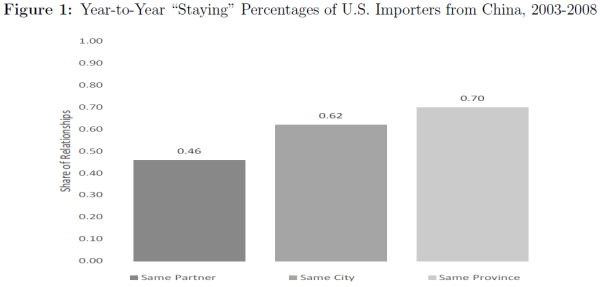
There is an interesting new Federal Reserve paper by Ryan Monarch that looks at some very detailed data on the relationships between US companies and their Chinese suppliers. The main finding is what he calls the inertia in these relationships: US importers tend to be reluctant to change Chinese suppliers, even to get a lower price. And when they do change suppliers, they often go to one that is located not very far from the old one. Here’s the key graphic and the author’s summary:

monarch-importers-fig1

Two facts are clear from Figure 1. First, there is a significant share of U.S. importers who maintain the same supplier over time. Even though the number of potential exporting choices is increasing over this time period, the share of importers using the same supplier year-to-year is 45.9%. As a benchmark, given that there are an average of 30 Chinese exporters to the U.S. per HS10 product in the data, if importers were choosing their partners randomly each year, the probability of staying would be 1/30, or 3%. Thus path dependence is far higher than would be expected if importers were choosing their supplier randomly. Secondly, among those firms who do choose to switch, approximately one-third of all importers remain in the same city as their original supplier. Using a similar benchmark as above, random exporter selection would imply a 12-13% chance of staying in the same city. Thus there is strong inertia keeping firms in their original city, even if they choose not to use the same supplier as before.

Much of the rest of the paper is about how making it easier for US companies to find trusted new suppliers could lower import prices. I’m more interested in a different angle: what this importer inertia means for the Chinese suppliers and for regional development within China.

Chinese exporters are clustered in the coastal provinces, and for years people have been talking about how rising labor costs in those provinces will push manufacturing inland. The government has embraced this putative trend as a development strategy, building up infrastructure in the inland provinces to lower transport costs and actively encouraging relocation (see for instance this good Reuters piece on the drive to develop textile manufacturing in Xinjiang). Yet despite conventional wisdom and government policy, the inland provinces’ share of Chinese exports is only marginally higher than it was a decade ago.

coast-vs-inland-export-share

Inertia helps explain why: existing trade relationships, concentrated in the coastal provinces, change only slowly, and when they do change the geographic shift is likely to be close. The need to maintain customer relationships is thus likely another reason for why manufacturers in the coastal provinces are not in fact so terribly eager to relocate inland. Here is a good observation from a recent Bloomberg article on Guangdong:

By moving elsewhere in China, factories may be able to trim wage bills or gain access to cheaper land, but they lose the concentration of suppliers, logistics and services that Guangdong has built up over 30 years. Gao Dapeng, CEO of Desay SV Automotive Co., which makes car navigation systems in Huizhou, said the overall cost saving of moving to an inland province like Chongqing is only about 10 percent, and it would mean the plant would be hundreds of miles from its suppliers. He said the company is not sure if the relocation is worth that.

It seems like the network effects and economies of scale and scope that China’s coastal provinces have developed are fairly powerful advantages, against which the cheaper labor and cheaper land in inland provinces are not proving as attractive as expected. Or to put it a different way, the cost of switching suppliers remains high, despite policies aimed at reducing it. The same issue could be affecting the lower-wage Asian economies who have been trying to grab export market share from China–which they have, but not as much as some economists expected, as Mark Magnier reports in the WSJ.

Saving labor isn’t everything: charts on capital in China

The excellent Scholar’s Stage blog reminded me to go through the Asian Productivity Organization’s latest  APO Productivity Databook, a feast of growth accounting data that has been sitting in my to-read pile for a while now. While I also like the consumption chart that Greer chose, my own favorite chart from the report is below; it’s pretty striking.

APO-labor-capital-price

While it’s possible there are some data problems in their estimation (that’s a pretty steep hockey stick), the direction of the trend is quite plausible. There is plenty of anecdotal evidence that the incentive to substitute capital for labor in China has been quite strong recently. And the government is not shy about using subsidies and other industrial policy to push things even further in that direction. Here is a recent piece from the FT:

Across the manufacturing belt that hugs China’s southern coastline, thousands of factories like Chen’s are turning to automation in a government-backed, robot-driven industrial revolution the likes of which the world has never seen. Since 2013, China has bought more industrial robots each year than any other country, including high-tech manufacturing giants such as Germany, Japan and South Korea. By the end of this year, China will overtake Japan to be the world’s biggest operator of industrial robots, according to the International Federation of Robotics (IFR), an industry lobby group. The pace of disruption in China is “unique in the history of robots,” says Gudrun Litzenberger, general secretary of the IFR.

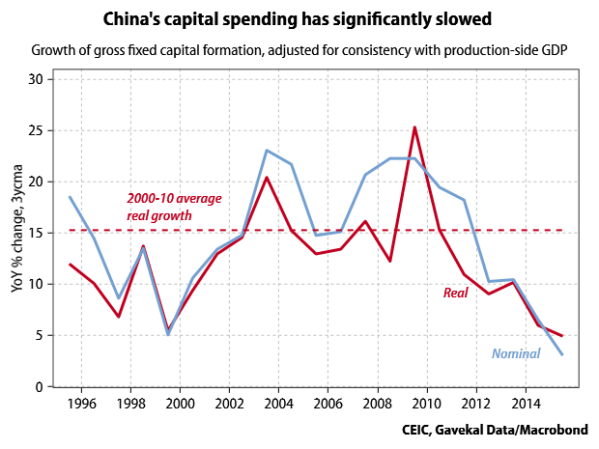
Yet over the exact period during which it became much more compelling for companies to invest in capital rather than labor, overall investment spending in China nonetheless slowed substantially. The chart below is my estimate of real growth in capital formation in the national accounts (a better if less timely indicator than the monthly fixed-asset investment numbers). Gross investment growth was about 5% in 2015, against an average of 15% over the previous decade.

capex-slowdown

What’s going on here? How can investment growth be so weak when the incentive to substitute capital for labor is so strong? As for almost all macro questions about China, housing is a big part of the answer (a theme I have hammered on before; see this rant and this more sober post). Residential construction drove a big chunk of that 15% annual growth in the past, but housing now looks like it has moved off the steep part of the S-curve and on to the flatter part. With residential construction stalling out, it’s hard for aggregate investment to grow very fast. It will take a while for robots to compensate for that.

What Xi Jinping really said about Deng Xiaoping and Mao Zedong

It’s been hard to escape the Xi-is-the-new-Mao meme of late, especially with the anniversary of the Cultural Revolution offering an occasion for historical reflection. Andy Browne’s piece in the WSJ is one of the better overviews of the question, noting high up the many important ways in which Xi is not the new Mao; Andrew Nathan’s article in the New York Review of Books is also very much worth reading. Both authors point out an important statement by Xi on the legacies of Mao Zedong and Deng Xiaoping; here is Browne, whose shocked reaction was probably shared by many:

He has declared that it is just as unacceptable to negate Mao’s 30 years in power as it is to speak critically of the 30 years that followed under Deng. He has set side-by-side, on equal footing, a period marked by spasms of mass killing and destruction and an overwhelmingly peaceful era that saw the greatest economic progress in human history.

This naturally piqued my curiosity, so I looked up the original remarks by Xi, which he made on January 5, 2013 in a speech entitled “Some Questions on Maintaining and Developing Socialism with Chinese Characteristics.” The speech is indeed very interesting for how Xi positions himself relative to the legacies of Deng and Mao. There is an official summary from Xinhua which covers the main points, including the statement that Browne and Nathan focus on: “we cannot use the historical period after reform and opening to deny the historical period before reform and opening, nor can we use the historical period before reform and opening to deny the historical period after reform and opening” (不能用改革开放后的历史时期否定改革开放前的历史时期,也不能用改革开放前的历史时期否定改革开放后的历史时期). But I also dug up the full text of the speech, which though not online is in an official book of Party documents (十八大以来重要文献选编), and this has more context and some very direct language, which makes it easier to understand what Xi is getting at. Here is my translation of the most relevant section of the speech:

For our Party leading the people in building socialism, there are two historical periods: before “reform and opening” and after “reform and opening.” These are two interrelated periods that also have major differences, but the essence of both periods is that our Party was leading the people in the exploration and practice of building socialism. “Socialism with Chinese characteristics” was created in the new historical period of “reform and opening,” but it was created on the basis of New China having already established the basic socialist system and carried out more than twenty years of work. A correct understanding of this problem requires grasping three points.

First, if our Party had not taken the decision in 1978 to carry out “reform and opening,” and to unswervingly push forward “reform and opening,” socialist China would not be in the good situation it is today–it is even possible it could have faced a serious crisis like the Soviet Union and Eastern Europe. At the same time, if in 1949 New China had not been established in a socialist revolution, and accumulated important ideas, materials and institutional conditions, gaining both positive and negative experiences, it would have been very difficult for reform and opening to proceed smoothly.

Second, although the ideological direction, policies and practice of building socialism in these two historical periods were very different, these two periods are not separate from each other, and are not at all fundamentally opposed. Our Party has in the process of building socialism proposed many correct positions, but at the time they were not properly implemented; they were only fully implemented only after “reform and opening,” and we will continue to adhere to them and develop them in the future. Marx said long ago: “Men make their own history, but they do not make it as they please; they do not make it under self-selected circumstances, but under circumstances existing already, given and transmitted from the past.”

Third, there must be a correct evaluation of the historical period before “reform and opening.” We cannot use the historical period after “reform and opening” to deny the historical period before “reform and opening,” nor can we use the historical period before “reform and opening” to deny the historical period after “reform and opening.” The practice and exploration of socialism before “reform and opening” built up the conditions for the practice and exploration of socialism after “reform and opening;” the practice and exploration of socialism after “reform and opening” is to maintain, reform and develop the previous period. …

The reason I emphasize this question is because this is a major political issue that, if not handled properly, will have serious political consequences. The ancients said: “To destroy the people of a country, first go at their history.” Hostile forces at home and abroad often write articles about the history of the Chinese revolution and the history of New China–they stop at nothing in attacking, vilifying and slandering, but their ultimate purpose is to confuse people and to incite the overthrow of the Chinese Communist Party and our country’s socialist system. Why did the Soviet Union disintegrate? Why the Soviet Communist Party fall from power? One important reason is that in the field of ideology the struggle was very intense–fully negating the history of the Soviet Union and the Communist Party, negating Lenin, negating Stalin, promoting historical nihilism and confused thinking. Party organizations at all levels hardly did anything, and the army was not under the leadership of the Party. In the end, the Soviet Communist Party, this great Party, was scattered, and the Soviet Union, this great socialist country, fell to pieces. This is a cautionary tale!

Comrade Deng Xiaoping pointed out:  “On no account can we discard the banner of Mao Zedong Thought. To do so would, in fact, be to negate the glorious history of our Party. On the whole, the Party’s history is glorious. Our Party has also made big mistakes in the course of its history, including some in the three decades since the founding of New China, not least, so gross a mistake as the ‘Cultural Revolution’. But after all, we did triumph in the revolution. It is since the birth of the People’s Republic that China’s status in the world has been so greatly enhanced. It is since the founding of the People’s Republic that our great country, with nearly a quarter of the world’s population, has stood up — and stood firm — in the community of nations.” He also stressed: “The appraisal of Comrade Mao Zedong and the exposition of Mao Zedong Thought relate not only to Comrade Mao personally but also to the entire history of our Party and our country. We must keep this overall judgement in mind.”

This is the vision and thinking of a great Marxist statesman. Think for a moment: if at that time we had fully negated Comrade Mao Zedong, could our Party still stand firm? Could our country’s socialist system stand firm? If it does not stand firm, then the result is chaos. Therefore, correctly handling the relationship between socialism before and after “reform and opening” is not just a historical issue, in fact it is mainly a political issue. I suggest that everyone take out the “Resolution on Certain Questions in the History of Our Party Since the Founding of the People’s Republic of China” and read it again.

I think it is not quite right to read this as Xi glorifying everything about Mao, and saying China made just as much progress during the Great Leap Forward as it did after 1978. What Xi is saying is that the legitimacy of the Communist Party China rests on the whole history of its rule, and that if the legitimacy of Party rule is questioned for one historical period, then it can be questioned for other historical periods. Deng felt the same way, and what Xi is doing in this speech is forcefully repeating Deng’s own evaluation of Mao. The 1981 resolution on Party history that Xi cites is best known for how it assigned primary blame for the Cultural Revolution to Mao personally. But the resolution’s overall assessment of Mao is rather balanced, and Deng himself insisted on this. The quotes from Deng that Xi mentions are remarks Deng made during the drafting of the resolution, and some other Deng comments from the same source make the point very clear:

Comrade Mao Zedong was not an isolated individual, he was the leader of our Party until the moment of his death. When we write about his mistakes, we should not exaggerate, for otherwise we shall be discrediting Comrade Mao Zedong, and this would mean discrediting our Party and state. … What we have achieved cannot be separated from the leadership of the Chinese Communist Party and Comrade Mao Zedong. It is precisely this point that many of our young people don’t sufficiently appreciate.

The parallel that both Deng and Xi very clearly had in mind is the Soviet Union, and the backlash against Stalin that began with Khrushchev’s famous “secret speech” acknowledging Stalin’s crimes. Chinese leaders clearly view the “negation” of Stalin that Khrushchev began as fatally undermining the legitimacy of the Soviet Party, and leading inevitably to its collapse in subsequent decades. And they are not alone in this judgment. Here is the historian Orlando Figes on the impact of Khrushchev’s 1956 speech, from his excellent Revolutionary Russia, 1891-1991: A History:

The speech changed everything. It was the moment when the Party lost authority, unity and self-belief. It was the beginning of the end. The Soviet system never really recovered from the crisis of confidence created by the speech. How could people continue to believe in a revolution that had killed so many in the people’s name? In leaders who had told so many lies? For the first time the Party was admitting that it had been wrong— not wrong in a minor way but catastrophically. How could it rebuild its credibility?

Exactly. I do not see much daylight between Xi Jinping and Deng Xiaoping in terms of their positions on Mao Zedong and Communist Party history. Xi is very much following in Deng’s footsteps here, though he may be departing from Deng’s legacy in other ways.