The resource curse is alive and well in Mongolia

Catching up on my reading after a break, I see that the excellent Bill Bikales has written a nice summary of the unfolding economic crisis in Mongolia, where the currency is plunging, borrowing costs are rising and boom-era debts are suddenly looking very doubtful:

The crisis traces back to 2012, when a new Mongolian coalition government took office facing extremely favorable economic conditions, including high mineral prices and strong demand from China. Gross domestic product had grown by 17.3% in 2011 and by another 12.3% in 2012, making the country a global leader.

Investment flowed into Mongolia as a result of an agreement with Rio Tinto to develop the massive Oyu Tolgoi copper-and-gold resource in the Gobi Desert. There was also strong interest in the equally massive Tavan Tolgoi coal deposit in that region, along with other coal, iron and copper deposits.

But the new government had won election by making highly populist promises, and this led to a contradictory agenda. On the one hand, the government attempted to renegotiate the already signed Oyu Tolgoi agreement, and in general started seeking better terms from foreign mining firms. This led to a quick drop in investment, growth and revenues. At the same time, the government rapidly expanded spending on housing, government salaries, social welfare and pensions.

The only way the government could finance the resulting large budget deficit was by borrowing. For the first time, Mongolia became a significant global issuer of commercial paper. Between 2012 and June 2016, the government raised $3.6 billion, roughly one-third of GDP, on global bond markets, paying high interest rates. There was also a massive buildup of domestic debt. In a throwback to the planned-economy era, the banking sector once again became a major financier of government programs. Total loans in the economy doubled in the first two years of the 2012 government’s term, and the money supply expanded at an extraordinarily rapid pace. Nonperforming loans began to build up. …

By 2014, international financial institutions expressed measured but clear concern about the deteriorating economic situation. The central bank slowed monetary expansion and budgets were tightened somewhat. This coincided with a continued collapse in foreign investment and a steady decline in global mineral prices due to China’s slowdown. As a result, Mongolia’s growth slowed sharply to 2.3% in 2015 and is likely to be zero or negative in 2016.

But the current economic downturn isn’t primarily due to a decline in global commodity prices. It is the result of the government borrowing heavily against future export earnings while taking actions that deferred the day when those exports would materialize. Instead of preparing for an inevitable cyclical downturn in commodity prices, the government took steps that magnified that downturn’s impact.

A sovereign debt default now looks very much like a live possibility for Mongolia. This sad narrative fits very well the best current understanding of the resource curse–which is not that possession of natural resources mechanically causes lower growth. There are enough countries that manage to do well while having large energy or mining industries (such as the US) so that attempts to find correlations between resource endowments and growth outcomes have had decidedly mixed results. Rather, the problem with having a big resource sector is that it exposes a country to the huge boom-bust cycles typical of commodity markets–and it is rare for countries to be able to make good decisions at either end of a commodity cycle. The temptations to make borrow too much and make bad investments in the boom days is particularly strong; note this sentence from a recent World Bank paper: “Credit growth has been most pronounced, and nearing the pace associated with past credit booms, in commodity exporting countries.” As Bikales shows, Mongolia has problems because it made bad decisions, not just because it had a mining boom. One useful recent summary of the literature on the resource curse is Cullen Hendrix and Marcus Nolan’s Confronting the Curse: The Economics and Geopolitics of Natural Resource Governance, who conclude:

Natural resources are neither discovered nor exploited in an institutional vacuum. Preexisting institutions are the key moderating factor. If these institutions are strong and the size of the mineral sector does not dwarf the rest of the economy, resource wealth provides additional capital for productive investment. Even if Dutch disease dynamics come into play, these resources can be invested in ways that promote intergenerational equity and the accumulation of long-term wealth. Under these circumstances, resource income is growth promoting, and the “curse” becomes more of a blessing. This condition seems to be the equilibrium path of Norway, the United Kingdom, the Netherlands, and the United States. If preexisting institutions are weak and the mineral sector is much larger than the rest of the economy (as in Angola, Nigeria, and Saudi Arabia), the resource curse dynamic emerges.

An interesting comparison is available just over the border in the Chinese province of Inner Mongolia, which is a huge coal producer and has experienced a similar boom-bust cycle along with commodity prices. Both Mongolia and Inner Mongolia are currently enjoying nominal GDP growth of less than 4%, down considerably from their recent highs–though Mongolia’s peak nominal growth rate neared 50% while Inner Mongolia was–only!–around 25%.

mongolias

The province of Inner Mongolia of course does not have its own currency and does not borrow internationally, so it is not going to experience the same type of fiscal and currency problems as the independent nation of Mongolia. And while the governing institutions in the two places are quite different, neither place is exactly pursuing Norway-type best practices for managing their resource wealth. So there is also some evidence of the resource curse playing out in Inner Mongolia, essentially meaning bad economic decision-making during commodity booms. The famous “ghost city” of Ordos could be one supporting anecdote; however that example is probably overplayed, as Wade Shepard reports: “The real story consists of a mining boomtown building a new district on a long-term timeline in a period when hundreds of other cities across the China were doing the same thing.” On a macro level however it seems pretty clear that investment got even more out of hand in Inner Mongolia than in the rest of China, and is correcting harder:

inner-mongolia-investment

Is China’s growth now increasing rather than reducing global inequality?

Here is an interesting tidbit from Branko Milanovic’s latest book, Global Inequality: A New Approach for the Age of Globalization. Much of the book is about the recent, unusual combination of a trend for inequality to rise within countries (as the upper classes take a larger share of each nation’s income) and a trend for inequality between countries to fall (as rising incomes in developing countries narrow the gap between the haves and have-nots on a global basis). China has been the main driver of the latter dynamic, but we may already be at a turning point in that trend–one that will require India to keep growing if global inequality is to keep falling:

Population-weighted intercountry inequality has been uniformly decreasing since the late 1970s, since about the time when China introduced the “[household] responsibility system” (de facto private ownership of land) in rural areas and growth picked up. Moreover, convergence (the decrease in intercountry, population-weighted Gini values) has been remarkable and has accelerated in the first decade of the twenty-first century. We have already seen that this movement was the key factor behind the decrease in global inequality and the broadening of the global middle class. …

China’s role as the main engine driving the reduction in global inequality becomes less important as the country gets richer. In 2011, China’s mean per capita income, calculated from household surveys and expressed in international dollars, was 22 percent below the global mean and was greater than the mean incomes of 49 percent of the people in the world (assumed to have the mean incomes of their countries).

The world will very soon be in the position where China’s high growth rate begins to add to global inequality, not detract from it. India’s mean income is currently ahead of only 7 percent of the world population, and India cannot be expected to “turn the corner,” that is, to become, in average per capita terms, richer than more than 50 percent of the world population, in the next twenty years. Thus it will, if it grows fast, take over from China as the main engine of global income equalization.

The technicalities are interesting and worth citing in full:

Footnote 16: In the case of the Gini coefficient (with which we work here), the point at which a unit begins to add to inequality depends on its rank (let’s call it the “turning point rank”), that is, the number of units from which it has a higher income, but also on the initial Gini. The turning point rank formula is i > ½ (G + 1)( n + 1) which for a large n simplifies to i > ½ (G + 1) n, where i = the turning point rank (the rank i runs from 1 to n), n = total number of units, G = Gini coefficient. Note that the turning point is n/ 2 (i.e., the median) only when the Gini is zero. For the derivation of the formula, see Milanovic (1994).

With the current level of population-weighted global Gini being around 0.54, the turning point rank is 0.77n. That means that China’s mean income has to be such that, when all individuals in the world are ranked by the mean incomes of their countries, 77 percent of the world population is left behind China. But because China’s population is 20 percent of world population, for a Chinese person to be at that (“turning”) point, he or she needs to leave behind only 57 percent (77 − 20) of the world population. Currently, as we have seen, China’s mean income exceeds the mean income of 49 percent of world population. This means that China needs to leave behind just an additional 8 percent of people in the world to begin adding to global population-weighted inequality. This could already be happening by the time this text is being read.


The return of the random Sun Ra title generator

Since it’s the summer, I’ve been indulging myself a bit. On my very first website, back in 1996, I wrote a goofy piece of software to generate song titles in the distinctive, cosmic style of Sun Ra–an attempt to imitate the inimitable, of course, but still entertaining (to me, anyway). I forgot about it for a long time, but it popped back to mind recently on a long bus ride, and I decided to recreate it. Random generator technology has advanced some since then, so it was not too hard to do. And the result is still a source of nearly endless amusement for this Sun Ra fan. Here it is, press the More button as many times as you want:

The Random Sun Ra Title Generator

One of the fun little things about life in Beijing is that you can see Sun Ra almost everyday–it’s part of the logo of a major brand of electric bikes. I still get a kick out of this.

SunRaBikeStore

The brief renaissance of Chinese market economics in 1961

File under “the road not taken.” The following is from Carl Riskin’s China’s Political Economy: The Quest for Development since 1949, a 1987 book that is still a very useful guide to the Mao-era economy.

The return to rigid centralization in the early 1960s [in reaction to the Great Leap Forward] meant that very soon the economy was facing the same problems as before the 1957-8 reforms [i.e., sluggish growth in agriculture, ineffective central planning, rising unemployment]. At this time a very far-reaching discussion took place among economists, in which the possibility of enterprise autonomy and a major role for the market was cautiously explored. …

A number of reforms were advocated during this period that anticipated the reform proposals put forward from 1979 on. In accordance with the emphasis on efficiency, the idea of diversified, comprehensive enterprises was rejected in favour of specialized units and division of labour. At the level of the individual worker, specialization and division of labour meant a strictly enforced individual responsibility system with emphasis on individual material interests to shore it up. …

The remarkable debates among economists during the 1961-4 period went far beyond the specific reform proposals listed above. Among the most important subjects covered was the role of commodity production and the law of value under socialism. …

‘Commodity production’ refers, of course, to the production of goods and services for exchange rather than for direct use. The ‘law of value’ refers to the tendency, under competitive market conditions, for goods to exchange with each other at rates proportional to their relative socially necessary labour times. The two concepts are linked, in that the production of commodities for exchange presupposes exchange values satisfactory to all parties, and the workings of competition in a market commodity economy will tend to make such values gravitate toward proportionality with socially necessary labour times, given certain assumptions. It was also widely held that a commodity economy requires regulation by the law of value (i.e., requires regulation by a market through which the law of value determines exchange relations), but that a non-commodity economy—such as one with only a state sector, producing and distributing goods strictly according to plan—is free of such a requirement. Sun Yefang denied the latter contention, arguing that instead that the law of value states a basic principle of optimal resource allocation that must be respected whether in a commodity economy or a totally planned one. …

The importance of these apparently esoteric exercises in Marxist theory is not hard to see. The finding that socialism still provides considerable scope for commodity production and exchange constitutes a theoretical basis for relaxing centralized command planning—up to then established by Soviet theory and practice as the only orthodox form of economic organization—without betraying socialism. The proposition that the law of value must regulate resource allocation even in a planned economy is tantamount to a repudiation of arbitrary and intuitive planning. And, since central planners nowhere (and certainly not in China) have the capacity to allocate physically tens of thousands of individual goods and services in conformity with the law of value, this proposition also implies the need to replace command planning with the use of the market. …

Sun Yefang had gone well beyond the theoretical exploration of these questions to map out a series of reform proposals that would fundamentally alter the nature of China’s planning and management system. The essence of his proposal was the replacement of administrative command planning with market socialism, in which autonomous enterprises would strive to maximize profits under a regime of parametric planning, with the state influencing enterprise behaviour via economic levers such as prices, taxes, and credit policies. …

The Tenth Plenum in September 1962 made it clear that radical changes of the sort discussed would not take place… most of the reform proposals had to wait during another decade and a half of turmoil before getting a sympathetic hearing from a relatively united leadership.

And from 1964 on, as the polemics that would become the Cultural Revolution began to build, Sun Yefang and other economists were subject to increasingly vicious public attack. More detail, albeit more than most readers will want, can be found in Cyril Lin’s 1981 article, “The Reinstatement of Economics in China Today” (JSTOR link).

Sun Yefang

Sun Yefang

China’s top economics prize commemorates that history: it is called the Sun Yefang Prize in Economic Science, supported by a foundation set up in 1983 by a number of officials and reformist scholars. Interestingly, the most recent recipients of the award are two economists at the Federal Reserve Bank of San Francisco.

The case against targets in healthcare liberalization

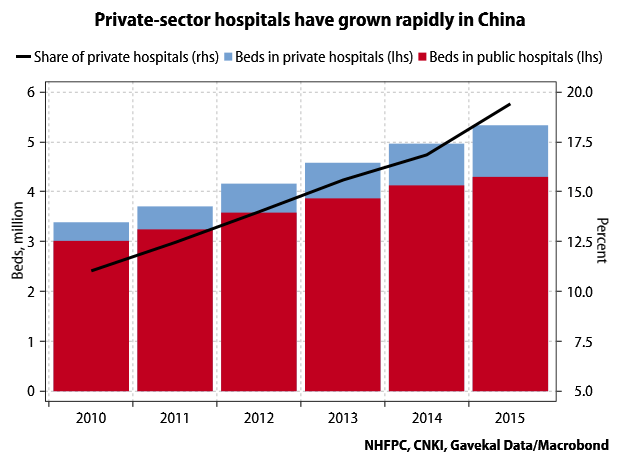
China’s new statistical communique on healthcare is just out, providing another snapshot of how the private sector is doing in this state-dominated field. Although the role of the private sector across the economy has not, unfortunately, increased much in recent years, healthcare has generally been an exception to this worrying trend since the reforms adopted in 2009. According to the communique, private hospitals accounted for 19.4% of hospital beds in the country as of end-2015, up from 11% in 2010, after they added nearly 200,000 new beds in the year. Private hospitals’ market share is probably a bit lower than their share of capacity, as they accounted for 14.7% of hospital admissions in the year. But both indicators represent pretty decent progress toward the goal, set in the 12th five-year plan on healthcare, to have private hospitals account for 20% of “hospital beds and service volume” by 2015.

Public and private hospital beds

I have argued that China could also adopt such targets for raising the private sector’s role in sectors other than healthcare (see this Q&A, and the full paper). And some domestic experts argue that the target for the private sector’s share of healthcare should be radically increased, in order to drive more decisive liberalization. The weight of establishment opinion appears to be swinging against these views, however, judging from a new report on healthcare reform, jointly produced by the Ministry of Finance, the National Health and Family Planning Commission, the Ministry of Human Resources and Social Security, the World Bank, and the World Health Organization. There is a lot in the report, but the section on the private sector’s role attacks the target fairly directly:

Quantity targets have spurred private sector growth in ways not consistent with national health objectives. …

It is worth noting that no OECD country has used quantitative targets to expand the private sector, but has rather employed a combination of supportive policies and regulatory structures that level the playing field with government-owned providers and assure alignment with health system goals.

Why has the expansion of private sector healthcare not been ideal from the perspective of the overall goals for healthcare delivery? Apparently because private sector hospitals are only serving a narrow part of the market:

Occupying a space created by the over-worked and crowded public system, the private sector offers alternatives to those seeking more and better medical products and services. However, despite central policies encouraging greater collaboration between public and private sectors, many local governments continue to focus their service planning and public financing on public service providers, effectively segmenting the market for the private sector for services targeting the wealthy and specialty facilities mostly offering elective services.

This seems to be a function of the fact that, despite setting a target for an increased role for the private sector, there are many unresolved regulatory issues for private hospitals and very uneven implementation of reforms granting them greater market access:

Despite the acceleration in recent years in the pace and scope of policies promoting private healthcare production and delivery, there continues to be no unified vision for the role of private providers in improving service delivery or contributing to national health objectives, and consensus has yet to be formed across government agencies on whether the private sector should be complementary, supplementary or integral to the public delivery system. …

The central government has enacted a rich set of national policies regarding private sector engagement, yet there are differing interpretations of these policies by provincial and municipal governments, among government agencies and between the public and private health sectors on the role of the private sector in contributing to national health objectives. From an implementation perspective the policy direction is unclear.

There is also a concern that the regulatory system is not keeping up with the changes, so it is ill equipped to address malpractice or other problems at new private-sector facilities.

The private sector requires a well-functioning governmental stewardship mechanism in order to grow, one that has the capacity of monitoring (and shutting down, as necessary) facilities seen to be endangering patient safety or defrauding social health insurance. Regulatory frameworks for accountability and quality assurance, however, exhibit wide local variations and are not uniformly strong. It is widely believed that private providers are more likely than their public counterparts to engage in false advertising, over-treatment, or fraudulent billing practices, and unsurprisingly, the private health sector in China does not have a good reputation with health consumers.

The report recommends a different but, I have to say, somewhat vaguer approach:

In keeping with the focus on quality development as against quantity growth, move away from quantity targets for private sector market share and instead employ a combination of supportive policies and regulatory structures that level the playing field with government-owned providers and assure alignment with health system goals.

It seems unlikely, then, that China’s next five-year plan for the healthcare sector will include a clear, quantitative commitment to a much larger private-sector role in the healthcare sector.

Is there are an ideological divide over China’s regional divide?

Headlines in the Chinese official media over the last couple of days have been dominated by Xi Jinping’s tour of Yinchuan, in the western province of Ningxia. The visit was the occasion for some stirring rhetoric about helping poorer regions like Ningxia; on his first day, Xi declared that

No region or ethnic group can be left behind in the drive to build a moderately prosperous society by 2020 (到2020年全面建成小康社会,任何一个地区、任何一个民族都不能落下)

He also made a speech at a conference on poverty alleviation that emphasized the duty of the prosperous eastern provinces to aid the inland. In a no-doubt-deliberate echo of Deng Xiaoping’s famous formulation that “we permit some people and some regions to become prosperous first,” Xi said that

The first to prosper should help the latecomers, to achieve the final goal of common prosperity (实现先富帮后富、最终实现共同富裕目标)

The conference was about a system where wealthier cities and counties in the east are “paired” with poorer counterparts in the west, which Xi praised because

a gradual reversal of the trend of widening regional gaps in development has been achieved, and poverty alleviation in impoverished western regions and old revolutionary areas has made great progress (区域发展差距扩大的趋势得到逐步扭转,西部贫困地区、革命老区扶贫开发取得重大进展)

(For the sources, here are links the first round of official reports in Chinese and English, and the ones on the poverty alleviation conference in Chinese and English)

Of course, it’s stretching the truth a bit to say that China’s regional gaps have been narrowing; the widening regional gaps in the current slowdown have been a huge subject of huge public debate. But I’m more interested in what Xi’s comments show what he thinks should be done: of course, regional gaps should narrow; of course, funds must flow from wealthier provinces to poorer ones. So this latest propaganda push seems like a very clear example of the egalitarian-Maoist strain of thought that is still very powerful in Chinese economic thinking.

Which is interesting, because some people who are close to Xi seem to have have been pushing back quite strongly against this line of thought. In early May, the People’s Daily carried a now-famous interview with an unnamed “authoritative personage,” who is widely assumed to represent the views of Xi’s top economic advisors (Barry Naughton’s recent piece in the China Leadership Monitor is the best overview of the debate). The piece got headlines for the way that it directly attacked stimulus policies and openly expressed worries about debt and slowing growth, all in a rather harsh tone unprecedented in recent official discourse. But the “authoritative personage” also attacked the notion that widening regional gaps are inherently bad, and must be aggressively tackled by the government. Here is the passage, in my translation:

Question: At the same time that the economy is slowing, we have also noticed that the trend of divergence has become more pronounced: the stabilizing and improving trend in the economy of the eastern coastal region has strengthened, but some resource-dependent provinces in the northeast and the west are still experiencing economic difficulties. Some foreign media call this “two worlds.” What signal does this trend of divergence send?

Authoritative Personage: Divergence is a necessity of economic development. …

In the “new normal,” we need to optimize the allocation of resources, develop new growth drivers, and form a new industrial structure. Therefore the faster divergence happens, the better. Whether we are talking about regions, sectors or companies, one part of them will, following the “80-20 rule,” obtain 80% of the benefits, and stand out from the rest as having a bright future. And there is another part that will experience hardship, but will also learn a lesson and will know what to do next. To me this is not a bad thing.

Since China began reform and opening up, the divergence in the economy has accelerated, and in this process there has emerged a group of vibrant regions and competitive sectors and companies with famous brands. After the global financial crisis, divergence in the world economy accelerated, our country entered the new normal, and domestic economic divergence further intensified. Last year, in analyzing the first quarter’s economic trends the Party Central pointed out that as long we actively adapt to the new normal, and focus on innovation and qualitative efficiency, then the trend of development will be relatively good; if not, the pressure will be very great. This year this trend has continued and even intensified, so while some are happy others are worried.

In the foreseeable future, amid economic divergence, vibrant regions and internationally competitive sectors and companies will continue to arise, but some regions, sectors and companies will encounter more and more difficulties. … The people in these regions, sectors and companies have now shed their illusions, are relying on themselves, are taking the initiative to promote reform and innovation, and are striving to catch up.

The “authoritative personage” is presenting a more classically laissez-faire view, where regional gaps reflect the workings of market forces, and the failures in the backward regions are in fact necessary for them to develop further. Xi himself on the other hand seems to be more comfortable in a more paternalistic and interventionist mode. This of course is not the first time that different parts of the leadership have sent conflicting messages about the economy, and is another indication that the economic strategy at the moment is rather confused.

When “It’s the economy, stupid” falls short

I read the news today, oh boy. For some clear thinking if not reassurance, I recommend an essay by Yascha Mounk at Project Syndicate, in which he surveys various people’s takes on the recent global political instability, and comes down fairly hard against the economists’ argument that all this stuff is the result of stagnating incomes. Here is a condensed excerpt, though the whole thing is worth reading:

In what sense are politicians as different as Trump, Erdoğan, and French National Front leader Marine Le Pen connected? Does the anger that has set so many countries’ voters against their political establishment have common causes – and, if so, are there common remedies that can halt the rise of populists? …

According to Bill Emmott, former Editor of The Economist, the reasons are straightforward: “the interests of ordinary people have been subordinated to those of the elite.” … Harvard’s Dani Rodrik agrees, arguing that “the internationalization of markets for goods, services, and capital drives a wedge between the cosmopolitan, professional, skilled groups that are able to take advantage of it and the rest of society.” …

The problem with these explanations is the mismatch between the root causes of popular anger and the form this anger takes in most countries. Supporters of Trump or the Netherlands’ Geert Wilders may blame free-trade agreements for eroding job opportunities; but the bulk of their energy and anger is directed not at prevailing economic orthodoxy, but at social policy. The defining feature of their political brand is hatred of immigrants, not of the World Trade Organization. …

Joschka Fischer, a former foreign minister of Germany, has a more radical view of the economic causes of an essentially cultural rage. He argues that the “White Man’s World” is under attack from the “globalization of labor markets, gender parity, and the legal and social emancipation of sexual minorities.” Immigration is the “issue that brings that prognosis home (not just metaphorically) to today’s angst-inspired nationalists.”

Fischer’s view helps to explain a puzzle identified by Daniel Gros, Director of the Center for European Policy Studies in Brussels. If losses from globalization “account for the rise of populism, they must have somehow intensified in the last few years, with low-skill workers’ circumstances and prospects deteriorating faster vis-à-vis their high-skill counterparts.” But “that simply is not the case,” Gros shows, “especially in Europe.” While the economic transformations of recent decades help to explain falling trust in existing political institutions, it is facile to assume that it is primarily globalization’s immediate losers who support the populists, much less to expect that an upswing in the business cycle will halt the populists’ rise. …

The most optimistic observers emphasize that the costs of globalization stem from politics, not economics. As J. Bradford DeLong of the University of California at Berkeley argues, income stagnation was caused not by globalization, but rather by politicians who have “failed to implement policies to manage globalization’s effects.” … But if such desirable policies exist, why should our political systems, having failed to pursue them in the past, be able to do so now?

In my view, the choices facing us in the next decades may be far starker than the optimists admit. There are three reasons why attempts to shore up living standards are unlikely to stem the populist threat: the right policies might not be adopted; even if they were adopted, they might fail to redress economic grievances sufficiently; and, most important, even if they did redress economic grievances, they would not necessarily defuse the culturally-based anxieties of many citizens. As Harvard’s Ricardo Hausmann emphasizes – and as the Brexit vote clearly showed – the “sense of ‘us’” is more important to many people than achieving greater success through integration with “others.” …

This implies that redistribution and compensation of globalization’s losers will not be enough, and that liberal democracy is likely to become an increasingly unstable political compound.

I find this convincing albeit somewhat depressing. I think it’s pretty clear that the Trump phenomenon is mostly about white identity politics rather than economic issues, and that the Brexit vote was also mostly about English nationalism rather than economic issues. Greg Ip’s recent column has a good summary of research on anti-immigrant sentiment, and how it is in fact driven mainly by national identity rather than economic issues.

The benefit of an economic explanation of the populism/nationalism/whatever thing that is going on in so many different countries is that it can unify what is being explained: all these events are manifestations of the underlying trends in the global economy. I’m don’t find the economic explanations that convincing, but the alternatives are admittedly more complicated. If the working-out of national identity issues is central, as it indeed seems to be, that makes it harder to explain in terms of a cross-country phenomenon.

So I don’t have the unifying field theory for all this, but I do think it’s worth thinking more about how to understand nationalism. One basic conclusion is that politics is not in fact economics by other means, but actually about politics. And there is no more crucial political task than defining the nature and boundaries of the political community. Reflexively looking for the hidden economic interests underlying a political position is a Marxist fallacy if there ever was one–invoking “it’s the economy, stupid” is not always the smart move.

Three books on Russia

I’ve been on a bit of a Russia kick in my nonfiction reading of late. In part that was because I felt like knowing more about the history of Communism would help me understand China better, and in part because I just wanted to know more than what I learned from my initial immersion in its 19th-century literature at university. So far I’m batting a thousand, as all three of the books I somewhat randomly chose have turned out to be very worthwhile:

  • Orlando Figes, Revolutionary Russia 1891-1991: A HistoryA concise and very nicely written general history, which did exactly what this kind of book is supposed to: conveyed the big picture in a clear and vivid way, and made me want to learn more about many specific questions.
  • Rosemary Sullivan, Stalin’s Daughter: The Extraordinary and Tumultuous Life of Svetlana AlliluyevaOverly long, as is so often the case with biographies, but still consistently fascinating and moving. She was dealt a horrible hand from birth, and tried valiantly to live an ordinary and decent life anyway–it is impossible not to feel sympathy for her, though she also made many poor choices. The book is definitely about her and not really about Stalin, though it still conveys something of an insider’s perspective on the USSR.
  • Charles Clover, Black Wind, White Snow: The Rise of Russia’s New NationalismOne of the most interesting pieces of intellectual and political history I’ve read in a long time. The book starts as quirky historical detective story, digging out the origin of some unlikely ideas in an unusual cast of characters, including Russian aristocrats and structural linguists. Then it morphs into a more journalistic account of recent Russian political history, detailing how those unlikely ideas came to have real political force. Altogether an excellent explanation of where Russia is today and how it got there, highly recommended. Check out this excerpt for a taste.

I haven’t decided what Russia book I’m going to tackle next, but I do feel like I need to know some economic history of the Soviet Union, and have added some recommended titles to my list.

What I’ve been listening to lately

  • Chris Potter – Song For Anyone. I first heard Potter’s searching tenor sax when he was a member of the late, great Paul Motian’s bands, but am only now catching up on his solo work. His Imaginary Cities, a work for a large ensemble including a string quartet, got a lot of notice last year, but it was not the first time he had put together a big group. I also enjoyed this 2007 recording, which is perhaps even more accessible.
  • Ike Quebec – 1944-1946. Quebec would go on to record many moody, bluesy albums for Blue Note in the 1960s, but his big tone is also a treat in these earlier small-group swing sessions.
  • Charlie Mariano – Deep In A Dream. Mariano’s keening alto sax was one of the key ingredients in Mingus’ masterpiece, The Black Saint and the Sinner Lady, and I’ve been on the lookout for more of his work ever since that first exposure. His distinctive tone makes this 2001 album of ballads compelling listening.
  • Archie Shepp & Horace Parlan – Goin’ Home. For me, this album encapsulates Shepp’s transformation from avant-garde firebrand to mellow elder statesman of jazz. These 1977 duets on gospel melodies are long, ravishing, emotional.
  • Jones-Smith Incorporated. In 1936, just before Count Basie started his classic big-band recordings for Decca, he made four small group tracks featuring Lester Young’s first recorded solos. “Shoe Shine Boy” “Evenin'” “Boogie Woogie” and “Oh, Lady Be Good” are available on several swing-era compilations, but somehow I had managed not to hear them until this year. The producer John Hammond famously called these sessions “completely perfect,” and he was right: their understated craft is a true delight. They just make you wish Basie had recorded more in small groups, which he did not until much later in his career.

Why targets make sense for healthcare liberalization

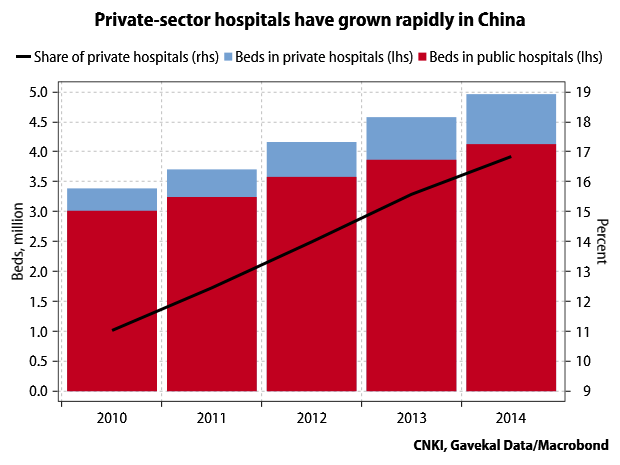
In working on my Paulson Institute paper on service-sector liberalization, I ended up putting a lot of emphasis on one seemingly minor component of the 12th five-year plan on healthcare. Among its many goals, the plan includes a target for raising the share of hospital beds in private hospitals to 20% by 2015; while the 2015 figures aren’t available yet, that share did in fact rise from 11% in 2010 to 17% in 2014 (see chart below). This seemed to me a useful example of how to use China’s planning system to drive liberalization rather than just increased output. And reading the excellent recent CSIS report on China’s 13th five-year plan, by Scott Kennedy and Chris Johnson, I find that I am not alone. The section on healthcare includes this comment from an anonymous interviewee:

One Chinese health care expert suggested that perhaps the best benchmark of whether the various reform proposals would actually transform the system would be to focus on the proportion of hospital beds that are in private hospitals. In order for that figure to rise dramatically, for example, to 60 percent, it would likely require changes in other areas of the system, including the development and marketing of drugs, the professional status of doctors, and the availability of private insurance.

So the reason to set a target for the private sector’s market share is to push people in the system to figure out all the different things that need to change in order for the target to be achieved. Rather than get bogged down in precisely specifying the means, the authorities can just specify the ends. The CSIS report puts it rather better than I originally did in my paper. This logic I think further supports the idea that these kind of targets should be more widely adopted if the Chinese government wants to ensure that its rhetoric about greater opportunities for the private sector is actually matched by reality.

The expert’s proposal for a very high and aggressive target for the private sector’s share of healthcare would certainly be controversial. As Kennedy and Johnson write, the complexity of healthcare markets makes it hard to simply argue that a much greater private-sector role would be uncomplicatedly good for everybody:

There is no consensus that a fully market-oriented health care system would yield better health care outcomes for Chinese society. Some worry that if things were made easier for foreign pharma[ceutical companies], private hospitals, doctors, and private insurers, the cost of health care would rise, and many who now are well treated would be priced out of the market. …

Would more thoroughgoing marketization serve China much better? It is hard to know for sure, given that there are both successful and failed examples of privately-based, market-oriented health care system.

On the other hand, they do note the ways in which the corruption and inequality in the Chinese healthcare system is linked to the high levels of state dominance:

China’s almost 3 million doctors have been prisoners in this state-controlled system. They are not classified as regular workers, and they are tied to their hospitals just the way SOE and government employees used to be fixed to their official work units. As a result, hospitals have gotten away with providing meager wages to their doctors of only a few thousand yuan per month. Not surprisingly, it is hard to attract promising minds to consider medicine as a profession. …Because of their terrible pay, some of those who do become doctors have been driven into corruption, taking bribes (masked as commissions or event fees) from drug companies and distributors in the hopes they press their hospitals to acquire certain drugs and encourage their patients to use them. Several sources reported that doctors also earn a large portion of their actual take-home pay from bribes from patients hoping to receive their care.

The 13th five-year plan for healthcare has not yet been published, so it will be interesting to see what happens to that private-sector target.

Public vs private hospital beds