Saying rude things about ‘supply-side structural reform’

…is not that common in China, where the drumbeat of propaganda for the government’s latest economic slogan has become nearly deafening. Tiff Roberts of Bloomberg however manages to quote a number of people, including me, who are generally un-enthused about what is happening, in a piece entitled “China’s ‘Supply Side’ Is a Far Cry From Reagan’s“:

No one expects the macroeconomic textbook definition of supply side in Xi’s China—the theory that inspired Ronald Reagan’s economic policies in the 1980s. Reagan’s version had as its goal freeing up the economy by cutting taxes and regulations in the hope that companies would invest and produce more, driving growth. Xi’s “supply-side structural reform” is a grab bag of policies, focused on cutting excess capacity, shuttering a limited number of “zombie” companies, and subsidizing favored and often inefficient industries, says Barry Naughton, an expert on the Chinese economy at the University of California at San Diego. The point isn’t to encourage supply but, for the most part, to curtail it. …

Provincial bosses, however, are eager to appear enthusiastic about the slogan. With a once-every-five-years party congress coming in the fall of 2017, they’re vying to show they’re on board with the policy; they hope that will help them win a promotion when China shuffles much of its senior leadership. Hebei, home to about one-quarter of China’s total steel production; Heilongjiang, part of China’s northeastern industrial rust belt; and coastal Shandong have all recently issued supply-side plans, including capacity reduction targets and tax breaks for new industries such as electric vehicles and eco-friendly agriculture. Guangdong, better known for making toys than steel, outdid others with a six-part, 42-page document, complete with a vision statement.

There is more discussion of what Chinese-style “supply-side reform” is and is not in the full piece.

Good China stories that I missed in the summer doldrums

Even with all the reading about China that I do, some stuff still slips through the cracks. It’s been a fairly slow summer news wise, so lately I’ve been challenging people to tell me about some interesting stories. Here are a few good pieces that I missed when they first came out–thanks to various journalist friends for passing these on.

Local officials judged by the people on a new reality TV show

Towns built on exhausted coal mines are sinking into the earth

Increased openness is finally making the scope of China’s child sexual abuse problem clear

How one Chinese welder navigated the economic slowdown

Robotics parks are springing up like mushrooms after the rain

Bonus link: amazing photos of China in 1956

The Hirschman explanation for China’s egalitarian turn

Of late there has been a strong egalitarian theme in Chinese policymaking, evident in things like Xi Jinping’s increased use of terms like “common prosperity;” the stepped-up program of aid for the northeast, the region worst-hit by the economic slowdown; and a pledge to eliminate absolute poverty by 2020. This trend to me is quite striking and already the subject of some domestic debate. Previously I have chalked this kind of thing up to Xi Jinping’s tendency to present himself as the leader who will complete the epochal tasks set by the great figures in China’s political history: such equalizing policies are part of the Maoist tradition, but were also endorsed by Deng Xiaoping.

Re-reading Albert Hirschman’s classic essay “The Changing Tolerance for Income Inequality in the Course of Economic Development” (in The Essential Hirschman), I see that it can offer an alternative theory. In this piece Hirschman made that the argument that:

In the early stages of rapid economic development, when inequalities in the distribution of income among different classes, sectors, and regions are apt to increase sharply, it can happen that society’s tolerance for such disparities will be substantial.

The tolerance for inequality comes about through what he called the “tunnel effect”:

Suppose that I drive through a two-lane tunnel, both lanes going in the same direction, and run into a serious traffic jam. No car moves in either lane as far as I can see (which is not very far). I am in the left lane and feel dejected. After a while the cars in the right lane begin to move. Naturally, my spirits lift considerably, for I know that the jam has been broken and that my lane’s turn to move will surely come any moment now. Even though I still sit still, I feel much better off than before because of the expectation that I shall soon be on the move.

In other words, people can see the economic success of others as a good thing rather than a bad one, as it may be a sign that they themselves will eventually be successful. But this is not always the case, of course:

For the tunnel effect to be strong (or even to exist), the group that does not advance must be able to empathize, at least for a while, with the group that does. In other words, the two groups must not be divided by barriers that are or are felt as impassable. … In passably homogeneous societies where resources are largely owned domestically, the tolerance for economic inequalities may be quite large as no language, ethnic, or other barrier keeps those who are left behind from empathizing with those who are “making it.”

China would seem to qualify on those criteria. But here we get to the key point. For the tunnel effect to produce social tolerance for inequality, people also have to believe that economic success is not just the result of connections and arbitrary government policies:

If decision making is perceived to be largely decentralized, individual advances are likely to be attributed to chance, or possibly to merit (or demerit). When decision making is known to be centralized, such advances will be attributed to unfair favoritism or, again, to merit. To the extent that merit is not a likely attribution, decentralized decision making, which permits success of others to be explained by chance, is therefore more conducive to giving full play to the tunnel effect. It is indeed characteristic of market economies. Centralized-decision-making economic systems have come typically into the world because of excessive inequalities existing in, or arising under, decentralized systems.

It is interesting to note that they will strain to be more egalitarian not just because they want to, but also because they have to: centralization of decision making largely deprives them of the tolerance for inequality that is available to more decentralized systems.

So Hirschman’s model would suggest that China’s government pursues egalitarian policies because officials know it is important to keep up the general population’s tolerance for inequality, and not have it turn to a corrosive cynicism that economic opportunity is just due to corruption. That realization would certainly be consistent with the general tenor of Xi Jinping’s apparently never-ending anti-corruption campaign.

Albert Hirschman

Albert Hirschman

Regional convergence versus regional aid

A few recent reports have noted that some of China’s poorer western provinces are still enjoying GDP growth of more than 10%, years after the country as a whole said goodbye to double-digit growth rates. In the first half of 2016, Tibet notched up 10.6% growth and Guizhou, in the southwest, 10.5%. Jan Zilinsky (briefly here, and at more length here) interprets this data optimistically, as a sign that the convergence process (aka catch-up growth) is still operating: incomes in poorer provinces are rising to close the gap with wealthier provinces.

The official narrative emphasizes how the poorer provinces are benefiting from investment flows taking advantage of their lower labor costs–Guizhou for instance is supposedly in the midst of a big-data boom, while Chongqing is emerging as a new manufacturing hub. It is definitely true that, since Foxconn opened a facility, Chongqing has risen in the export rankings. But overall there is not actually a massive shift of export-manufacturing activity to the Chinese inland.

A simpler explanation for the continued fast growth of poor western provinces is, in my view, that they just get lots of direct and indirect government subsidies, which are not subject to the cyclical vagaries of the rest of the economy. Tibet is in a class of its own: in 2014, it received 103 billion yuan in net fiscal transfers from the central government, a sum larger than its annual GDP of 92 billion yuan (for more detail, see this previous post on Tibet’s Potemkin economy). In other words, Tibet’s GDP growth is more or less whatever Beijing wants it to be. Guizhou, which is actually poorer than Tibet on a per-capita GDP basis, also gets most of its local budget from the center, though its dependence is not as extreme as Tibet’s. Most of the poorest provinces are in a similar situation:

transfers-vs-income

And here’s another chart, just because I can. Fiscal transfers are not the whole story in China, since a lot of government influence on the economy occurs not through the formal budget but through state-owned enterprises. In the chart below is the same data on central transfers as a share of provincial revenue, plotted against the share of state-owned enterprises in fixed-asset investment. Aside from the wealthiest coastal provinces, these two channels of government support seem to move together for most provinces. And the remote western provinces are notable for both receiving large fiscal transfers and for having very SOE-dominated economies.

Two-dimensions-state-support

There’s nothing wrong with regional aid of course: one of the benefits of having a national government is that it can spread resources around the country and help even out living standards. The political salience of regional redistribution seems to be particularly strong in China, part of its socialist heritage. Regional aid programs are certainly part of the process by which poor regions can converge with richer ones, but they are not generally thought to be all of it. So the large scale of state aid to China’s western provinces for me raises the question of how much of their income convergence is due to that support and how much to other drivers. It could even be the case that the state presence is so overwhelmingly large in some places that it crowds out the private-sector activity that would drive more market-based forms of convergence.

Stalin and Mao are not making a comeback, but nationalism sure is

One interesting theme in recent press coverage of Russia is the revival of the popularity of Stalin, which seems to parallel the increasingly authoritarian governing strategy of Putin. Here is Alec Luhn in the New York Times:

In 2015, the Communist Party, which has 92 of 450 seats in Parliament and often toes the Kremlin line, raised a banner with pictures of Lenin and Stalin as the backdrop for the party plenary session. At Victory Day celebrations last May 9, his image adorned a fence next to a Moscow police station. Moscow’s best-known bookstore was recently promoting a book called “How Stalin Defeated Corruption.” School textbooks and state television programs, even if they briefly mention his human rights abuses, celebrate Stalin as a great leader. Mr. Putin …wants to play to the masses who are growing enamored of Stalin without alienating those Russians, such as the Moscow intelligentsia, who abhor him. The president has also carefully praised Stalin: “We can criticize the commanders and Stalin all we like, but can anyone say with certainty that a different approach would have enabled us to win?” he once said about World War II. …

This quiet rehabilitation began after Vladimir V. Putin came to power in 1999. Stalin’s legacy has become a tacit justification as the Putin government has strengthened its own grip on power. Under Stalin, “order” and national prestige trumped human rights or civil liberties. “By raising the figure of Stalin, the Putin regime is trying to raise the idea that collective interests are more important than individual lives, and that means the regime has less responsibility to society,” Lev Gudkov, who conducts the Levada Center’s Stalin polls, told me.

Yet in an interesting piece at the Lowy Institute’s site, Matthew Dal Santo says that while it is tempting to think the revival of Stalin is simply an official strategy to justify Putin’s authoritarian rule, that would be a mistake:

‘It is absolutely not the case’, says [Mikhail Remizov, director of the National Strategy Institute], ‘that there’s any official programme for rehabilitating the Stalin cult from above. It’s a popular movement, driven from below, propelled by a sense of anger towards what is perceived to be a vast trahison des élites.’ Motivated by a desire to cut the country’s oligarchs down to size, popular nostalgia for Stalin offers an implicit challenge to what has from the start been a central element of Putin’s legitimacy: his claim to have ‘tamed the oligarchs’. Despite his public image, says Remizov, Putin isn’t a Vozhd (‘Leader’, a popular name for Stalin) before whom Russia’s ruling elite trembles; he’s an (imperfect) moderator of their squabbles. Official treatment of Stalin reflects the result of this impasse, neither to suppress nor promote popular support for his legacy.

But if the Kremlin isn’t trying to revive Stalinism, what is going on?

Absent from Western reports of ‘re-Stalinization’ is the evidence for a much wider shift in Russians’ views on their country’s history. Particularly striking has been the rehabilitation of the pre-revolutionary regime. The same survey that showed an increase in favourable perceptions of Stalin also revealed that since 1999 the number of Russians believing the reign of Nicholas II (1894-1917), Russia’s last tsar, ‘brought more good than bad’ had risen from 18% to 30%. Also, the number believing the 1917 Revolution to have been a good thing fell from 27% in 1999 to 19% in 2016, while those believing it to have been for the worse rose from 38% to 48%. …With communism having withered, the contours of an older Russia have re-emerged.

What’s happening in Russia seems to be more like the creation of a new nationalism that encompasses both the Soviet era and the pre-revolutionary past (Dal Santo continues this theme with two more interesting posts on the revival of the Romanovs). In the logic of nationalism, the nation is good, and so everything that helped create the nation is also good: Russia would not be what it is today without the Romanovs, or without Stalin, so both should be embraced as part of the nation’s heritage. Including Stalin in such a nationalist vision is only appropriate, as Stalin himself made strong appeals to Russian nationalism during the Second World War. The following is from Charles Clover, whose book I previously recommended:

As the German forces swept closer to Moscow, Stalin began rapidly to restore the idols of Russian patriotism that the Bolsheviks over the last 20 years and more had assiduously purged from the national existence. The patriarch of the Orthodox Church was summoned and told, as he stood dumbfounded, that the Church would be expanded, with new positions and new churches. Stalin famously drank a toast to the ‘Russian people’ and had the national anthem changed from the ‘Internationale’ to the Soviet ‘Hymn’ because, it was thought, soldiers would respond to an anthem dedicated to their motherland more readily than to a worldwide movement. One (probably apocryphal) story has it that Stalin ordered the Madonna of Kazan icon flown around Moscow in an aeroplane, evoking the ancient Russian practice of parading icons around cities on the eve of war to bring good fortune and God’s blessing.

There seem to be some fairly strong parallels with China here. Xi Jinping’s alleged revival of the reputation and political methods of Mao Zedong has been a feature of much recent writing about Chinese politics. Suisheng Zhao’s recent article “Xi Jinping’s Maoist Revival” in the Journal of Democracy is a good representative of this line of argument:

Xi used Maoist imagery, rhetoric, and strategy to boost his own stature and revive public support for the Party. Mao Zedong, seemingly consigned to the bookshelf of history by Deng and his reforms, was dusted off and restored to a place of reverence as the unifier of the nation. In a collection of speeches that appeared following the CCP’s Eighteenth Party Congress in November 2012, Xi urged Party members to embrace “Mao Zedong Thought” lest China fall into chaos. On 26 December 2013, Xi honored the 120th anniversary of Mao’s birth by lauding him as “a great figure who changed the face of the nation and led the Chinese people to a new destiny.” Borrowing from Mao’s playbook, Xi launched a campaign to enforce CCP authority. Harkening directly back to the Maoist era, when officials were required to “get close to the masses” and to become intimately familiar with their needs and demands, Xi urged Party cadres to “focus on self-purification, self-improvement, self-innovation, self-awareness” or, as he put it in his folksy way, “take a good look in the mirror, comb your hair, take a bath, and try to fix yourself up.” The evocation of a Mao-style “rectification” movement—a tactic favored by the “Great Helmsman” when he wanted to purge rivals and enforce ideological discipline—was unmistakable. Xi, as observers noted, was “emboldening hard-liners who have hailed him as a worthy successor to Mao Zedong.”

I have previously been skeptical of the idea that Xi Jinping is trying to bring back Mao. Partly this is because it is pretty obvious that Xi is not in fact a Maoist: Mao was an ideologue who believed in permanent revolution and tried to destroy most forms of political and economic organization, while Xi is basically a nationalist organization man who wants to strengthen political order and discipline, not overturn them. And partly this is because Mao never really left: he continues to occupy his central place in the Communist Party’s history of itself. Xi is saying exactly the same things about Mao that Deng Xiaoping did–in fact often repeating Deng’s statements word-for-word. Far from consigning Mao to the “bookshelf of history,” Deng held that Mao had to be respected as the founding political figure of modern China.

Deng himself was a strong nationalist, and Xi Jinping is building on and expanding that nationalist approach. A Communist Party that sponsors “Confucius Institutes” around the world and glorifies the nation’s “feudal” past in expensive dramas on state television has gone a long way from what Mao would have supported. As in Russia, what’s going on seems to be more about building a nationalist narrative that includes both traditional culture and Communism. Liberals don’t really like the government saying nice things about Mao, and they use Maoist as a term of abuse. The official praise of Mao can indeed be hard to stomach, but I don’t think there is in any objective sense a revival of Maoism. It feels like China is not bringing back something old, but trying to create something new: a synthetic nationalism in which Mao and Confucius sit happily side by side as symbols of proud Chinese tradition.

Is China’s growth now increasing rather than reducing global inequality?

Here is an interesting tidbit from Branko Milanovic’s latest book, Global Inequality: A New Approach for the Age of Globalization. Much of the book is about the recent, unusual combination of a trend for inequality to rise within countries (as the upper classes take a larger share of each nation’s income) and a trend for inequality between countries to fall (as rising incomes in developing countries narrow the gap between the haves and have-nots on a global basis). China has been the main driver of the latter dynamic, but we may already be at a turning point in that trend–one that will require India to keep growing if global inequality is to keep falling:

Population-weighted intercountry inequality has been uniformly decreasing since the late 1970s, since about the time when China introduced the “[household] responsibility system” (de facto private ownership of land) in rural areas and growth picked up. Moreover, convergence (the decrease in intercountry, population-weighted Gini values) has been remarkable and has accelerated in the first decade of the twenty-first century. We have already seen that this movement was the key factor behind the decrease in global inequality and the broadening of the global middle class. …

China’s role as the main engine driving the reduction in global inequality becomes less important as the country gets richer. In 2011, China’s mean per capita income, calculated from household surveys and expressed in international dollars, was 22 percent below the global mean and was greater than the mean incomes of 49 percent of the people in the world (assumed to have the mean incomes of their countries).

The world will very soon be in the position where China’s high growth rate begins to add to global inequality, not detract from it. India’s mean income is currently ahead of only 7 percent of the world population, and India cannot be expected to “turn the corner,” that is, to become, in average per capita terms, richer than more than 50 percent of the world population, in the next twenty years. Thus it will, if it grows fast, take over from China as the main engine of global income equalization.

The technicalities are interesting and worth citing in full:

Footnote 16: In the case of the Gini coefficient (with which we work here), the point at which a unit begins to add to inequality depends on its rank (let’s call it the “turning point rank”), that is, the number of units from which it has a higher income, but also on the initial Gini. The turning point rank formula is i > ½ (G + 1)( n + 1) which for a large n simplifies to i > ½ (G + 1) n, where i = the turning point rank (the rank i runs from 1 to n), n = total number of units, G = Gini coefficient. Note that the turning point is n/ 2 (i.e., the median) only when the Gini is zero. For the derivation of the formula, see Milanovic (1994).

With the current level of population-weighted global Gini being around 0.54, the turning point rank is 0.77n. That means that China’s mean income has to be such that, when all individuals in the world are ranked by the mean incomes of their countries, 77 percent of the world population is left behind China. But because China’s population is 20 percent of world population, for a Chinese person to be at that (“turning”) point, he or she needs to leave behind only 57 percent (77 − 20) of the world population. Currently, as we have seen, China’s mean income exceeds the mean income of 49 percent of world population. This means that China needs to leave behind just an additional 8 percent of people in the world to begin adding to global population-weighted inequality. This could already be happening by the time this text is being read.


The brief renaissance of Chinese market economics in 1961

File under “the road not taken.” The following is from Carl Riskin’s China’s Political Economy: The Quest for Development since 1949, a 1987 book that is still a very useful guide to the Mao-era economy.

The return to rigid centralization in the early 1960s [in reaction to the Great Leap Forward] meant that very soon the economy was facing the same problems as before the 1957-8 reforms [i.e., sluggish growth in agriculture, ineffective central planning, rising unemployment]. At this time a very far-reaching discussion took place among economists, in which the possibility of enterprise autonomy and a major role for the market was cautiously explored. …

A number of reforms were advocated during this period that anticipated the reform proposals put forward from 1979 on. In accordance with the emphasis on efficiency, the idea of diversified, comprehensive enterprises was rejected in favour of specialized units and division of labour. At the level of the individual worker, specialization and division of labour meant a strictly enforced individual responsibility system with emphasis on individual material interests to shore it up. …

The remarkable debates among economists during the 1961-4 period went far beyond the specific reform proposals listed above. Among the most important subjects covered was the role of commodity production and the law of value under socialism. …

‘Commodity production’ refers, of course, to the production of goods and services for exchange rather than for direct use. The ‘law of value’ refers to the tendency, under competitive market conditions, for goods to exchange with each other at rates proportional to their relative socially necessary labour times. The two concepts are linked, in that the production of commodities for exchange presupposes exchange values satisfactory to all parties, and the workings of competition in a market commodity economy will tend to make such values gravitate toward proportionality with socially necessary labour times, given certain assumptions. It was also widely held that a commodity economy requires regulation by the law of value (i.e., requires regulation by a market through which the law of value determines exchange relations), but that a non-commodity economy—such as one with only a state sector, producing and distributing goods strictly according to plan—is free of such a requirement. Sun Yefang denied the latter contention, arguing that instead that the law of value states a basic principle of optimal resource allocation that must be respected whether in a commodity economy or a totally planned one. …

The importance of these apparently esoteric exercises in Marxist theory is not hard to see. The finding that socialism still provides considerable scope for commodity production and exchange constitutes a theoretical basis for relaxing centralized command planning—up to then established by Soviet theory and practice as the only orthodox form of economic organization—without betraying socialism. The proposition that the law of value must regulate resource allocation even in a planned economy is tantamount to a repudiation of arbitrary and intuitive planning. And, since central planners nowhere (and certainly not in China) have the capacity to allocate physically tens of thousands of individual goods and services in conformity with the law of value, this proposition also implies the need to replace command planning with the use of the market. …

Sun Yefang had gone well beyond the theoretical exploration of these questions to map out a series of reform proposals that would fundamentally alter the nature of China’s planning and management system. The essence of his proposal was the replacement of administrative command planning with market socialism, in which autonomous enterprises would strive to maximize profits under a regime of parametric planning, with the state influencing enterprise behaviour via economic levers such as prices, taxes, and credit policies. …

The Tenth Plenum in September 1962 made it clear that radical changes of the sort discussed would not take place… most of the reform proposals had to wait during another decade and a half of turmoil before getting a sympathetic hearing from a relatively united leadership.

And from 1964 on, as the polemics that would become the Cultural Revolution began to build, Sun Yefang and other economists were subject to increasingly vicious public attack. More detail, albeit more than most readers will want, can be found in Cyril Lin’s 1981 article, “The Reinstatement of Economics in China Today” (JSTOR link).

Sun Yefang

Sun Yefang

China’s top economics prize commemorates that history: it is called the Sun Yefang Prize in Economic Science, supported by a foundation set up in 1983 by a number of officials and reformist scholars. Interestingly, the most recent recipients of the award are two economists at the Federal Reserve Bank of San Francisco.

The case against targets in healthcare liberalization

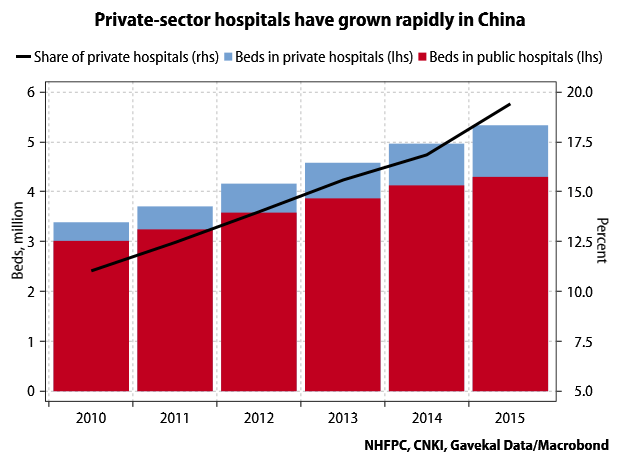
China’s new statistical communique on healthcare is just out, providing another snapshot of how the private sector is doing in this state-dominated field. Although the role of the private sector across the economy has not, unfortunately, increased much in recent years, healthcare has generally been an exception to this worrying trend since the reforms adopted in 2009. According to the communique, private hospitals accounted for 19.4% of hospital beds in the country as of end-2015, up from 11% in 2010, after they added nearly 200,000 new beds in the year. Private hospitals’ market share is probably a bit lower than their share of capacity, as they accounted for 14.7% of hospital admissions in the year. But both indicators represent pretty decent progress toward the goal, set in the 12th five-year plan on healthcare, to have private hospitals account for 20% of “hospital beds and service volume” by 2015.

Public and private hospital beds

I have argued that China could also adopt such targets for raising the private sector’s role in sectors other than healthcare (see this Q&A, and the full paper). And some domestic experts argue that the target for the private sector’s share of healthcare should be radically increased, in order to drive more decisive liberalization. The weight of establishment opinion appears to be swinging against these views, however, judging from a new report on healthcare reform, jointly produced by the Ministry of Finance, the National Health and Family Planning Commission, the Ministry of Human Resources and Social Security, the World Bank, and the World Health Organization. There is a lot in the report, but the section on the private sector’s role attacks the target fairly directly:

Quantity targets have spurred private sector growth in ways not consistent with national health objectives. …

It is worth noting that no OECD country has used quantitative targets to expand the private sector, but has rather employed a combination of supportive policies and regulatory structures that level the playing field with government-owned providers and assure alignment with health system goals.

Why has the expansion of private sector healthcare not been ideal from the perspective of the overall goals for healthcare delivery? Apparently because private sector hospitals are only serving a narrow part of the market:

Occupying a space created by the over-worked and crowded public system, the private sector offers alternatives to those seeking more and better medical products and services. However, despite central policies encouraging greater collaboration between public and private sectors, many local governments continue to focus their service planning and public financing on public service providers, effectively segmenting the market for the private sector for services targeting the wealthy and specialty facilities mostly offering elective services.

This seems to be a function of the fact that, despite setting a target for an increased role for the private sector, there are many unresolved regulatory issues for private hospitals and very uneven implementation of reforms granting them greater market access:

Despite the acceleration in recent years in the pace and scope of policies promoting private healthcare production and delivery, there continues to be no unified vision for the role of private providers in improving service delivery or contributing to national health objectives, and consensus has yet to be formed across government agencies on whether the private sector should be complementary, supplementary or integral to the public delivery system. …

The central government has enacted a rich set of national policies regarding private sector engagement, yet there are differing interpretations of these policies by provincial and municipal governments, among government agencies and between the public and private health sectors on the role of the private sector in contributing to national health objectives. From an implementation perspective the policy direction is unclear.

There is also a concern that the regulatory system is not keeping up with the changes, so it is ill equipped to address malpractice or other problems at new private-sector facilities.

The private sector requires a well-functioning governmental stewardship mechanism in order to grow, one that has the capacity of monitoring (and shutting down, as necessary) facilities seen to be endangering patient safety or defrauding social health insurance. Regulatory frameworks for accountability and quality assurance, however, exhibit wide local variations and are not uniformly strong. It is widely believed that private providers are more likely than their public counterparts to engage in false advertising, over-treatment, or fraudulent billing practices, and unsurprisingly, the private health sector in China does not have a good reputation with health consumers.

The report recommends a different but, I have to say, somewhat vaguer approach:

In keeping with the focus on quality development as against quantity growth, move away from quantity targets for private sector market share and instead employ a combination of supportive policies and regulatory structures that level the playing field with government-owned providers and assure alignment with health system goals.

It seems unlikely, then, that China’s next five-year plan for the healthcare sector will include a clear, quantitative commitment to a much larger private-sector role in the healthcare sector.

Is there are an ideological divide over China’s regional divide?

Headlines in the Chinese official media over the last couple of days have been dominated by Xi Jinping’s tour of Yinchuan, in the western province of Ningxia. The visit was the occasion for some stirring rhetoric about helping poorer regions like Ningxia; on his first day, Xi declared that

No region or ethnic group can be left behind in the drive to build a moderately prosperous society by 2020 (到2020年全面建成小康社会,任何一个地区、任何一个民族都不能落下)

He also made a speech at a conference on poverty alleviation that emphasized the duty of the prosperous eastern provinces to aid the inland. In a no-doubt-deliberate echo of Deng Xiaoping’s famous formulation that “we permit some people and some regions to become prosperous first,” Xi said that

The first to prosper should help the latecomers, to achieve the final goal of common prosperity (实现先富帮后富、最终实现共同富裕目标)

The conference was about a system where wealthier cities and counties in the east are “paired” with poorer counterparts in the west, which Xi praised because

a gradual reversal of the trend of widening regional gaps in development has been achieved, and poverty alleviation in impoverished western regions and old revolutionary areas has made great progress (区域发展差距扩大的趋势得到逐步扭转,西部贫困地区、革命老区扶贫开发取得重大进展)

(For the sources, here are links the first round of official reports in Chinese and English, and the ones on the poverty alleviation conference in Chinese and English)

Of course, it’s stretching the truth a bit to say that China’s regional gaps have been narrowing; the widening regional gaps in the current slowdown have been a huge subject of huge public debate. But I’m more interested in what Xi’s comments show what he thinks should be done: of course, regional gaps should narrow; of course, funds must flow from wealthier provinces to poorer ones. So this latest propaganda push seems like a very clear example of the egalitarian-Maoist strain of thought that is still very powerful in Chinese economic thinking.

Which is interesting, because some people who are close to Xi seem to have have been pushing back quite strongly against this line of thought. In early May, the People’s Daily carried a now-famous interview with an unnamed “authoritative personage,” who is widely assumed to represent the views of Xi’s top economic advisors (Barry Naughton’s recent piece in the China Leadership Monitor is the best overview of the debate). The piece got headlines for the way that it directly attacked stimulus policies and openly expressed worries about debt and slowing growth, all in a rather harsh tone unprecedented in recent official discourse. But the “authoritative personage” also attacked the notion that widening regional gaps are inherently bad, and must be aggressively tackled by the government. Here is the passage, in my translation:

Question: At the same time that the economy is slowing, we have also noticed that the trend of divergence has become more pronounced: the stabilizing and improving trend in the economy of the eastern coastal region has strengthened, but some resource-dependent provinces in the northeast and the west are still experiencing economic difficulties. Some foreign media call this “two worlds.” What signal does this trend of divergence send?

Authoritative Personage: Divergence is a necessity of economic development. …

In the “new normal,” we need to optimize the allocation of resources, develop new growth drivers, and form a new industrial structure. Therefore the faster divergence happens, the better. Whether we are talking about regions, sectors or companies, one part of them will, following the “80-20 rule,” obtain 80% of the benefits, and stand out from the rest as having a bright future. And there is another part that will experience hardship, but will also learn a lesson and will know what to do next. To me this is not a bad thing.

Since China began reform and opening up, the divergence in the economy has accelerated, and in this process there has emerged a group of vibrant regions and competitive sectors and companies with famous brands. After the global financial crisis, divergence in the world economy accelerated, our country entered the new normal, and domestic economic divergence further intensified. Last year, in analyzing the first quarter’s economic trends the Party Central pointed out that as long we actively adapt to the new normal, and focus on innovation and qualitative efficiency, then the trend of development will be relatively good; if not, the pressure will be very great. This year this trend has continued and even intensified, so while some are happy others are worried.

In the foreseeable future, amid economic divergence, vibrant regions and internationally competitive sectors and companies will continue to arise, but some regions, sectors and companies will encounter more and more difficulties. … The people in these regions, sectors and companies have now shed their illusions, are relying on themselves, are taking the initiative to promote reform and innovation, and are striving to catch up.

The “authoritative personage” is presenting a more classically laissez-faire view, where regional gaps reflect the workings of market forces, and the failures in the backward regions are in fact necessary for them to develop further. Xi himself on the other hand seems to be more comfortable in a more paternalistic and interventionist mode. This of course is not the first time that different parts of the leadership have sent conflicting messages about the economy, and is another indication that the economic strategy at the moment is rather confused.

Why targets make sense for healthcare liberalization

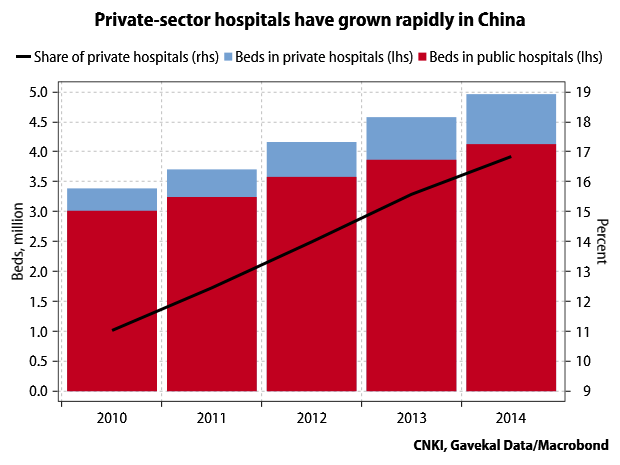
In working on my Paulson Institute paper on service-sector liberalization, I ended up putting a lot of emphasis on one seemingly minor component of the 12th five-year plan on healthcare. Among its many goals, the plan includes a target for raising the share of hospital beds in private hospitals to 20% by 2015; while the 2015 figures aren’t available yet, that share did in fact rise from 11% in 2010 to 17% in 2014 (see chart below). This seemed to me a useful example of how to use China’s planning system to drive liberalization rather than just increased output. And reading the excellent recent CSIS report on China’s 13th five-year plan, by Scott Kennedy and Chris Johnson, I find that I am not alone. The section on healthcare includes this comment from an anonymous interviewee:

One Chinese health care expert suggested that perhaps the best benchmark of whether the various reform proposals would actually transform the system would be to focus on the proportion of hospital beds that are in private hospitals. In order for that figure to rise dramatically, for example, to 60 percent, it would likely require changes in other areas of the system, including the development and marketing of drugs, the professional status of doctors, and the availability of private insurance.

So the reason to set a target for the private sector’s market share is to push people in the system to figure out all the different things that need to change in order for the target to be achieved. Rather than get bogged down in precisely specifying the means, the authorities can just specify the ends. The CSIS report puts it rather better than I originally did in my paper. This logic I think further supports the idea that these kind of targets should be more widely adopted if the Chinese government wants to ensure that its rhetoric about greater opportunities for the private sector is actually matched by reality.

The expert’s proposal for a very high and aggressive target for the private sector’s share of healthcare would certainly be controversial. As Kennedy and Johnson write, the complexity of healthcare markets makes it hard to simply argue that a much greater private-sector role would be uncomplicatedly good for everybody:

There is no consensus that a fully market-oriented health care system would yield better health care outcomes for Chinese society. Some worry that if things were made easier for foreign pharma[ceutical companies], private hospitals, doctors, and private insurers, the cost of health care would rise, and many who now are well treated would be priced out of the market. …

Would more thoroughgoing marketization serve China much better? It is hard to know for sure, given that there are both successful and failed examples of privately-based, market-oriented health care system.

On the other hand, they do note the ways in which the corruption and inequality in the Chinese healthcare system is linked to the high levels of state dominance:

China’s almost 3 million doctors have been prisoners in this state-controlled system. They are not classified as regular workers, and they are tied to their hospitals just the way SOE and government employees used to be fixed to their official work units. As a result, hospitals have gotten away with providing meager wages to their doctors of only a few thousand yuan per month. Not surprisingly, it is hard to attract promising minds to consider medicine as a profession. …Because of their terrible pay, some of those who do become doctors have been driven into corruption, taking bribes (masked as commissions or event fees) from drug companies and distributors in the hopes they press their hospitals to acquire certain drugs and encourage their patients to use them. Several sources reported that doctors also earn a large portion of their actual take-home pay from bribes from patients hoping to receive their care.

The 13th five-year plan for healthcare has not yet been published, so it will be interesting to see what happens to that private-sector target.

Public vs private hospital beds